The Fence Between My Fingers

I peer between the fractured fingers of the old paling fence, the common connection of our backyards. The weathered wood splays out with lichen fingernails and mossy knuckles.

Putting my foot on the bottom rail I push up. I can just loop my fingers over the top and my lips move closer to the splintered wood, riddled with deepening cracks of age and ants in their travels. I hear it creak as it takes my added weight. The fence bears it like I’m in my father’s arms, leaning against the strain.

I imagine your hair smells like the jasmine and the wisteria crowning the fence; tangled threads and strands of green shot through with sprigs of white flowers and clusters of purple reminding me of grapes.

I peer into your backyard catching slatted snippets of sight. Squinting one eye I can see the clothesline turning slowly in the breeze. And I wonder which t-shirt belongs to you; there is a new one on the line I don’t recognise. Maybe you have some new undies too. Mum bought me Superman undies and Teenage Mutant Ninja Turtle ones.

There’s your bike leaning against the house. And you’re riding without training wheels now.

The fence is biting into my fingers and I let go, dropping back to the grass. But I look through the slatted wall again, my nose pressed into the fence. Your back door opens and I run back to mine afraid you might see me.

I wonder if you sometimes look into my backyard.

Contrails

Contrails

Jack wound down the car window and felt the gush of summer air strike his face. His hands held onto the sill as he edged his nose closer to the invisible barrier between the interior and exterior of the car.

In the winter he would press his hands to the glass and bring his nose closer, but not quite touching, so he could watch the condensation form around his fingers. Taking a deep breath he experimented with different exhalations, from close, pursed lips to wide, open mouth and watched it condense on the glass and evaporate.

The summer wind grabbed at his hair and ruffled it with wild abandon. Jack was forced to squint into the force of the wind as he approached the event horizon of the windowsill. He observed the muted scenery through half-closed eyelashes, frequently blinking to push irritants out. The tears trickled out of the corner of his eyes and he felt them dry in the warm air.

“You ok back there, buddy?” his father asked from the front seat.

“Yeah, Dad.” Jack withdrew his face and let the wind continue to rush past.

Across the sky a miniscule spot moved, tearing the blue, leaving a scar of white. Jack followed the scar backwards until it grew broader and broke up, absorbed by the blue.

“Dad, are they clouds coming from the back of the plane?”

“Sort of. They’re called contrails.”

“What are they?”

“Contrails are clouds formed by the exhaust from the engines or from the change in air pressure.”

Jack looked back at the receding white scar, raised his hand, squinted through one eye and held the aeroplane between thumb and forefinger. Dropping his grip on the plane Jack extended his hand out of the window and let the wind catch in the cup of his hand. His arm rose and fell, a weightless object supported by the movement of air.

Resting his elbow on the will he expanded his fingers, letting star systems slip through. The landscape formed a blurred universe, his fingers in focus, in sharp relief against the smudged greens interrupted by splashes of red, blue, white and black cars.

From the tips of his fingers he imagined contrails, forming slowly and drifting into the quiet pocket of air behind his hand before spun like spider’s silk into the slipstream behind the car.

“What’cha doing, Jack?”

“Learning to fly.”

And The Kettle’s Whistle Went Unattended

A cold torrent shudders from the tap into the cauldron-like bowels of the kettle. He clanks it down on the stove and presses the ignition switch, hearing the click, click, click, WHOOOSH as prelude and prologue to conversation. The flames tickle the kettle’s underbelly as an anticipatory act, fostering his nervousness while he waits.

He dispenses one, two, three teaspoons of leaves into the round-bellied glass pot. On the bench two cups sit side-by-side, their handles turned inward, barely touching.

The kettle whistles and he pours a question. Silently she lets it draw. He pours the milk, stopping when she nods and stirs the words again. She adds sugar to both cups, two for him and one for her, and posits a question of her own.

The tendrils of steam rush headlong into each other, tripping over one another and caught in tangles, melding into one breath.

Lest they burn their lips the conversation is spoken in sips. As the beverage tempers and cools, deeper thoughts are expressed in longer draughts. Drained almost to the dregs, remainders of words stain the bottom of each cup. An unfinished conversation threatens to evaporate as each hand holds the cup for the last whispers of disseminating heat.

She ignites the flame knowing it simmers close to the boil.

They depart while the kettle’s whistle remains unattended.

The Mirror

The Mirror

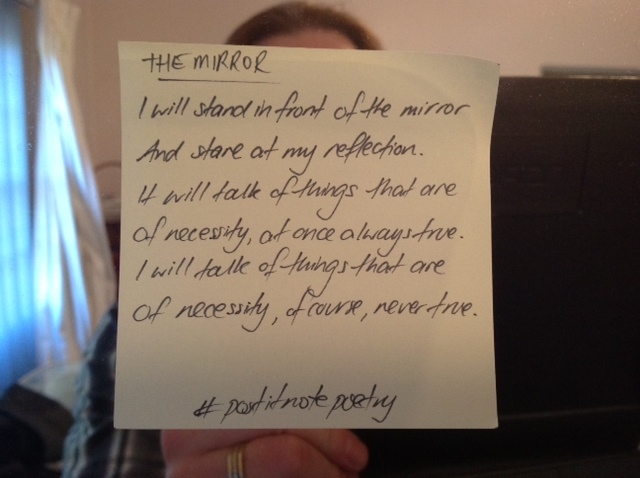
I will stand in front of the mirror

And stare at my reflection.

It will talk of things that are

Of necessity, at once always true.

I will talk of things that are

Of necessity, of course, never true.

The Mirror

Inspired by a quote from Bas Jan Ader, Dutch performance and conceptual artist, when reading James Roy’s blog, “Head Vs Desk.”

The Sound of Noise and Silence

The Sound of Noise and Silence

Go placidly amid the noise and haste, and remember what peace there may be in silence – Max Ehrmann, “Desiderata” (Desired Things)

Creativity is birthed in the chaos of noise and the silence of meditation.

As a drummer, I love sounds. Four limbs working together in synchronous co-ordination to create a pattern whether it’s a beat, groove or fill.

I create by reading the chart and playing the pattern.

But sometimes I forget something. I forget about the spaces between the notes, the gaps and silences. It is as important to understand the correct notes to play as it is to understand the silences between the notes.

It doesn’t matter if the tempo is slow or fast; if the beat is simple or complex, the gaps and silences are just as important. I am conscious of the silent movement of my hands and feet before they create a sound.

Noise in Creative Production

I can create out of the noise and I can create out of the silence.

Noise is the default creative setting: white noise, background noise, conversational noise. However, it’s where ideas are birthed and generated. The noise in the to and fro of conversation and found in the noise of information I sift through in my tweet stream.

As a drummer, I love sounds. Out of the noise something musical is created.

Silence in Creative Production

As a creative person I also need silence. I sit behind my drum kit and visualise the movements of my hands and feet, imagining the sounds I create when I strike a drum or cymbal and the pattern I am creating. In a similar way the sportsperson visualises the perfect throw, pass, stroke, movement in silence.

For writers, musicians, artists, dancers, filmmakers, there is a need for silence.

Silence is not a state of nothingness.

Silence is a state of meditation and mastication of ideas.

Silence requires time.

Silence requires patience.

Silence requires meditative focus.

Silence cannot be rushed.

Silence allows the mind to become still.

Silence brings introspection, clarity and solutions.

Silence restores strength and refreshment.

Silence is engaging with the moment as it is now.

As a writer, I need moments of silence to think through plot or characterisation, themes or symbolism, dialogue or description. I need moments of silence to compost ideas, turning them over in my mind like a koan.

Out of the silence and stillness comes creativity.

Find your place amongst the noise and the silence.

Expressing What’s Inside You Creatively

Some say there is a novel in every one of us, trying to get out, waiting to be written.

I say that’s wrong.

Not everyone is a writer, nor is everyone a musician, nor is everyone an artist.

But…

I say there’s a story within every one of us.

That story can be expressed:

  • as a novel
  • in a poem
  • through photography
  • in film
  • in music
  • via singing
  • performing a dance
  • with paint and brushes on a canvas
  • by creating a sculpture
  • cooking new meals
  • by designing a garden
  • creating a website
  • giving someone a new look with a haircut
  • on a fashion catwalk
  • in politics
  • in philosophy
  • in a scientific environment
  • through the skills of oratory…

The possibilities are endless.

You need to know your story.

You need to know how to best express your story.

Tell your story…

…your way.


Folded Peace – A Poem

Folded Peace

Folded Peace

Were I to fold one thousand pages

Into one thousand cranes

Will I have erased enough

Print onto my fingers

That I may wash it away?


I fold despair into wings


Each page I fold

Is a prayer for peace

A flock tied like a kite’s tail

To let serenity slipstream

Over a tattered fringe of feathers


And give flight to hope

Post It Note Poetry Collection

Back in February I started a little creative project, Post It Note Poetry. The premise was simple: everyday, for 28 days, write a poem on a Post It Note.

I have collected all the poems, and a few bonus pieces I’ve written since, into a single download for you to read (and apologies for the size of the file – it’s a little image heavy).

I hope you enjoy it and it inspires you to do something creative.

Click on the link below to download the book.

Post It Note Poetry Ebook

Why Shouldn’t I Continue to Read Your Novel?

Why Shouldn’t I Continue To Read Your Novel?

Coming across a couple of posts recently about when a writer/reader gives up reading a novel, I noticed a trend when a writer/reader will stop:  

  • when there’s little or no action to propel the narrative
  • lingering descriptions of ennui or minutiae (or the weather)
  • back story or info dumping (yes, I agree with this)
  • bad writing (yes, I’ll stop reading too)

The current literary aesthetic favours action over reflection, sacrificing the evocative power of language for a fast-food mentality of plot and writing.

Why not let language and words evoke scene, history and character idiosyncrasies, rather than simply pushing a plot along?

Literature is about plot and character and narrative tension, but it’s also about exploring the ennui of life, and why they are important, and the macro aspects of grand overarching themes in minute detail.

I want to read a fast-paced action story and I want to read a story that lingers on the little, unimportant things. I can have both. Trends be damned.

I want to enter the world the author has created, to see how they see the world and enjoy their word play, not consigned to reading a novel written within an artificial and constricted set of literary rules.

Writing is as much about observing and recording life’s details and universal abstract concepts as it is in participating and communicating, being involved with others, doing the action, and reading should be the same.

Create Because It Counts

We create not for fame.

Not for money.

Not for recognition.

Not for glory.

Not for the praise of others.

We create because it counts.

This principle came out of an article on pianist James Rhoades, “Find What You Love and Let It Kill You” from The Guardian newspaper in the UK.

Create because it counts.

James put himself through an extreme, almost ascetic regime: “no income for five years, six hours a day of intense practice, monthly four-day long lessons with a brilliant and psychopathic teacher in Verona, a hunger for something that was so necessary it cost me my marriage, nine months in a mental hospital, most of my dignity and about 35lbs in weight.”

I do not connect with the extremism (yet I can see the validity in it if you want to take something as far as you can go) but I do connect with the emotional response he has when he has put in the time and practice to learn and master a new piece of music; I apply it to writing.

“And yet. The indescribable reward of taking a bunch of ink on paper from the shelf … Tubing it home, setting the score, pencil, coffee and ashtray on the piano and emerging a few days, weeks or months later able to perform something … A piece of music that will always baffle the greatest minds in the world, that simply cannot be made sense of, that is still living and floating in the ether and will do so for yet more centuries to come. That is extraordinary. And I did that. I do it, to my continual astonishment, all the time.”

This is what counts: the emotional connection in creating, and in mastering a skill.

It is about the experience of joy in any creative endeavour. The joy in folding an origami crane for the first time; completing a short story; learning a new chord for guitar; finishing a water colour painting.

Doing it because it brings you a sense of completeness and wholeness as a person.

We do not have to go to the same extremities as James but his encouragement goes further to explore the “What if’s…?”

What if we used our time more wisely? Spent less time wasted on social media and engage in a creative activity? Spent a little bit of money to start a creative pastime like painting or photography? Knit? Crochet? Took our phone, shot some footage and made a short film? Used our time to engage with others in a writers’ circle? Wrote the story or novel we have been aching to tell for decades?

What if…?

So many possibilities. So many options.

And we create because it counts for something.

It counts for the children whose father draws a new picture on their lunch bag EVERY SINGLE DAY.

It counts for the short story writer, novelist or picture book writer creating worlds for others to inhabit.

It counts for the musician sitting in a cafe playing her guitar to six people.

It counts for the grandmother making a quilt as an heirloom for her grandchild.

It counts for the child who discovers the joy of the world through the lens of a camera and documents his journey to and from school every day.

It counts for the dancer at the bar, perfecting a pirouette.

It counts because we need stories and art and music and film and theatre and dance.

Creativity liberates your spirit. It enriches who you are, and the people who engage with your work.

Creativity is a mentality of giving; giving to yourself and others.

Creativity costs in terms of commitment, of sacrifice, of dedication.

You create because it counts.