Post It Note Poetry #21 – Telephone Booth

PINP 21

Telephone Booth

we pretended to be Superman
checked for loose coins
listened to the dial tone
wondered if we could
make it ring

Now I listen to the dial tone
a comfortable static
pausing before I dial
and remember the
conversations we never had
but wished we did

10 Fingers To Understand Silence Is Not An Absolute – Twitfic

10 Fingers To Understand Silence Is Not An Absolute

I.
He lived without a singular sense. His hands felt sounds at his throat, resonating in his head; a voice muted because it had no comparison.

II.
He voiced his language, clumsy at first, in the intricate dance of his fingers. Frustration was best countered with an upright middle finger.

III.
He smiled at her fingers speaking like a 3 year old: focused, exaggerated movements and incorrect spelling. No need to shout, he jokingly chided.

IV.
A text flickered on her screen.
“Take me to a concert. Bring me some ear plugs?”
Between the speaker and sub-woofer he found the sweet spot.

V.
The argument gesticulated angrily. She turned her back to silence. His hand reached to her shoulder, cold as it was, to apologise.

VI.
He uncrumpled the letter, like peeling a mandarin, to devour the words written he had spat out the night before. A hand to speak words when no voice attended.

VII.
Silence has layers, nuances, light and shadow, he said. It’s not an absolute.
Why are you silent with me? she asked. Will you listen?
She leaned in and kissed him.

Over the time I’ve been writing twitter fiction, I have come to appreciate the brevity of the form, limited as it is to 140 characters. It is, in essence, to capture a breath of moment, holding it for a little while and expecting the release and exhalation.

I like the number seven, echoing The Seven Ages of Man by Jacques in Shakespeare’s “As You Like It.” Thus my collections of twitfic are anthologies focused on a theme or have a narrative thread.

Playing with form allows me to link these brief pieces into something resembling a music video. Quick, short edits, compiled into a unified whole to tell a bigger picture. 

Coupled with Post It Note Poetry, another short form of writing I enjoy, I can post these experimental works here while I work on my current novella and put my novel through final edits.

I have considered compiling my Twitfic collections into a singular text, as well as collating my Post It Note Poetry into an anthology. Would anyone be interested?

Post It Note Poetry #20 – The School Reunion

PINP 20

The School Reunion

Nothing has changed
After 20 years
Sitting around
Recounting weekend stories
Anecdotes and non-sequiturs
And still questioning
Our own identity
hidden behind a
uniform of a
different type

6 Things A Writer Can Learn From Watching A Dance Show

The current season of So You Think You Can Dance is airing on television in Australia. It’s the home-grown version, not the US version telecast. I’m fascinated with the performance and artistry of physical movement that can be graceful, violent, articulate, mechanical, whimsical and profoundly intellectual.

I have two daughters who are enamoured with dance as a performing art, and my wife danced when she was younger. Many years ago, she stood in front of me, feet planted flat on the ground and proceeded to kick cleanly over my head. I’m approaching six feet tall and my wife is somewhat shorter. I vowed never to get on her bad side after that.

As a writer and creative type person I look for inspiration from a variety of sources. After watching a couple of episodes I saw parallels for writers.

1. Style in dance is genre in literature

The beginning of the series divided the dancers into their preferred style: ballet, jazz, contemporary and urban. They learned choreography in their style by an expert in the field. The dancers knew the talent and reputation of their teacher and sought to excel in the choreography they were taught.

For a writer the equivalent is immersing yourself in your preferred genre: literary, science fiction, western, romance, horror, speculative fiction, gothic. Learn from the masters of your field; absorb the lessons by reading and deconstructing their work.

2. Adaptability is essential (but know your strengths)

To whittle down the contestants, the dancers were then asked to perform in a style they were unfamiliar with. Ballet dancers had to learn an urban performance; jazz dancers had to learn a contemporary routine.

Some dancers adapted quickly to the new movements and techniques; others struggled. Yet they persevered. The results varied for each dancer; some excelled while others maintained a form of equilibrium, enough to get by but not enough to stand out from the pack.

As a writer, know your form, your technique, your movements. Then learn from another style. Adapt. But know your strengths. Learning from other genres will enhance your own writing and may even separate you from the pack and put you in front of it.

3. Discipline is Key

Part of the reality tv schtick is to give the viewer some background on individuals of note. The focus is on those who are endeavouring to succeed, but ultimately are shown their skills are wanting, and on those dancers who excel in their gifting.

And it is in these gifted individuals that you see due diligence and discipline in their practice and an innate sense of understanding about their chosen art form.

For a writer, as it is for a dancer, it is practice, practice, practice. I firmly suspect that practice for a writer and a dancer is two-fold: maintenance and improvement.

Practice for maintenance keeps you writing stories and producing work.

Practice for improvement means you’re seeking feedback on your work or taking classes, attending forums and conferences, to seek to understand your art form better and to produce better work.

4. Movement and rhythm is both graceful and violent

Every dance style has its form, repertoire, vocabulary and structure. Its manifestation in movement and rhythm is both graceful and violent. I don’t mean violence in an aggressive, physical act but the ability to portray emotion through face, body, limbs and the overall form of the dancer.

Vocabulary for the writer is the raw material to capture the emotion of the scene and engage the reader with its visceral description of beauty or horror.

A colleague described the language of “Lolita” as exquisitely beautiful while the content became darker and offensive.

Learn to utilise the movement and rhythm of language to create grace and violence.

5. Stories are interpreted through different forms

Ask a ballet dancer, a jazz dancer, a contemporary dancer and an urban dancer to perform a love story and the interpretation will vary, based on the lexicon of the specific dance style. I love contemporary dancing for its narrative capabilities, but what can I learn from the narrative in ballet? Or jazz? Or urban?

Learn to tell stories in a different form. Learn to tell a narrative from another angle.

6. Show your work, and know when to hide it

The show is built around showing the progression and development of each dancer as they learn new routines, often in styles they are not conversant with. I like seeing the growth of the dancer as artist when they are open to learning, stepping into an arena they are unfamiliar with and untrained in. Yet the psychology of dance, the mental framework of adaptability and learning allows them to rise above it.

As the viewer, I get to see the falls and stacks during rehearsal, and so appreciate the performance knowing the effort they have sustained to make it look effortless.

Sometimes as writers we are too quick to show off a new piece of work, not allowing it to settle before another round of edits or sent to a trusted beta reader.

Snippets on blogs is a good way of keeping readers hooked prior to a new release, or showing them works in progress. Know when to show your working; make it shiny and new and fresh and of a high standard.

Don’t rush it.

Now if you’ll excuse me I hear a lively tune; I’m inspired to dance.

Post It Note Poetry #19 – A Catalogue of Saviours

PINP 19

A Catalogue of Saviours

He flicks the pages
of the junk mail catalogues:
the sacred texts
of the emperor’s
new clothes
and believes
in their righteousness
(plus postage and handling
allow 2-3 weeks for delivery)

Post It Note Poetry #18 – Two-Faced

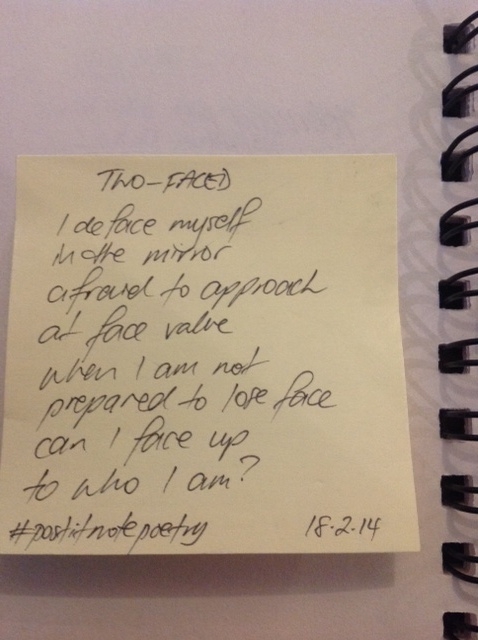
PINP 18

Two-Faced

I deface myself
in the mirror
afraid to approach
at face value
when I am not
prepared to lose face
can I face up
to who I am?

Post It Note Poetry #17 – The Machines


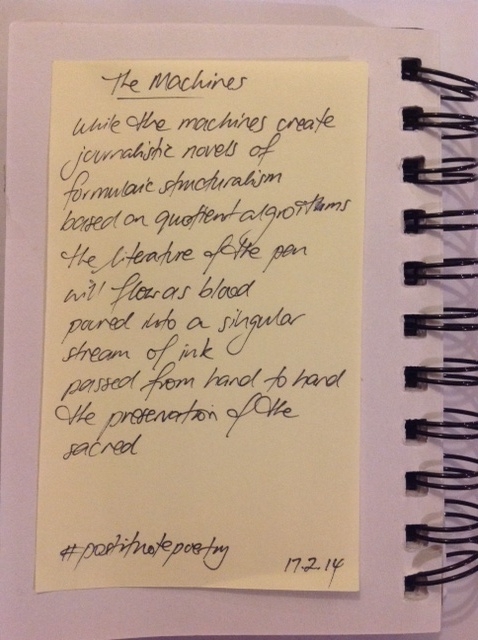
PINP 17The Machines

While the machines create
journalistic novels
of formulaic structuralism
based on quotient algorithms
the literature of the pen
will flow as blood
poured into a singular
stream of ink
passed from hand to hand
the preservation of the
sacred

Why Write Post It Note Poetry?

Why write poetry and why write it on a Post It Note?

In January last year my collaborative writing partner, Jodi Cleghorn, and I were having an online conversation about her month of writing bad haiku the previous year. The idea of a month of bad poetry was floated for February, you know, because creativity and complete naffness.

Between creative friends, ideas can easily get out of hand and all of a sudden they are free range chickens scratching at the dirt in your head.

My contribution to the conversation was to limit the size and focus of the poetry: it must fit on  a Post It Note.

Thus, #postitnotepoetry was birthed and the month of lyrical experimentation commenced.

It was an easy thing to do because it was a short, sharp burst of forced and focused creativity. Some days were more of a challenge to write: looking for ideas and inspiration, making it fit on to the parameters of a Post It Note, and trying to write a poem in the corners of the day.


Check out last year’s collection here.

This year I was tempted to pass on the opportunity to write because I wanted to focus on Getting Stuff Done (GSD) and sometimes you have to say “No” to opportunities. I know Jodi was the same.

But it only takes an individual, in this case Sean Blogonaut, to post one and we fell to it like seagulls on a hot chip.

But I need to answer the question posed above.

Why write poetry and why write it on a Post It Note?

* It’s a creative act ANYONE can do

I believe everyone can be creative. People are often too afraid to start or have no idea where to start.

Making the activity simple and accessible, giving people permission to try a new activity and more importantly, permission to suck at it, creates impetus to try a new thing.

I am no poet but I am quite proud of some of the pieces of I wrote last year. In the Aussie vernacular, it’s all about “having a go.”

I embrace that I suck at something.

* Limits and boundaries can be liberating

Giving yourself a restriction can free up your imagination and focus.

The size of a Post It Note doesn’t allow for an epic poem but a haiku, a senyru, tanka or couplet easily fits on. However, I do manage to squeeze a fair bit of text onto a Post It Note.

Use a range of colours. They vary from the traditional yellow square to pink and green and blue and purple squares to colourful rectangular pads with lines.

I am using the first pad I found in my writing drawer: a pale yellow, rectangular pad (Jodi says it’s cheating but she uses coloured rectangular Post It Notes WITH LINES ON THEM).

* It creates community

We started a facebook page last year and for the month of February it went off. It remained quiet during the year, but returned again with a focus.

Do it with other people. Make it a game, a challenge. Be involved with people doing creative things.

* It does not require a huge time commitment

You can scribble out a couplet in a minute or pen six lines of doggerel in less than five. Quality is not a factor; your commitment to write is.

Use moments of down time like in the shower or washing up, love making or taking the ferret for a walk to play around with words.

Creativity does not have to consume large portions of your time; five minutes a day is sufficient. You are very welcome to spend longer; if you’re enjoying it, take pleasure in it.

* I must practice what I preach

If I write about creativity and seek to proselytise the masses into the way of creativity, I must also do it. Post It Note Poetry is my reminder to be creative.

I also write random Post It Note Philosophy about the creative life. I am aiming to finish a novella in the first half of the year, have my collaborative novel out to agents and complete another short/novella in the second half. Note to self: Get Stuff Done.

I am thinking I might continue Post It Note Poetry beyond February this year and put them up on the blog from time to time.

You can see this month’s collection of Post It Note Poetry here.

* It leads to new ideas and opportunities

I subbed my first poem for publication in January (still waiting on rejection/acceptance) and it would not have happened had I not started writing bad poetry. Quality is another judgement. It’s the learning I gain from writing that is exciting.

The important thing is to DO SOMETHING CREATIVE. Take a picture a day, draw a cartoon, arrange flowers, bake cupcakes, doodle in the margins of the newspaper, deface magazines. There are many wonderful creative people out there doing things not for fame and fortune, but the fun of creating.

This guy likes to draw pictures on Post It Notes during his commute to work.

A father draws on his kids’ sandwich bags each day.

What about Moleskine doodles?

This doodle art will blow your mind.

Remember defacing pictures in magazines when you were a kid by drawing moustaches on everyone? Go and do it again.

Here’s a creative challenge for you: what else can you do with a Post It Note?

Please give examples in comments below, or better still, link to your blog and show everyone what you’re doing.

Get creative!

Post It Note Poetry #16 – The Prophet

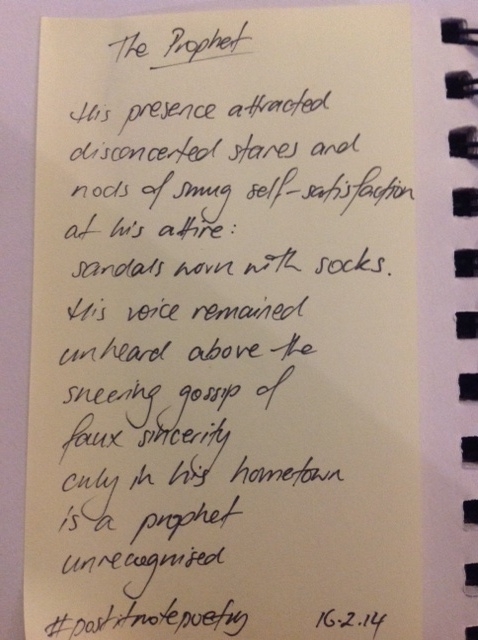
PINP 16

The Prophet

His presence attracted

disconcerted stares and

nods of self-satisfaction

at his attire:

sandals worn with socks

His voice remained

unheard above the

sneering gossip of

faux sincerity

Only in his hometown

is a prophet

unrecognised

Post It Note Poetry #15 – Traffic Cones

PINP 15

Traffic Cones

An orange cone

on a black tarmac

divides the flow of traffic


A young man holds a sign

of dishevelled appearance

divides the flow of pedestrians