Lessons Learned From Post It Note Poetry

A month of #postitnotepoetry has elapsed and 28 poems have been written and posted.

It started in 2013 when Jodi Cleghorn and I threw out some whimsical ideas with definite boundaries: write a poem to fit on a Post It Note.

It was permission to write; write dreadfully, write with abandon, write without caring what the poetry sounded like. It was permission to be creative and spontaneous; limited and restrictive in a positive way.

And we did it. We gathered adherents and spawned a community. We wrote poems and posted them. And some of them were quite good.

And we did it again this year.

I wrote 28 poems in 29 days (the last week of February was a cracker for me so I missed a day or two, posted late, crammed a few into one day and wrote the last on March 1 after half writing it the night before).

Time to reflect, look into the Navel of Introspection and see if I can find a gem to inspire you. At the very least you’ll have some blue-grey lint to take home.

1. I can write every day (but it wears me down)

Some writers pursue the notion that they must write every day. It is an adage recounted by many writers via social media, and it has validity. I like the Jerry Seinfeld approach of ticking off each day I write or meet a quota, forming an unbroken chain.

But it doesn’t work for me. My day job and other commitments do not allow an unbroken chain. I prefer to work in short bursts rather than long periods of focused attention.

Every creative person has their own cycles of inspiration, creation, recreation, restoration, production. Rinse and repeat.

Find your own rhythm and know your cycles.

2. I can think of a new idea every day (but some need more time to develop)

Finding a new idea each day was in turns easy and difficult. It was in the news, something I read, an emotional response to a situation, daily chores or activities.

The execution of the idea was also in turns easy and difficult. The easy idea was sometimes difficult to write while the difficult idea sometimes can easy in the writing.

No method, often madness; always an idea.

Exhaustion, physical and mental, made developing an idea hard. Some ideas needed more time for composting (what I mean when an ideas sits in the back of your head for a while). For example, the last poem, Frankenstein’s Classroom, needed more time for refinement.

However, that runs contrary to the spirit of Post It Note Poetry.

Pushing an idea that is not fully formed may result in a piece of work that is substandard and editing will only highlight its weaknesses. Letting an idea form over time may mean the editing is easier. Your mileage may vary.

There are plenty of ideas out there for you to catch. Know your methods for trapping them in the pages of your notebook (physical or digital).

3. It’s a whole lot of fun to do (but it detracts from my main purpose)

Creativity is meant to be fun; that was the point initially. There is fun in the hunting down of ideas, capturing the thoughts and emotional response in words, and satisfaction in the completion.

And in doing something fun, I have found a new appreciation for poetry and I like writing it. I like the framework and boundaries a Post It Note provides, similar to the framework and limitations on twitter where I also post short poetry.

However, focused for a month on writing poetry has taken me away from my main purpose of writing my novella. The timing of #postitnotepoetry coincides with the beginning of the school year (I am a high school English teacher) and it is something short I can do during the busyness of the opening of the school year.

I want to return to my novella, which is happily composting in the back of my head while I make updated notes in my notebook. I’m also in the last stages of edits for my collaborative novel.

The brevity of Post It Note Poetry is something I will continue to do throughout the year because I believe in developing my creativity; I am undecided if I will return in 2015 for the trifecta.

Have fun with your creative acts.

That’s it from me for #postitnotepoetry 2014.

Time to buy shares in the company that makes Post It Notes or see if I can get a sponsorship from them and turn it all into a book deal.
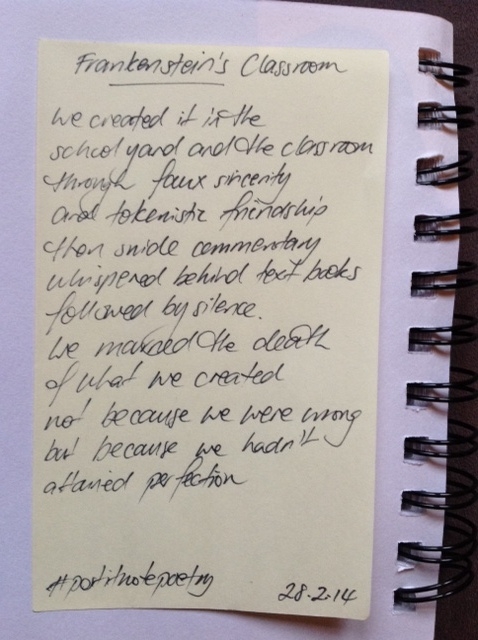
Post It Note Poetry #28 – Frankenstein’s Classroom

PINP 28

Frankenstein’s Classroom

We created it in the 
school yard and the classroom
through faux sincerity
and tokenistic friendship
then snide commentary
whispered behind text books
followed by silence.
We mourned the death 
of what we created
not because we were wrong
but because we hadn’t 
attained perfection

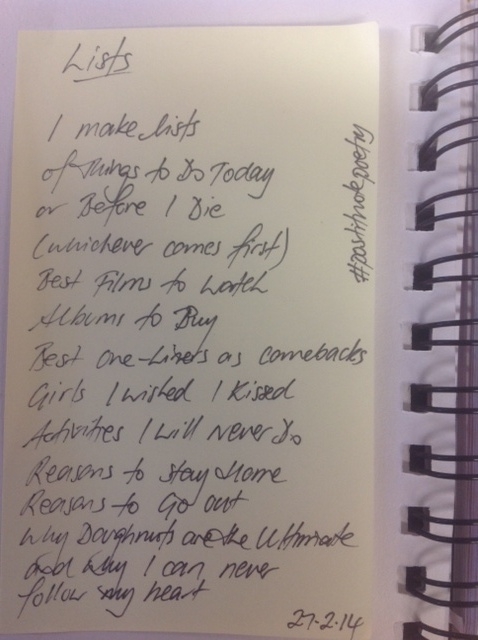
Post It Note Poetry #27 – Lists


PINP 27Lists

I make lists
of Things to Do Today
or Before I Die
(whichever comes first)
Best Films to Watch
Albums to Buy
Best One-Liners as Comebacks
Girls I Wished I Kissed
Activities I Will Never Do
Reasons to Stay Home
Reasons to Go Out
Why Doughnuts Are the Ultimate
and why I can never
follow my heart

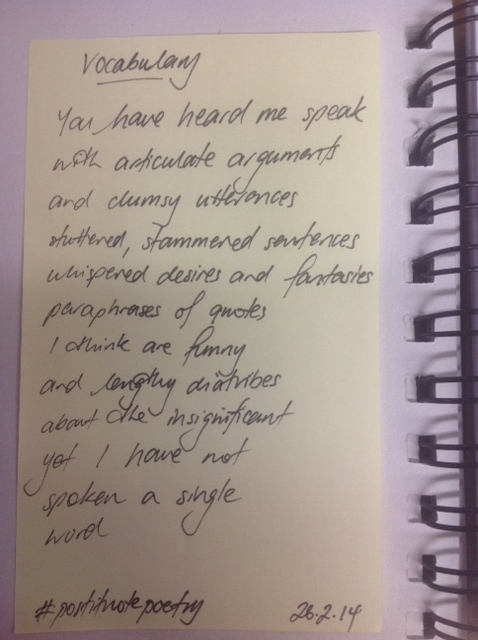
Post It Note Poetry #26 – Vocabulary

PINP 26

Vocabulary

You have heard me speak
with articulate arguments
and clumsy utterances
stuttered, stammered sentences
whispered desires and fantasies
paraphrases of quotes
I think are funny
and lengthy diatribes
about the insignificant
yet I have not 
spoken a single
word

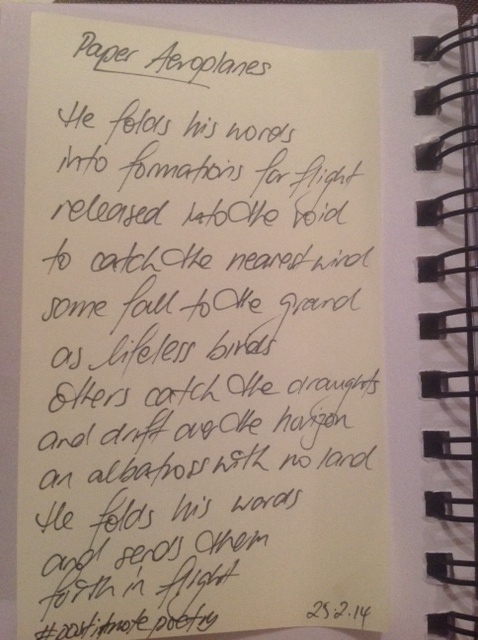
Post It Note Poetry #25 – Paper Aeroplanes

PINP 25

Paper Aeroplanes

he folds his words
into formations for flight
released into the void
to catch the nearest wind
some fall to the ground
as lifeless birds
others catch the draft
and drift over the horizon
an albatross with no land
he folds his words
and sends them
forth in flight

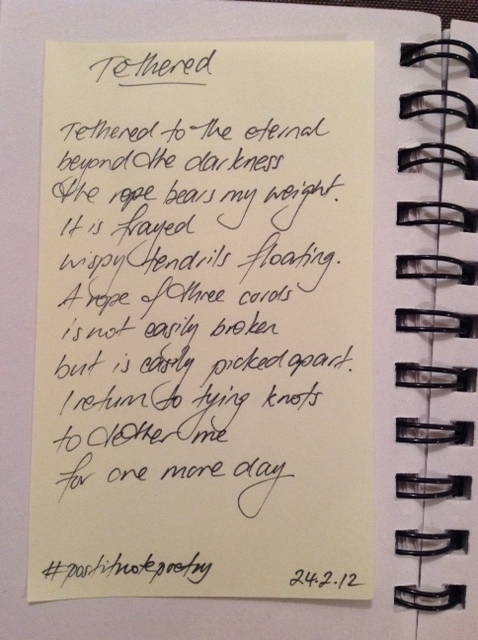
Post It Note Poetry #24 – Tethered

PINP 24

Tethered

Tethered to the eternal
beyond the darkness
the rope bears my weight.
It is frayed
wispy tendrils floating.
A rope of three cords
is not easily broken
but it is easily picked apart.
I return to tying knots
to tether me
for one more day

When Is Reading No Longer Reading?

When is reading no longer reading?

I am a high school English teacher and in the curriculum reading and viewing are separate modes (the other three are listening, speaking and representing).

Traditionally reading involves the printed word in either novel, poem, play or short story, feature article, news report or letter.

Increasingly, the definition of reading extends to visual media: television, film, the internet, graphic novels and comic books.

It could be argued that reading involved pictures long before words. And what are words but a recognised collection of pictograms arranged into a sequence:  Aboriginal rock art, Sumerian cuneiform, Egyptian hieroglyphics?

Reading is therefore the viewing of a codified system of verbal language.  But the modern codification of our verbal language means we now read the verbal equivalent in a codified form we call the alphabet, the written and printed word only.

With the advent of portable devices (tablets, smart phones, laptops and notebooks) the lines between reading and viewing are being blurred with multi-modal storytelling and the incorporation of multimedia into stories: text that moves, movies built into the experience of the text, the incorporation of sound.

For example, “The Fantastic Flying Books of Morris Lessmore” is a brilliant text. The illustrations are superb and the story is delightful.

There are 3 distinct modes of narrative;  3 distinct ways to ‘read’ the story: picture book, interactive narrative (app) and an (Oscar-winning) short film.

But which of these 3 modes of narrative is “reading”?

On the one hand I would argue that yes it is reading. We “read” film as we have learned the code for deconstructing and constructing meaning in film. I posit interactive narratives potentially detracts from the primary purpose of reading: the deciphering of code and symbolism to make meaning from words alone.

The imagination of the reader transports him or her into the world of the text, creating the visual images based on the words presented by the writer. In a picture book, the visuals are an adjunct to making meaning, giving the reader visual clues to the meaning of the printed words.

Brief research suggests different parts of the brain are activated by reading and viewing. Where does interactive, digital narratives fit into this scenario? I don’t know. Anyone have links to relevant research?

On a side note, the debate about handwriting and typing is analogous: what do we gain by learning to write and form letters that typing does not, despite the increased speed typing allows? 

Handwriting forms an integral part of learning and knowing a language, as opposed to learning to type (further longitudinal research needed). We are in a period of rapid change; the results of which we may not see for some years yet.

Anecdotally, I see my students who have grown up with computers and devices as a parallel, if not the preferred method of communication, rather than the handwritten word, and the formation of their language and conceptual framework is poorer than I think it should be for students who have access to more information than at any time in history. There is more educational research and study needed.

Does the definition of reading need to change?

The advent of digital storytelling and interactive narratives means we have to rethink the definition. And I suspect it will remain fluid for some time.

I have no firm answer on the matter. I define reading as the interpretation of the printed word. However, I see the reading of film as a legitimate, too. Somewhere in between lies picture books, comics, graphic novels. They are all valid texts to read, but I would caution balance between all forms.

What do you think “reading” is?

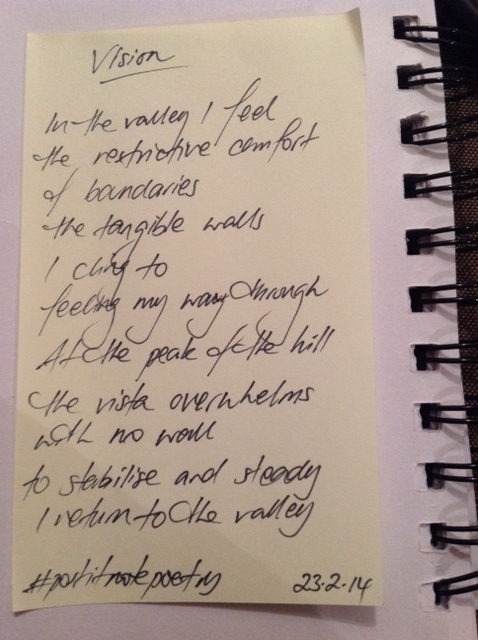
Post It Note Poetry #23 – Vision

PINP 23

Vision

In the valley I feel
the restrictive comfort
of boundaries
the tangible walls
I cling to
feeling my way through
At the peak of the hill
the vista overwhelms
with no wall
to stabilise and steady
I return to the valley

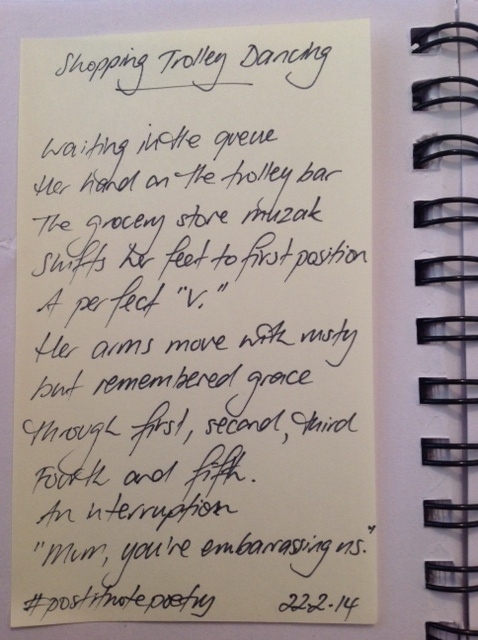
Post It Note Poetry #22 – Shopping Trolley Dancing

PINP 22

Shopping Trolley Dancing

Waiting in the queue
Her hand on the trolley bar
The grocery store muzak
Shifts her feet to first position
A perfect “V”
Her arms move with rusty
but remembered grace
through first, second, third,
fourth and fifth.
An interruption
“Mum, you’re embarrassing us.”

Disposable Creativity

Disposable Creativity

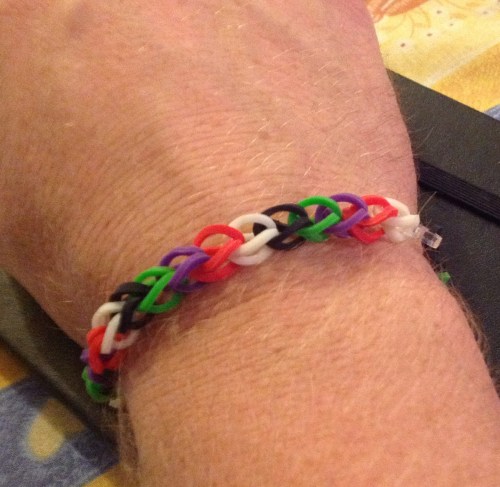
I have two daughters, aged 8 and 6.  The 8 year old likes little creative projects. At her primary school the current trend is Loom Bands. They are simply small looped elastic bands and take about 10-15 minutes to make. I love the simplicity of it (and it’s not expensive).

She made one for me and I have worn it to work (I teach high school English). When my younger students ask me who made it I take pride in I saying it was my daughter.

The Loom Band my daughter made for me.

The Loom Band my daughter made for me.

When I posted this picture on my social media feeds, a friend commented her daughter had made bands for her whole class for Valentine’s Day, her teacher and Principal. All of them wore them proudly during the week.

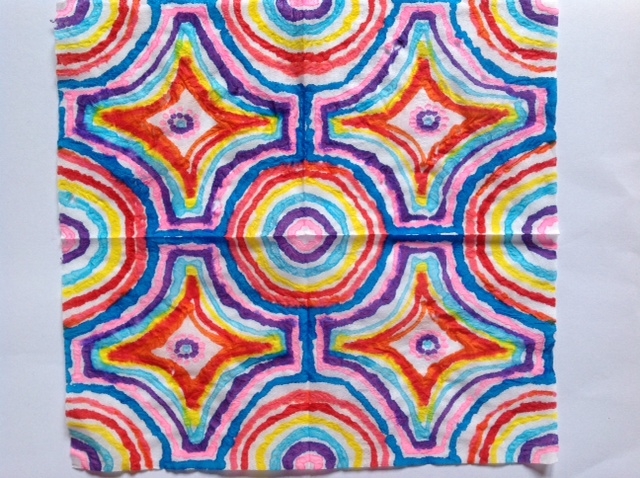
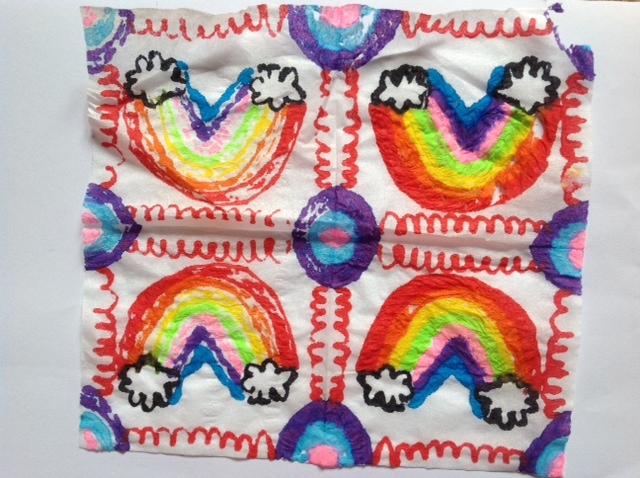
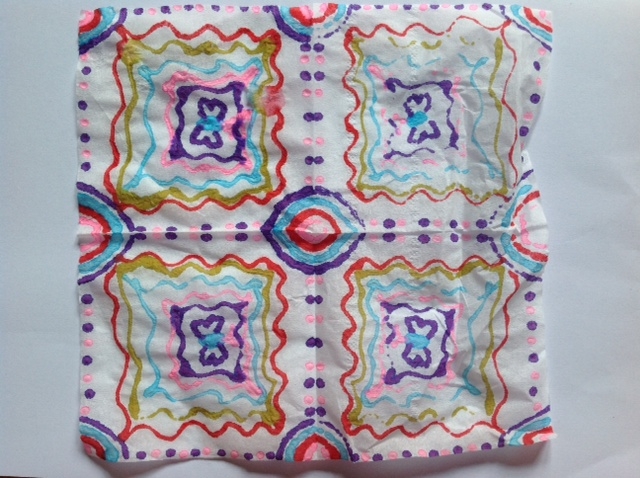
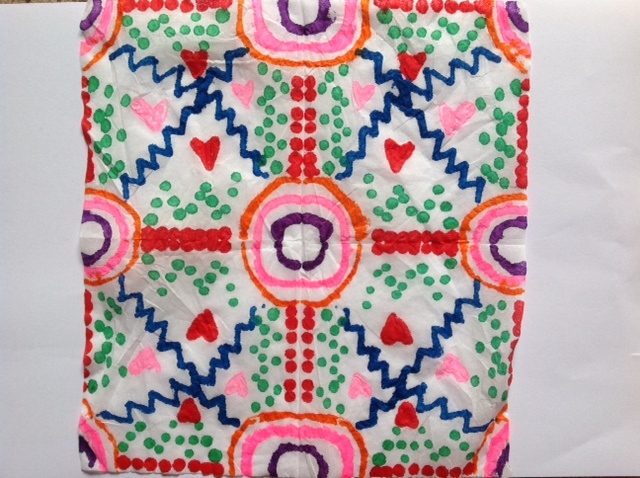
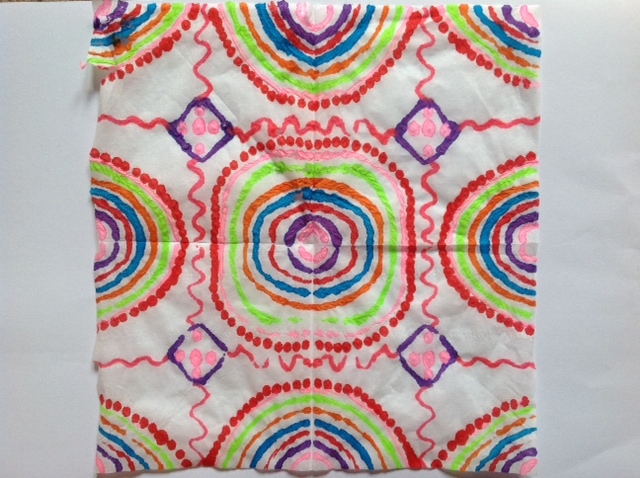
The other creative project she has been doing of late she learned at school from her teacher. Take a tissue, fold it into four squares then colour a pattern onto the tissue with Textas. The colours bleed through each other and when you open it up, it’s like you’ve cut a snowflake.

And it looks fantastic.

We took some photos of her artwork today.

CR Tissue Art B

CR Tissue Art C

CR Tissue Art A

CR Tissue Art F

CR Tissue Art D

CR Tissue Art E

Primary school teachers are fonts of many creative projects. See what your kids or nieces and nephews are coming home with.

Don’t think it’s a children’s activity; be creative and have a go.

For a writer like myself, they are cool pockets of inspiration and may find themselves into a story somewhere or are a short, brief activity to do while I let my mind wander and add compost to a story idea.

A tissue is a disposable item, repurposed into a creative work.

Any other cool creative projects?