The Only Proof
the only proof
I ever existed
was meeting
a stranger’s eyes
acknowledgment of
another presence
for the length
of a heartbeat

The Only Proof
the only proof
I ever existed
was meeting
a stranger’s eyes
acknowledgment of
another presence
for the length
of a heartbeat
The Act of Creation
When I create
I destroy
The pencil dulls
The paper soiled
What I have destroyed
Is a crucible
For the phoenix
To live again
Posted in Ars Poetica, Creativity
Tagged creativity, experimental, just because of thoughtfulness, life in general, microfiction, micropoetry, poetry, slice of life, writers, writing
The Piano Accordion
The wheezy rattle
Of the squeezebox
Amused us
When we played it as kids
In my grandfather’s hands
It sang love songs
Posted in Ars Poetica, Creativity
Tagged creativity, experimental, microfiction, micropoetry, slice of life, writers, writing
Capes and Undies
It’s hard to be a superhero
When your cape is caught
On the door handle
And you’re left outside
The door in
Only your undies
Posted in Ars Poetica, Creativity
Tagged creativity, experimental, microfiction, micropoetry, poetry, writers, writing
I am going to say the F-word. It’s not a word we like to hear, nor is it a word we like to use. It exists in our vocabulary but it is very rarely used.
I’m going to say it. Ready?
Failure.
Now, tell me, how do you feel? And remember, this is for posterity, so please, be honest (Thank you, Count Rugen, you six-fingered man of wisdom).
A recurrent refrain is, “I feel like I failed,” said with the tone of negativity intimating it has the finality of death.
I feel like I have failed. I look back over the last year and the first few months of this year and I have failed. I have failed in achieving what I wanted to achieve. I did not meet my writing goals. I did not meet my reading goals. I look over recent writing and now think it stinks worse than the night after a hotdog and baked bean eating contest.
The stereotype of the artistic person as a neurotic, shambolic, ridden-with-fear and afraid of being called a fraud is prevalent in my social media feeds. I see many writers and creative people who declare their insecurities and fears, and I’m no different.
We are afraid of failing.
For example, my collaborative writing partner, Jodi Cleghorn, spoke at her editing workshop, and elaborated on by Delia Strange (How To Stop Hating Your Manuscript) that when you’re editing, you are looking for the faults and problems. It does make you feel like your work is something filthy you’ve stepped in and fit only to be scraped from the bottom of a shoe and discarded. It feels like failure.
The attitude must change.
Recognise the positive attributes of your work, and be aware that you are there to fix the negatives, not be defined by them.
The fear of failure needs to be put to pasture with the myth of the muse.
I see in the students I teach a distinct fear of failure. They would rather not complete a task, therefore failing, rather than attempt the task and risk knowing their work is only worth a Pass. It reinforces their sense of self worth and perception of their ability.
The issue for my students is they cannot see how disciplined effort, feedback and commitment to learning can improve the quality of their work, improve their sense of self worth and individuality.
What constitutes ‘failure’?
Every writer and creative person will define it differently but at the core is a sense of inability to reconcile the imagined world and the real world, seeing the shortfall between the expectation and reality.
Whatever measure you have used against yourself, whether it’s word count, project completion, editing, planning, plotting, the discrepancy between “achieved” and “not achieved” will be interpreted as failure.
What do you do when you feel like you have failed?
Rethink the definition and the perception of what failure is.
When I look at business people and entrepreneurs, their definition of failure is different to that of a stereotypical creative person. They see failure not as an absolute, but as an opportunity.
Failure is always an option. I love seeing it on the Mythbusters t-shirts. Failure is an opportunity for teaching (if you are willing to be taught).
As writers, our characters are faced with failure and disappointment but they learn, or fail to learn from their experience. It is what makes a narrative engaging. Why can’t we learn from our characters and look at our creative endeavours as learning experiences?
Failure is not an absolute.
Failure is teaching and learning process.
Failure is a creative tool.
Let’s start speaking positively about ourselves and understand our failures do not define who we are.
Our perceived failures help us to refine our work, develop our creative skills and in the words of Neil Gaiman, “Create good art.”
It is not our failures that will speak for us but the quality of our creativity.
Fear not.
Posted in Creativity, The Writer's Life
Tagged creativity, failure, just because of thoughtfulness, life in general, poetry, slice of life, writers, writers' woes, writing
Barred Vision
Standing at the kitchen window
The cross beam of the pane
Demarcates sand/ocean
Standing back the beam
Separates ocean/horizon
Posted in Ars Poetica, Creativity
Tagged creativity, experimental, microfiction, micropoetry, slice of life, writers, writing
The Murraya Hedge
the cloying scent of murraya
thick like syrup
in the morning stillness
waiting for the bus and
gagging on last night’s
argument
Posted in Ars Poetica, Creativity
Tagged creativity, experimental, microfiction, micropoetry, murraya, poetry
Dame Evelyn Glennie is an extraordinary percussionist and gave this insightful TED talk in 2003 (I only came across it recently) in Monterey, California. And she has a beautiful Scottish lilt in her voice.
It has been sitting in the back of my head, slowly composting. As a writer and a drummer, I wanted to find the connection between music and writing, to apply the principles of music to that of writing and creativity, and what it takes for a creative person to teach others to listen.
It’s a long presentation (just over half an hour) so here is the TL;DR version of highlights I picked out.
One of the first comments she makes is that her job as a musician is all about listening. It is foundational. And it is the same for the writer and the creative person. We listen to stories, to the world around us to inspire and teach us. To teach to listen is to teach people to translate the meaning from their heads and hearts.
I see it as having two parts. The first part is listening as a creative person, listening to the world around you in order that you can create. The second part is the listening by the audience and receivers of your work. We have control over the first part, but not the second.
As a creative person a translation is reading the given text as it is, without adding your own personality to it. It is the technical aspect of reading a piece of music, a novel, a piece of art or film. It is absorbed as data, fact, neutral information.
Evelyn points out that the literal translation of the music will only take you so far. It requires an interpretation.
For a creative person to interpret we assimilate the raw data and begin to synthesise it through the lens of our values and beliefs, gender, perspectives to create. We assimilate and synthesise through listening. Listening to ourselves.
But how do we listen?
Evelyn is profoundly deaf, and has written about her deafness. She says, “I hear it thr0ugh my ears. And through my hands, feet, stomach, cheeks, every part of my body. Listening through the walls; listening far more broadly than simply the ears.”
She goes on to ask the audience, “When you clap, what do you use? Just your hands? How about your body, the floor, thighs, jewellery? Experimentation = improvisation.”
It is about learning how to listen with a different set of “ears.”
As a percussionist, Evelyn uses a range of different sticks. They produce different sound colours. It depends on the weight of the stick, the type of head (rubber, woollen, wooden) and produce different sound colours. They are the tools to allow her to interpret the music and can be likened to our own likes, dislikes, personality, temperament, culture.
As the percussionist uses drumsticks as a tool, what tools do we use to produce our art? How do we use them? To what effect?
Performing a piece on the glockenspiel, Evelyn points out the resonators beneath the instrument. Their purpose is to amplify the sound made. She comments that we are all connected to sound and become a participator in the sound. What the eye sees, sound is happening, being imagined. We are all participators of sound. When we listen, listen carefully, we become the resonators and participators.
As writers or creative people we listen to be able to say something through our creativity. To create a piece of art where the reader and participator experiences the whole of the sound, in the entirety of the journey from the breath to the striking or plucking of the instrument to make sound; in the reading of a novel, watching of a film, appreciating a piece of art.
A creative person teaches someone to listen. First they listen to the text they are reading before it is internalised and filtered. Then they can hear what we are saying through our art.
Posted in Creativity, The Writer's Life
Tagged creativity, drumming, Evelyn Glennie, music, percussion, writers, writing
Thus begins Degenerate Dictionary.
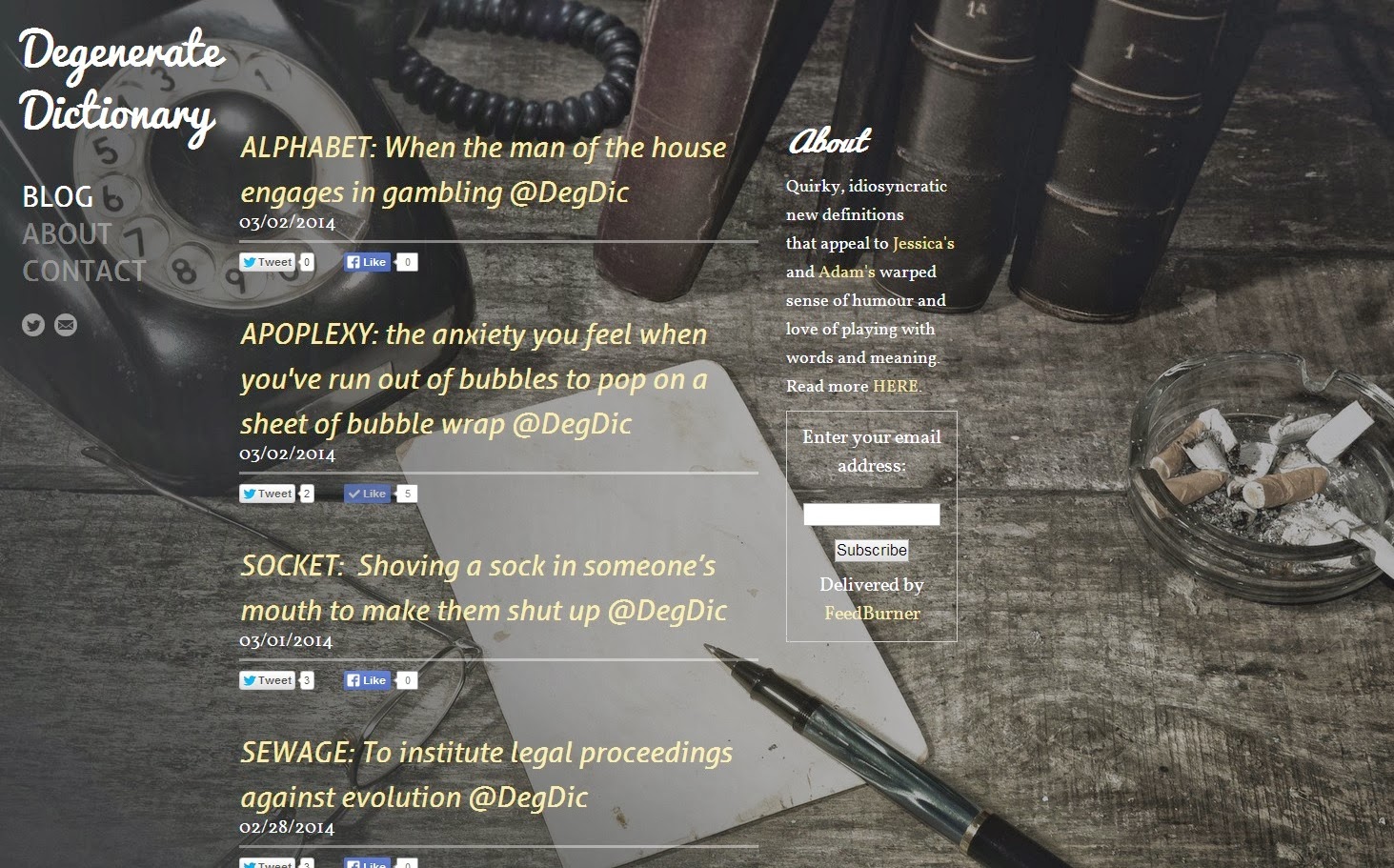
What is the Degenerate Dictionary?
It all stems from a family game Jessica Bell remembers as a child when her mother and friend played with words.
ARSENIC: A cut on the bum.
PROPAGANDA: Having a good look.
Last year Jessica began posting these idiosyncratic definitions on twitter and Facebook with the hashtag #Jessicasdictionary.
I decided to join in and contribute my own:
PANTOMIME – the dance performed when putting on underwear in a public change room.
The exchange went back and forth over a few days until a surprise message arrived in my Inbox.
The gist of it was this: Would you like to write a dictionary with me?
Me: *brief pause* Oh yeah!
And so, what was once #Jessicasdictionary has become Degenerate Dictionary.
It appeals to our warped sense of humour and our love of playing with words and meaning, degenerating words into something different.
Now the little project that could is now even bigger and better than ever.
Here’s how the Degenerate Dictionary process plays out:
We hope to see you join in the fun!
Posted in Short Stories
Yesterday I was teaching my Year 7s (the first year of high school in Australia) Creative Writing. They are a learning enhanced class which means there are a range of intellectual and learning disabilities.
We were learning the structure of a story, using the primary school method of Orientation, Complication, Events and Resolution (O.C.E.R.). It works for any writer really; it’s the fundamental structure to any scene whether it’s for a short story or a novel.
I gave them an opening line, “I had my costume all planned out; I was going to be a superhero” and after a brief planning session, they were set to work. While they wrote theirs, I plugged my laptop into the data projector and wrote my own. It’s best practice to model what you’re after.
It’s far from perfect but it showed my students what to do.
So here it is for your… pleasure… or interest… or something.
SUPERHERO SATURDAY
I had my costume all planned out; I was going to be a superhero. Sitting on my bed I could see it hanging from the wardrobe door. It was a spectacular outfit: black tights with red lightning bolts down the outside of the legs, a red t-shirt with a black lightning bolt on the front and the bestest cape ever. My Mum made it for me.
I am Super B. I seek to right the wrongs, make this world a safer place, and have doughnuts for afternoon tea.
Once Mum let me outside to play, I put on my costume and hit the streets of our cul-de-sac, ready to be the hero. It was a quiet afternoon; only the neighbour’s dog, Scruffy, was outside the fence so I put him back.
I felt pretty good having done my helpful deed for the day. Standing on the footpath I put my hands on my hips and held my best superhero pose. But there was no wind to make my cape fly out behind me so I felt a bit silly.
Was there no other good deed to do today? Not much of a superhero if you only get to do one good deed.
There was a squeal from up the street and the rattle of plastic trike tyres on the footpath. Mrs Jenkins from Number 96 was yelling as her little Patty went hurtling down the footpath on her runaway tricycle.
Patty’s feet were blurry circles as the pedals span faster and faster, threatening to throw her off. Her tiny mouth formed the biggest “O” I’d ever seen and from it came the loudest scream, enough to scare the cat!
This is my chance, I thought. I can be the hero!
I twirled my cape and ran towards little Patty, before she became patty-cake all over the footpath. Putting my feet in the brace position and crouching down I readied myself for impact. Patty came closer, the screaming louder and louder. She was almost on top of me when I stepped to the side, swung my arm around Patty’s waist and lifted her to safety. The tricycle careened off the footpath and into the gum tree outside my house. I expected the tricycle to burst into flames. But it didn’t.
Mrs Jenkins stopped right in front of me, gasping for air.
“Thank you so much,” she said as Patty jumped into her open arms. “You’re such a hero for saving my little Patty Cake.”
“The pleasure is all mine,” I said.
“Come inside and have a biscuit,” Mrs Jenkins said. “You deserve something for your brave actions.”
“Thank you, Mrs Jenkins,” I said. A superhero always remembers his manners.
Mrs Jenkins fed me choc chip biscuits. She insisted I have two, and on my way out the door, she gave me one more.
Walking home I felt pretty darn good. I wiped the biscuit crumbs from my mouth, I didn’t want Mum to think I’d filled my tummy before dinner, and wondered what adventures Super B might have tomorrow.
I stood in our driveway, struck a superhero pose and thankfully there was a breeze to make my cape billow out. I surveyed the cul-de-sac and knew it was safe. It was good to be a superhero.
Posted in Creativity, The Writer's Life
Tagged comedy, comic superhero, creativity, fiction, flash fiction, slice of life, writers, writing
I am an English teacher and drummer/percussionist with an interest in literary pursuits, creative endeavours, rhythmic permutations, theological amplifications and comedic outbursts.
Here you will find my creative detritus: articles on living a creative life and writing explorations.
And other ideas I have snaffled from the papers stuck on the fridge door.
Twitter: @RevHappiness
Instagram: @handwrittenpages
My collaborative epistolary novel, "Post Marked: Piper's Reach," written with Jodi Cleghorn (@JodiCleghorn) out now via Vine Leaves Press.
Come and browse through the library; there is no need to be silent.

 A Fullness in Brevity - Adam Byatt