Handwritten Pages #11

IMG_20160809_172658

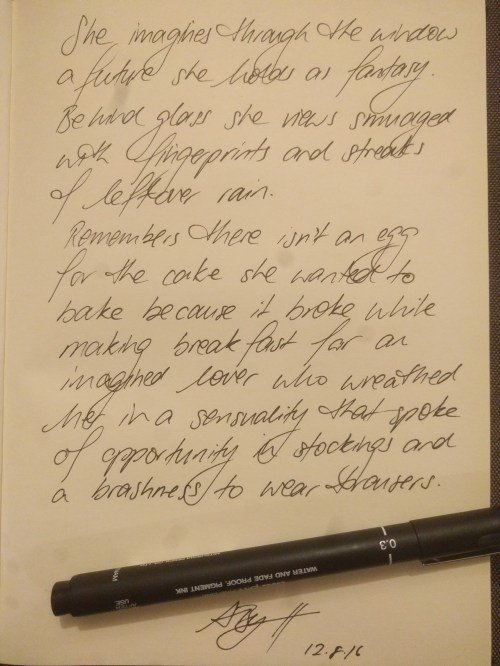
She imagines through the window a future she holds as fantasy.
Behind glass she views smudged with fingerprints and streaks of leftover rain.
Remembers there isn’t an egg for the cake she wanted to bake because it broke while making breakfast for an imagined lover who wreathed her in a sensuality of stockings that spoke of opportunity and a brashness to wear trousers.
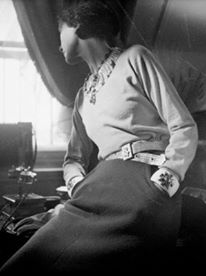
Francois Kollar

The image above is the base for today’s Handwritten Page is a photo by Francois Kollar who was a vogue photographer in the 20’s-40’s.

Earlier this week I was speaking with a friend in another city via Facebook, talking about what we were working on (I wasn’t working on anything; instead I was recovering from a migraine and procrastinating). She was in the middle of working on bibliomancy poems – taking images and old books and cutting up the text to form poems, and gave me a preview of what she was working on. The photo was the foundation image for her poem.

In my usual flippancy I made a silly comment about what the woman in the photograph was looking at. Jodi provided a list of alternatives and I melded them into a single, obtuse sentence. In her usual fashion, Jodi downloaded a quick poem, sparked by the initial thoughts and posted it. I took a single line from Jodi’s poem and remixed it into the narrative.

If you want to buy some of Jodi’s works or place an order for a commission, drop along to her website.

Creativity can be sparked by anything, anywhere, anytime. Another little glimpse behind the curtain to spoil the mystery.

What have you been creating lately?
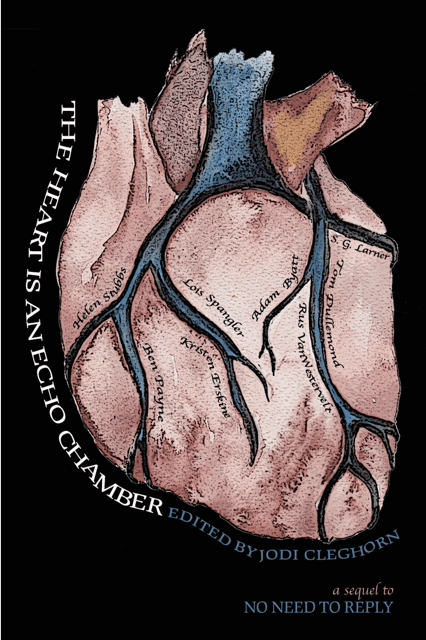
The Heart Is An Echo Chamber Release Day

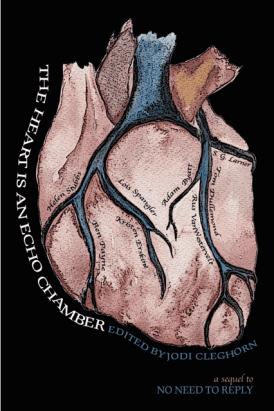
Today The Heart Is An Echo Chamber is released. It is the companion to Jodi Cleghorn’s No Need to Reply.

Screen Shot 2016-04-28 at 12.19.01 AM

My story, “Untethering” is a response story to “Squeezebox.” Get both books and see what the authors have done with the original idea.

You can grab yourself a copy by heading over here.

Zentangle Poetry #2

IMG_20160803_212652

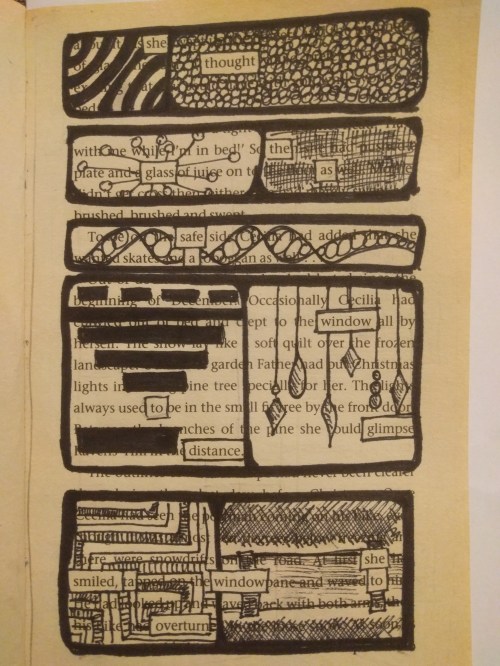
I realise I am better at blackout/erasure poetry than I am at doodling for zentangle poetry. Not that I am going to give up creating zentangle poems; it’s admitting a limitation to a skill set I do not have mastery of. 

I also realised I made this poem harder to read due to the division of the sections. It looks like a comic book format which makes the reading more complex as it divides the words in a way that I had not planned. It’s an error of planning on my part.

To read it, read across from left to right as you normally would and ignore the arbitrary divisions. Hope that makes sense. 

Still learning. Still having fun creating. 

Handwritten Pages #10

IMG_20160804_215950

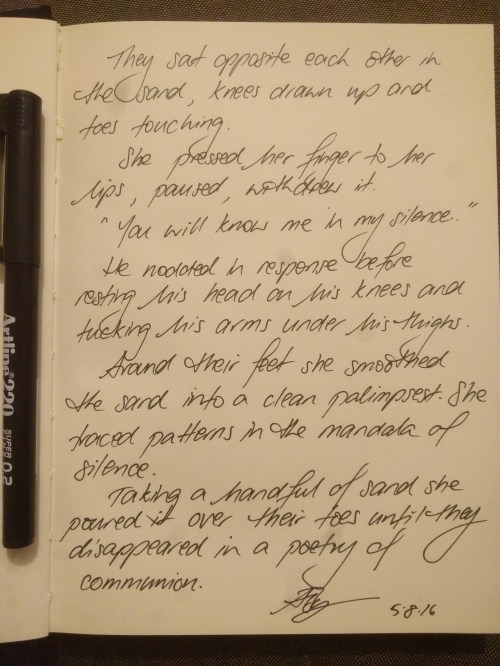
They sat opposite each other in the sand, knees drawn up and toes touching.
She pressed her finger to her lips, paused, withdrew it.
“You will know me in my silence.”
He nodded in response before resting his head on his knees and tucking his arms under his thighs.
Around their feet she smoothed the sand into a clean palimpsest. She traced patterns in the mandala of silence.
Taking a handful of sand she poured it over their toes until they disappeared in a poetry of communion.


I was about to take a picture when I saw the error of a repeated word. I debated what to do: rewrite or edit? First, I scribbled out the word, made the edit. Then I looked over it again and rewrote it. Oh the glamour of artistry (letting you behind the curtain of creativity).

Zentangle Poetry #1

IMG_20160730_122821~2

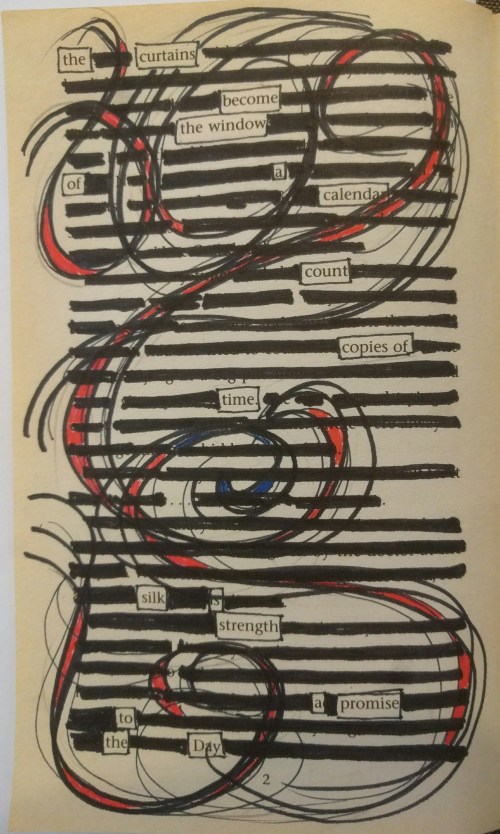
This is my first attempt at zentangle poetry. I have dabbled with blackout and erasure poetry in the past but zentangle poetry was unfamiliar. 

Zentangle poetry is a combination form of blackout/erasure and found poetry where the author/artist adds an illustrative aspect to the poem. Think of an illuminated manuscript. But more scribbly. Google it for some quite stunning examples. 

But why do it?

It’s another way of being creative; a short activity that can be done in between other tasks or in some down time, or a way to relax. There are colouring in books for adults so think of this as another form of colouring in.

The down side is the defacing of a book.

In this case it’s Jostein Gaarder’s Through A Glass Darkly. Might make a thematic approach as I work through this one or let the page decide what it wants to speak.

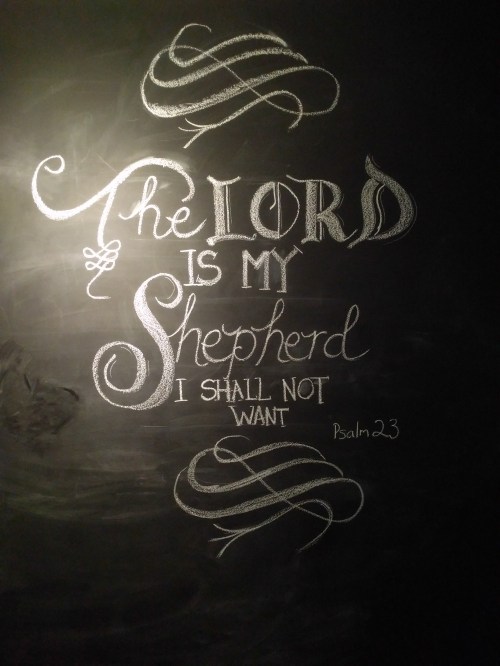
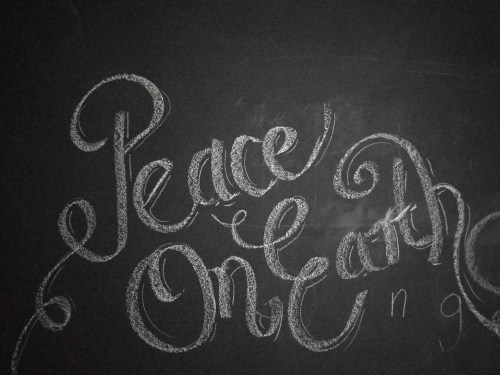
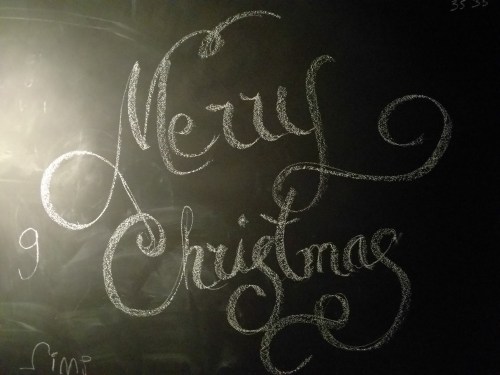
I love the tactile sensation of handwriting. My sister-in-law has a custom chalk wall in the foyer of her house. When I get the chance to play with chalk I do. Here are a couple of my initial experiments.

IMG_20160706_145240

Mixed typography but I’m happy with this. 

IMG_20151225_163115

With additions from one of my nephews – this was done on Christmas Day. A little bit better than my first attempt after some research on my phone for typography.

IMG_20151219_201701

My very first attempt; the family was watching Carols on the television so I utilised the time for some creative play. Not very good for a first attempt but giving something a try.

I have plans in my head for new designs next time the wall is cleared from her boys having fun all over it. As you can see I’m still developing my calligraphy skills but that’s the joy of creativity.

Start small, make mistakes, continue to practice and improve. 

All the while I need to sort out my Major Projects list and get back to them but these are good, fun activities to continue creative play. 

Go and have some creative play.

Handwritten Pages #9


IMG_20160729_114933

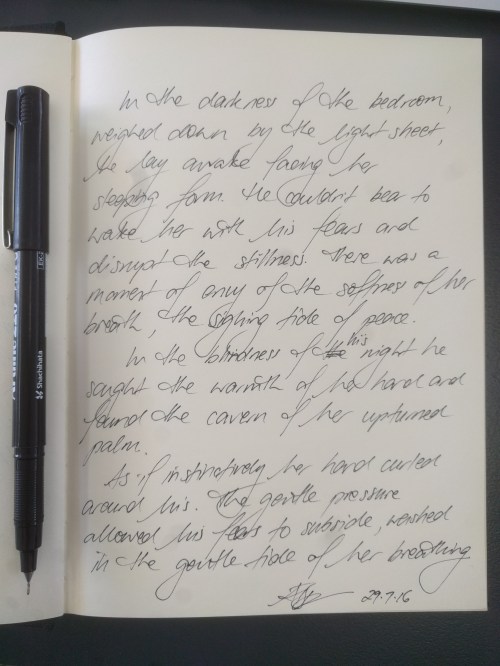
In the darkness of the bedroom, weighed down by the light sheet, he lay awake facing her sleeping form. He couldn’t bear to wake her with his fears and disrupt the stillness. There was a moment of envy of the softness of her breath, the sighing tide of peace.
In the blinds of his night he sought the warmth of her hand and found the cavern of her upturned palm. 
As if instinctively her hand curled around his. The gentle pressure allowed his fears to subside, washed in the gentle tide of her breathing.


The Heart Is An Echo Chamber Release Date

It has taken a little while but on August 10th I will have a new story coming out in Jodi Cleghorn’s collection, The Heart is An Echo Chamber.

My story, “Untethering” is a response story to “Squeezebox” from No Need to Reply.

Screen Shot 2016-04-28 at 12.19.01 AM

Screen Shot 2016-04-28 at 12.18.52 AM

Follow the link below to get your hands on one or both of the books.

The Heart Is An Echo Chamber

Handwritten Pages #8

IMG_20160713_141420

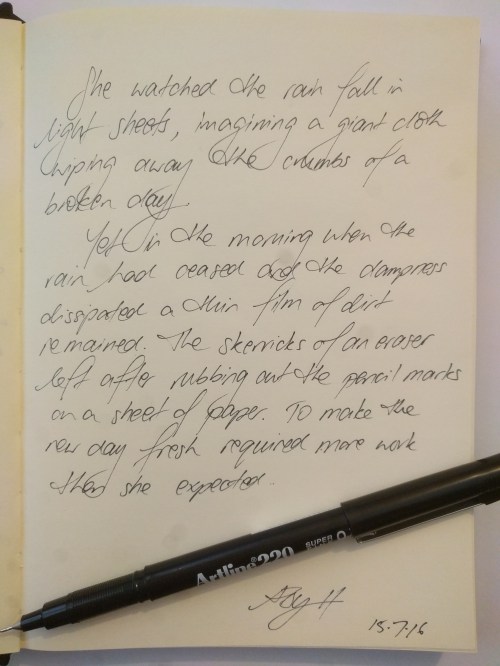
She watched the rain fall in light sheets, imagining a giant cloth wiping away the crumbs of a broken day.
Yet in the morning when the rain had ceased and the dampness dissipated a thin film of dirt remained. The skerricks of an eraser left after rubbing out the pencil marks on a sheet of paper. To make the new day fresh required more work than she expected.


SIDE NOTE: When I was writing this, transcribing it from my notebook where I first scribbled the idea, I asked myself why I ascribed the feminine pronoun to the character of the narrative. It was arbitrary, without conscious assignation.

I then reread the paragraph replacing ‘she’ with ‘he’ and saw a different reading. As a personal reflection, I think I tend to write more from a female perspective than a male one. For purely unscientific research I did a gender breakdown on the Handwritten Pages.

  1. “I” (indeterminate)
  2. Couple (male/female)
  3. Female (2 sisters)
  4. Female 
  5. “I” (indeterminate)
  6. He
  7. Male (2 brothers)
  8. Female

In examining the content of each piece, the seemingly arbitrary allocation of gender pronouns was determined by its focus. The third Handwritten Page was inspired by a friend’s recollection of her childhood with her sisters so it was a natural response to use the feminine. 

In last week’s Handwritten Page I ascribed masculine pronouns, except to the “I” persona. In reality it could easily be the sibling rivalry between a brother and sister yet in my head it was between brothers; we tend to pair brothers with brothers and sisters with sisters in terms of sibling rivalry and not a brother/sister combination.

It also made me think about how the content of a narrative influences the reader’s understanding of gender. Does it affirm or subvert paradigms? Why or why not? Just asking.

But the distinction of female or male POV in a narrative made me think about how I read gender in a story (being male) and how others would read the piece above (male or female). I know men and women will read the paragraph differently based on their own gender, and their reading of gender. 

Try reading today’s piece replacing ‘she’ with ‘he’. Does it make a difference in your reading? What nuances or differences are borne out of a different reading? Does it matter? I’m interested in your ideas.

Handwritten Pages #7

IMG_20160708_105922

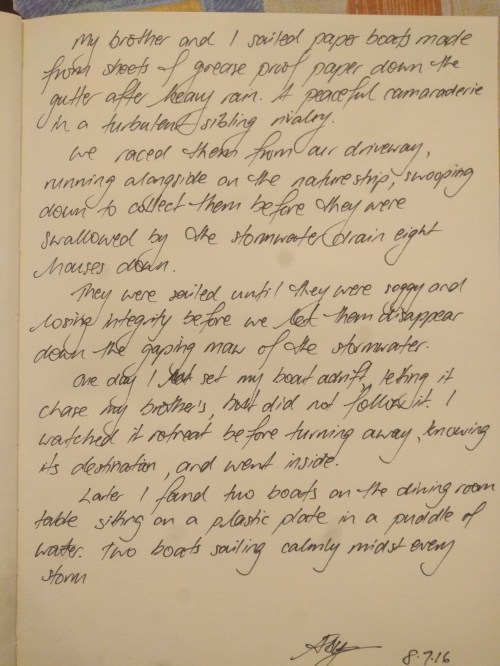
My brother and I sailed paper boats made from sheets of grease proof paper down the gutter after heavy rain. A peaceful camaraderie in a turbulent sibling rivalry. 
We raced them from our driveway, running alongside on the nature strip, swooping down to collect them before they were swallowed by stormwater drain eight houses down.
They were sailed until they were soggy and losing integrity before we let them disappear down the gaping maw of the stormwater.
One day I set my boat adrift, letting it chase my brother’s, but did not follow it. I watched it retreat before turning away, knowing its destination, and went inside.
Later I found two boats on the dining room table sitting on a plastic plate in a puddle of water. Two boats sailing calmly midst every storm.

Digging the Creative Well

As creatives we often speak of drawing from the well; to draw from within ourselves the creative spark and energy.

But to draw from the well of creativity first requires you to dig your own. It requires you to construct the access to creative water. 

While you are digging your own well, you can draw water from the wells of others to help your creativity. However, it is temporary measure. Drawing water from others’ wells enables you to draw strength while you are building your own.

Finding good water takes time. It may require digging many wells to find the source of good water. Once you have dug your well do not neglect the upkeep. 

As you have drawn from the wells of others, allow new creatives to draw from your well while they dig their own.

Think it’s time to break out the heavy machinery and start digging.