Category Archives: The Writer’s Life

How Do You Make Something Creative and Cool?

How do you make something creative and cool?

I like seeing what people are doing with their creativity. Sites like This Is Colossal are a constant inspiration for what people can do. I love watching my mates Deane and Gary post their photos on Facebook, and through my twitter feed I see some very creative ideas.

I’ve seen cartoons drawn on Post It Notes, drawings scribbled on plastic lunch bags, bird cages suspended above a narrow laneway, umbrellas suspended in a similar way like a hundred invisible Mary Poppins.

And it’s brilliant. And so very cool.

So when I came across next earth is now on tumblr, I was intrigued. And even more surprised when I found out it was a writing friend, Daniel Ritter. I only made the connection when I saw it linked via his Facebook page. So I asked him about it.

In Daniel’s words, “(It’s) sort of an alternate reality experiment. Approaching it as if the photo/narrator is experiencing delusions that aliens or some other unknown agency has taken over the world, but he’s the only one that has noticed.

So far, this has been random, pants, discovery, stack-on-the-weirdness approach. Names have been named, rules have been established, so, it could be developed.”

They fill their zoos with us. Their zoos overcrowd with halfbreed children. They refuse to euthanize. They install …buttons under our feet. We do the dirty work, step by step. They’re absolved of murder.

They fill their zoos with us. Their zoos overcrowd with halfbreed children. They refuse to euthanize. They install …buttons under our feet. We do the dirty work, step by step. They’re absolved of murder.

You make something creative by experimenting, and Daniel has done this so well, playfully taking a foray into an idea and seeing where is goes.

And this is what makes creativity so very cool.

Follow next earth is now on tumblr
See what Daniel is up to on twitter @ReginaldGolding
And go have a sticky beak at his blog, Grounded Stories


Throw Out Thursday – Showing Your Work

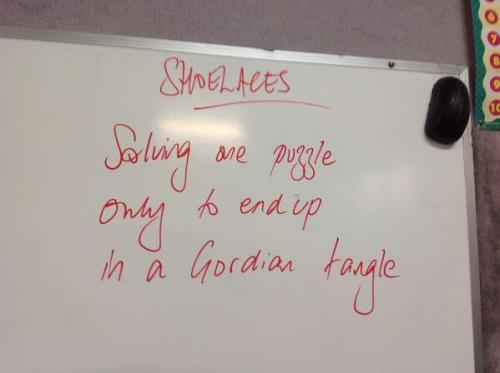
For this week’s Throw Out Thursday, I’ve collected the random poetry I wrote with Year 8 last term. The focus was on haiku.

It’s a great way of introducing students to a poetic form and while there is a beautiful simplicity to haiku, there is also great depth and complexity in the form when explored.

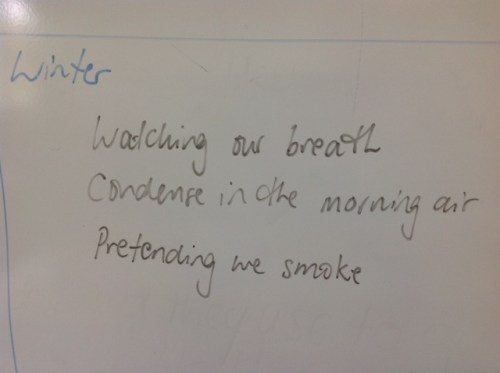
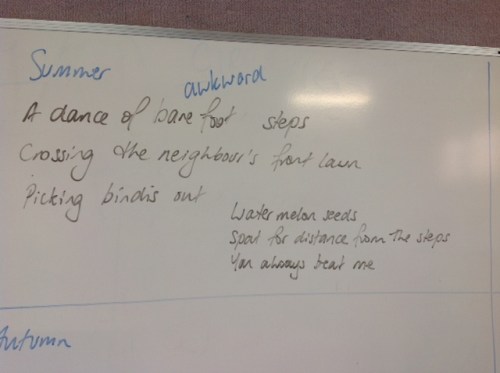
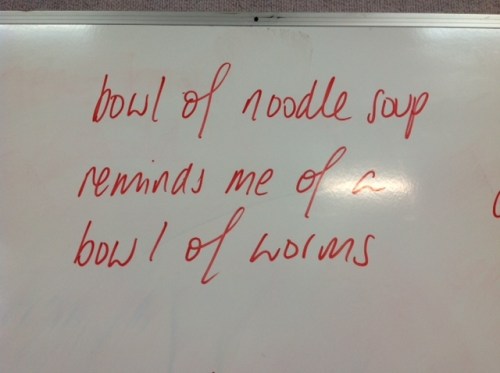
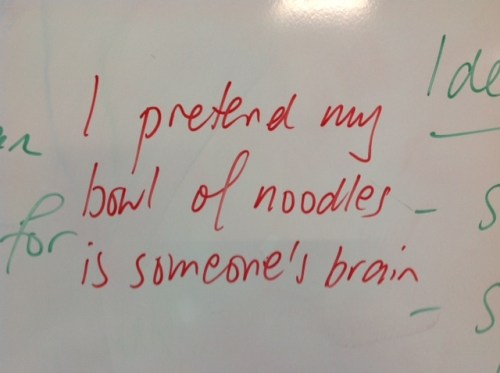
But this is about throwing stuff out. And these are haiku I wrote on the board while my class was working. I believe it’s important for my students to see my writing, correcting, experimenting and exploring creatively.

Haiku with Year 8

Haiku with Year 8

Winter Haiku

Winter Haiku

Summer Haiku

Summer Haiku


Noodle Worms

Noodle Worms

Noodle Brain

Noodle Brain

Creativity is about experimenting, exploring, examining, and having a whole lot of fun.

These are brief experiments and part of the process of improving my writing craft. As Austin Kleon says, “Show your work.” You get to see a little of the word wrangling I do to.

Dare you to have a go at something creative.

Answering a Six Year Old’s Question

Yesterday my second daughter (aged 6) was playing with my Lego Star Wars Micro Fighters. She has played with them more often than I have because of current work commitments.

My daughters often see me at the computer where I am either working (prepping lessons for school), goofing off on social media, or working on a story. And more often it’s the six year old who asks, “Why do you write stories?” 

And I am completely flummoxed for an answer. At least one she’ll understand.

I have an intellectual answer for her; a rational explanation of my thinking behind creativity as to why I write stories. And for all the intellectual rigour, philosophical posturing and rationale, the best answer is, 

“Because it’s fun.”

Please, Make Yourself At Home

Throw Out Thursday – The Breaking News

Over the next few weeks my work life is going to dominate all my spare time. One of the vagaries of being a teacher is knowing there are intense times in the course of a term when there is a lot to do be done to the exclusion of pretty much everything else.

This means I won’t be around here so much posting; I’ll still be thinking , making notes and taking down ideas, but probably no full posts for a little while. I have scheduled a couple of posts that I had ready so you won’t be too short on reading material when you have to visit the bathroom.

While I am gone, I’ve stocked the fridge, made sure the cupboards are not Mother Hubbard and there is enough rolls of toilet paper in the bathroom.

Make yourself at home here, take time to browse through the library of posts, leave a comment, spread the good word, even find some of my early fiction writing from when I first started out back in 2009/2010.

Please don’t short-sheet my bed while I’m gone. Bin night is Thursday night and when replacing the toilet paper, it hangs over, not under.

In the immortal words of the wise body-building philosopher, Arnold Schwarzenegger, “I’ll be back.”

What Am I Working On?

What am I working on?

It’s a very good question. About 2 years ago I mapped out a 3 year plan of writing projects. It was overly ambitious and I have not fulfilled anywhere near what I had in mind. One project is completed, my collaborative epistolary novel, Post Marked: Piper’s Reach. It is ready to send out to agents and publishers.

Every thing else is languishing and waiting. Some ideas I have abandoned, others I have modified. And I’m ok with that.

In the meantime I am pursuing a couple of smaller projects as I’ve mentioned before.

What happens on Facebook from time to time is writers tag each other to see what each other is up to. It looks like this:

“I was tagged in 77 for 7 by Person X.
Go to page 77 (or page 7 if you’re not up to 77) of your current work in progress. Starting on the 7th line, share the next 7 lines, then tag 7 more people.
The challenge will be finding 7 author friends that haven’t been tagged.”

I am working on a novella at the moment. Here is the working logline or summary:

When Jack meets Takashi at a bird breeding convention; Jack is displaying his birds while Takashi paints them, they form an unlikely friendship and begin to come to terms with their experience of World War 2 that shaped their lives, discovering that the very things that trap them are the things that give them the most freedom.

Scrolling through to page 7, and line 7, here is the following 7 lines (I made it 8 as it was a complete paragraph). Please note it is a draft only and any errors, grammatically or linguistically, are purely intentional.

The old man selected another brush, dipped it in the ink and continued his study of a bird in flight, transforming the caged bird into a bird beyond the confines. As the brush moved across the lightness of the page it appeared as if it opened the darkness beneath and bled into the contrasting whiteness. Yet the image appeared with a life and breath of its own; the finch alighting onto the imagined tree’s limb. The bird’s wing arched out behind it to capture the air and slow its descent. Its translucent feathers of black ink let the white of the paper bleed through, suspended in the descent as its claws were held infinitesimally away from touching the branch.

I am aiming to have this novella completed by the end of the year. I am also working on a verse novel, a modified idea I originally had for a YA novel. I will share some of it in a few weeks’ time. I also aim to have a draft completed of the verse novel completed by the end of the year. Will see how I go.

Go and be creative.

Random Creativity (And Why It’s Important)

On Friday my Year 8 class were set the task of writing haiku.

The English approximation of a beautiful Japanese art form is known to most, if not all, primary school children. They learn it is a poem of 17 syllables broken into 3 lines (5, 7, 5) and it is about nature (or something…).

It is taught because it is easy and accessible for students. It gives definite boundaries and restrictions, confinements for words and their interplay of meaning.

But writing great haiku is difficult.

I told my students I wanted them to experiment and play with language. I encouraged them to enjoy the process, to have fun with language. And so I had a go at writing a couple myself.

Summer Haiku

Summer Haiku

A dance of barefoot (awkward) steps
Crossing the neighbour’s front lawn
Picking bindis out

Watermelon seeds
Spat for distance from the steps
You always beat me

Winter Haiku

Winter Haiku

Watching our breath
Condense in the morning air
Pretending we smoke

Are they any good? Probably not.

Why is random creativity important?

It can be done quickly and in spare moments, disposable as an empty soft drink container or laboured over and agonised and deliberated for each and every syllable.

This is why creativity is important. 


Understanding Alchemy – My Writing Process

I suspect many readers, and indeed if conference questions are anything to go by, are mystified by the process writers have of hunting down, killing and skinning an idea and presenting it as a story. It’s like the medieval alchemists who attempted to combine elements and transform it into gold.

I was reluctant to write this post, tagged by another writer, my collaborative writing partner Jodi, but realised if I believe everyone can be creative then it behooves me to explain the process and guide new writers into the mystery.

Please don your robes and grab a doughnut; the initiation is about to begin.

There are many pithy quotes by writers about how to write but they are only relevant if you have immersed yourself in the craft of writing. Experienced writers nod sagely and ironically at the pithy wit and wisdom of those they admire but it doesn’t let the novice into an understanding.

The focus of the My Writing Process tagalong was to ask writers 4 questions. Here are the 4 questions asked and my attempt at an answer. Particularly #4 where I will attempt to show how I work and see if it helps novice writers on their journey.

1. What are you working on at the moment?

Too many things. Here are the most significant projects.

a. Post Marked: Piper’s Reach is a collaborate epistolary novel written with Jodi Cleghorn. It was hand written in real time and sent through the mail.
We are now at the stage of finalising our synopsis and getting it ready to submit to a variety of avenues.

b. The Java Finch (novella – working title) This is the logline I developed in my planning:
When Jack displays his finches at a bird breeding convention he meets Takashi who is painting the birds. They form an unlikely friendship and begin to come to terms with their experiences of World War 2 that shaped their lives, discovering that the very things that trap them are the things that give them the most freedom.

c. The Broken Chord (YA verse novel – working title) The (very rough) logline: Caitlyn-Rose is a gifted musician in her final year of high school, and having lost her mother in her first year of high school, struggles with her identity and purpose on the verge of graduating, afraid of the future and who she is.

d. I am also working on Degenerate Dictionary, Post It Note Poetry and a non-fiction book on creativity.

2. How do you think your writing differs from that of other writers in your genre?

I honestly have no idea. I am a newbie author so comparisons to other writers is unfounded.I do not have a substantial body of work to hold up for scrutiny. What I do have is an interest in authors who writing I admire: Tim Winton, Marcus Zusak, Craig Silvey. It is from these writers that I take inspiration in terms of style. I like Winton’s poetic prose, Zusak’s voice and Silvey’s humour.
My own writing infuses elements of all three, but it is my voice. I do not intend to be a slavish copyist but to speak articulately in my own voice. I love how the minutiae of life is a smaller version of the bigger thematic concerns of a work.

3. Why do you write what you do?

I remember watching an indie film with an old friend when we were growing up called ‘The Saint of Fort Washington’ and it was a couple of lines of dialogue that stuck with me.
“What’s your story?”
“I haven’t got one.”
“Everybody got a story.”
At the heart of it is a desire to know people’s story; how often do you hear someone say, “My life is uninteresting” or “I’m so boring” but that is the point of intersection where I want to ask the person about his or her life and listen to the stories that are important to them (I have plans for a project to take this idea a step further).
I write what I do because it’s the little things in life that interest me. For example:
* who decided it was a good idea to share a bed with someone?
* why does it take so long to hang out socks and underpants on the washing line?
* how long should you let someone walk around with their fly unzipped?
* is falling in love better or worse than getting gravel rash when you fall off your skateboard?
I wrote a manifesto some time ago, to articulate my vision for why I write.

I am a writer.

I write because I want to tell a story, but not just any story.

I write because I want to tell the story of those who are not heard.

I write because I want to tell the story of those who cannot speak.

I write because I want to tell the story of those who are disempowered.

I write because I want to tell the story for those who cannot.

I write because I believe that telling a person’s story is integral in understanding who they are.

I create art to speak into the darkness, that I may be a light for others to ignite their own flame and walk clearly.

People’s lives are not boring; writing is an exploration of how and why the everyday variables and events impact a person.

4. What’s your writing process, and how does it work?

Process assumes a regularity of work habit. Yeah, about that. Nope. Doesn’t work for me.
I know writers who can park their backside in a seat for an entire day and churn out 2000 words, 5000 words or even 10,000 words. Others I know work in small chunks of time, half an hour or an hour while others write until they have 1000 words.
For me, I work in bite-sized portions of time, snatching words in paragraph fashion. I have, in the past, written in chunks of time and written to 1000 words. It is always dependent on the workload of my day job.
I can go days or weeks without substantial writing yet still manage to scrawl words here and there. And I write slowly.
I also don’t have a regular process because I also write poetry and short stories. What I am working towards is a more consistent pattern, say 2-3 times a week of set aside time to write.
There is no formula to writing; you simply write.

How you create stories is another matter.

When I first started writing I knew a story needed a beginning, a middle and an end; a complication, a series of events, a resolution. But how to put these into a cohesive piece was what I needed to learn. I read as many blogs as I could about the writing process and how to craft a good story. I wrote 1000 word pieces of flash fiction and posted them to my blog, linked them to others and sought feedback to improve my work.

You learn to write by writing and reading. A writer is the sum of their reading influences and their vision and perspective on the world. You tell stories for myriad reasons but at the heart of it for me is the power of story to transform the individual and also a love of words and language.

Find a pen, a piece of paper, and write a story. Find your voice.

Tincture Journal Winter Edition #6 The Cicada Clock

Today I have a new story published in Issue #6 of Tincture Journal: The Cicada Clock.

Tincture Journal (@TinctureJournal) is a relatively new Australian-based literary magazine, edited by Daniel Young (@jazir1979), Stuart Barnes (@StuartABarnes) and Jessica Hoadley (@JessicaHoadley)

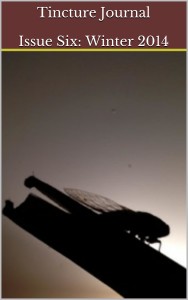
My story, The Cicada Clock also seems to have inspired the front cover.

Tincture Issue 6 Cover

Image copyright of Stuart Barnes

I also get to share the Table of Contents with Brisbane-based authors I know, Stacey Larner and Tiggy Johnson.

From the Tincture Journal website:

Issue Six of Tincture Journal is available now. To celebrate the launch of this issue, an interview between Stuart Barnes and poet Stu Hatton is now freely available on our website along with the rest of our interview series. Inside the issue you can also find Stuart’s interview with Nathanael O’Reilly. Both of these poets have new books being released this year and we are very excited to be featuring their poetry and the accompanying interviews.

Table of Contents

  • Editorial, by Daniel Young
  • Inferior Bedrooms, Part Six, by Meg Henry
  • The Horror of the Body, by Sam van Zweden
  • Waiting, by Tiggy Johnson
  • The Interesting People of Mount Kiliminjaro, by Stephen Koster
  • Christian Girls, by Nathanael O’Reilly
  • I Was Not Like the Other Kids, by Nathanael O’Reilly
  • Nathanael O’Reilly interviewed by Stuart Barnes
  • The Cicada Clock, by Adam Byatt
  • Spash, by Les Wicks
  • Carnival, by Beau Boudreaux
  • Rain of Ashes, by Rhys Timson
  • It’s a Marilyn Free-For-All, by John Grey
  • The Man Who Killed James Dean, by Sam Ferree
  • Back to Front, by Nathan Hondros
  • Memory, by Andrew Hutchinson
  • hail the goer, by Stu Hatton
  • i sit unfinished    in breath-, by Stu Hatton
  • A Look of Revelation, by Deborah Guzzi
  • The Favour, by Annette Siketa
  • Circles, by w.m.lewis
  • Only After School, by Anna Ryan-Punch
  • Mrs Fernandez, by Su-May Tan
  • The Happy Mule, by Frank Scozzari
  • Proximity, by S. G. Larner
  • White Noise, by Eleanor Talbot
  • It’s An Adventure If You Want It To Be, by Calista Fung

I hope to post a review of the issue next week; I’ve already read a few pieces and there is some amazing work.

Can I please encourage you, if you are a reader, to support small literary magazines whenever you can as they are vital in building our literary culture. A copy will only set you back $8 (and back issues are only $5). There is a wealth of reading material in a superb range of short stories, poetry and interviews.

But a bit of background to the story (and no spoilers).

I wrote the story in January when on holidays on the beach in Brunswick Heads, just north of Byron Bay in New South Wales, Australia.

I forget which book I was reading (I was working through three) but it had  a line about cicadas and the image stuck. I began the story on my iPad, throwing down scenes and ideas about two childhood friends in their final year of primary school, prior to starting “big school” the following year. It is set in the late 80s, a time of nostalgia for me (but it’s not autobiographical).

It took a while to find the focus of the story, utilising the cicada as a metaphor of adolescent metamorphosis, framed by school as the awkward ground of burgeoning adolescence and puberty, mixed with the innocent acceptance of life as it is and a burgeoning awareness of sexuality.

I made the conscious decision to write this story in a different style; to forgo my usual poetic, flowery prose and instead strip it back to bare, almost minimalistic sentences. I have a tendency to use imagery prolifically in my stories; here I pared it back to single images or none at all. Instead I wanted the action and dialogue to create the characters, setting, thematic focus and subtext of the narrative. It was to mimic the headspace of the pre-teen protagonists, letting the story unfold through their eyes.

I hope I can encourage you to purchase Issue Six of Tincture Journal, support literary magazines and enjoy the literary delights.

Writing Is Like A Roll Of Toilet Paper… A Little Cleaning Music, Please Maestro

…there’s a big, brown stain no one wants to clean up.

Remember the last time the toilet roll spun off and collected in a pile on the floor? Rolling it back on made it look like a cack-handed attempt to restore order in the universe.

Let’s leave this mess, shall we?

It has been a while since we have sat down to have a chat and catch up; we have seen so little of each other lately, for which I sincerely apologise. Let me fill you in on the changes happening.

While the monkey butler winds the gramophone and sets the record playing, take a seat in the comfy chair.

Would you like tea, coffee, Gravox? Please, help yourself. Milk and sugar to the left.

Let me begin…

I took a bit of time off from writing here on the blog about my writing and creativity, from writing Post It Note Poetry and micropoetry, even from my current works in progress, as it all appeared to be one glorious mess of paper strewn across my desk utilising a filing system dependent on an understanding of Base 6 and Kermit the Frog’s rendition of “The Rainbow Connection.”

I knew where everything was, and is, but the boundaries were beginning to blur and it meant losing focus on the bigger picture I have in mind for my writing. I had too many projects on the To Do list and I was losing focus, impetus and momentum.

In order to separate the strands of my writing I am having a cleaning out of the blog. Some things will disappear, others will stay the same. It means a clearer delineation of my writing projects, my writing life and your connection as a reader.

In the middle of May I decided to take a writing sabbatical until the beginning of June to enable myself to think through what it was I really wanted to do. It was the culmination of a sense of failure I felt earlier in the year, and something I raised with my online writing group. I had a sense of dissatisfaction and felt like I was wading through a pile of dirty washing with no map and coming out the other side with a pair of dirty underpants on my head.

I broke my writing sabbatical (I makes the rules; I gets to breaks the rules) with upwards of 500 words towards my verse novel. However, the small break gave me permission to not write, to take the pressure off. It helped clear the foggy windscreen, replace the toilet roll and consume an unhealthy amount of doughnuts.

What’s on the “Assault on the Literary World” agenda/game plan?

Firstly, changes to this blog:

A Fullness In Brevity – Blog posts on what is happening in my writing and other nonsensical wonderments will continue to appear here.

Post It Note Poetry and Micropoetry will be moving to tumblr where I will repost my old works and continue with new ones. The link is here (please note the name change to Post It Notes and Poetry – someone already had “Post It Note Poetry”).

I am fond of writing micro poetry on twitter but want to consolidate my poetic scribblings into one place. I intend to release an anthology of Post It Note Poetry and micropoetry once I have sufficient works of quality.
Expected Completion of Draft: ongoing but aiming for 2015 ebook release.

Creativity for the Uncreative – here on the blog I have been writing about creativity and sincerely believe everyone can be creative. I intend to relaunch my blog with this focus in July/August (potentially on a new site), revamping older articles and writing new ones with a definite plan in place for an ebook version when it is completed.
Expected Completion of Draft: ongoing but aiming for 2015 ebook release.

Secondly, what am I working on?

Post Marked: Piper’s Reach – my collaborative epistolary novel with Jodi Cleghorn is edited, finalised and ready for submission to the portals of bookdom once we have written a synopsis *insert curse words here*
This is a project I have a very strong belief in; it’s powerful, poetic, brutal, beautiful and it made me cry.

Novella – The Java Finch (working title)
I have approximately 7.5K words down but am fiddling with the structure and plot of the narrative. I fear it may blow out to a novel but I want to restrain it to 30-35K and write it as a literary novella.
Expected Completion of Draft: end of the year.

Verse Novel – The Broken Chord (working title)
This is a YA WIP inspired by Australian poet Steven Herrick’s verse novel, The Simple Gift and Peter Goldsworthy’s classic, Maestro. With both texts there is a remarkable simplicity of language yet stunning depth of ideas. My story will have a rawness to the poetry, to fit the voice of the protagonist. I am 3.5K words in to a projected target of 15-18K.
Expected Completion of Draft: end of the year.

Degenerate Dictionary – another collaboration, this time with author Jessica Bell. It is an opportunity to play with language, have a bit of fun and put it out as a book when we have enough words and definitions.
Expected Completion of Draft: ongoing.

Poetry and Short Stories – I have a note book of potential story and poem ideas; some are half written and baking in the sun. Others are skid marks at the bottom of the toilet bowl waiting to be flushed. I intend to balance out work on my novella and verse novel with shorter works intended for publication.

It’s a lot of balls floating in the bowl but I now feel clearer in my head regarding the direction I want my writing to go. There are a couple more projects on the horizon waiting for the correct time frame to present itself.

It’s diversifying to other places but simplifying it for you the reader to enable you to get the most out of this.

I will leave the past on the blog, a scrapbook of my beginnings, kind of like reading my teenage journals (which reminds me, I’d better burn those).

Now, if you’ll excuse me, I need to splash out and buy some luxury in the form of 3-ply toilet paper.

What Makes Your Life Extraordinary?

What Makes Your Life Extraordinary?

In Dead Poet’s Society, Mr Keating takes the boys to the hallway to see the photos of past students and whispers the immortal lines, “Carpe diem. Seize the days, boys. Makes your lives extraordinary.”

A current television commercial runs the slogan, “Escape ordinary.”

What makes a life extraordinary?

People buy into this idea of your life having to be a Broadway extravaganza or a Hollywood blockbuster ALL. THE. TIME.

We are presented with hyper-idealised notions of reality. Do life BIGGER, BETTER, FASTER, LOUDER, MORE DEMONSTRATIVE, IN YOUR FACE and (dare I use it because I hate the acronym) YOLO! It’s perfectly captured in the Selfie Generation: LOOK AT ME, I’M IMPORTANT AND I DESERVE YOUR ATTENTION.

It is the wrong perspective.*adjusts cardigan and puts on slippers*

What’s wrong with ordinary? Ordinary is where I live and find my inspiration. I joke my life is coloured beige for boring, making my life extra ordinary.

For the creative person, extraordinary is a way to burn out because it demands you give out so much more of yourself than is returning to you.

“The candle that burns twice as bright burns half as long.”

For me as a writer, the greatest stories are not the ones we see in films, the lives of movie stars, but in the embarrassing ordinariness of people doing things in their every day lives that benefits others. The ones who don’t see their work as anything important; they are filling a need, taking care of their community, advocating for the poor and disadvantaged. Living an extraordinary life is one lived in service of others and pursing your own dreams. Balancing the self with the care of others. Telling their story is an extraordinary privilege.

I like to think of the word as “extra-ordinary.” The one thing that defines the ordinary from the extraordinary is passion. Mr Keating exhorted his young charges to engage with the aspects of life that they were passionate about.

For the creative person, the passion manifests itself in the choice of medium whether it’s writing, art or music.

As it relates to creativity, to continually produce great art, to live an extra ordinary life, requires repetition, ritual and reflection.

Repetition

Not once, not twice, not even thrice but continually and habitually. Continue to produce art: write regularly; sketch, doodle, scribble whenever possible; practice scale and rudiments.

Repetition can become staid and uninspiring so it requires a dedication and committed work ethic to maintain your focus on being creative.

Early efforts will be complete and utter rubbish. But that’s the point of repetition: you do it until you get better.

Ritual

Setting aside an assigned time to work on your creative project is like attending church or settling onto the couch to watch your favourite television show or sport team compete. Like repetition, it is a repeated event but the goal is one of individual development.

Ritual provides structure and is an active reminder to develop a disciplined approach to our creativity.

Reflection

Movement without reflection will only end up with you moving in a circular fashion, only ever returning to the starting point without having learned or progressed.

Every once in a while it is important to reflect on your goals, your progress in terms of work produced and skills developed. Are you improving? Has anything weakened? What else do you need to know?

Creativity makes your life extraordinary because you have embraced repetition, ritual and reflection. You are taking the ordinariness of life and giving it meaning through creating great art.

This makes you extraordinary.

Addendum: This morning in the shower (place of many great epiphanies along with the kitchen sink while washing up) I had another idea to add. It was the one thing that makes a life extraordinary: Relationship.

Without relationship, we are merely individuals without community and connection. In relationship with other creative people we make our lives extraordinary because we have companionship, connection and community. We are no longer alone. This is fundamental in making our lives extraordinary.