Category Archives: The Writer’s Life

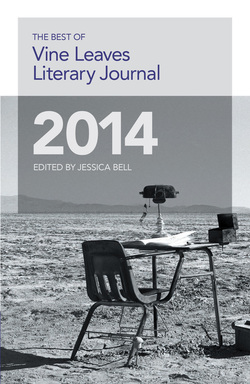
Small Achievements – Best of Vine Leaves Literary Journal 2014

Earlier this year I had a poem, Elihu’s Meditation on Questions Unanswered, published in Vine Leaves Literary Journal.

And now it is being published in the Best of Vine Leaves Literary Journal.

I would encourage you to support small press and publishers as they are pushing boundaries and discovering brilliant new literary voices. This edition is full of remarkable vignettes, poetry and art.

Follow Vine Leaves (@VineLeavesLJ) and its editor-in-chief, Jessica Bell (@MsBessieBell) on Twitter.

Orders can be made directly through the web site. Order HERE. It would make for a wonderful Christmas present for the book lover in your family.

Best of Vine Leaves 2014

Releasing A Story Is Like Farting In An Elevator

In the midst of my writing journey I am contemplating releasing a collection of Post It Note Poetry and Micropoetry. This is before I have sold a novel, completed a novella or sold more than one short story to a paying market. 

There are a bunch of questions hanging around:
Is it too early? 
Have I progressed as a writer to have confidence in my work?
Is it an act of onanism?
Or is it, as the title of the post alludes to, farting in an elevator. You want to do it because all the comedy films tell you it’s funny. You want to let it go it but unsure if there will be a sound to tell people of your release. Or maybe you want there to be a mighty trumpet.

The reality is, it may simply stink no matter how much you enjoy the release.

A writer never has confidence in his or her own work. I know I doubt what I write. I look back at the early beginnings of what I wrote, as evidenced here on the blog, and cringe, but I see the foundations of my writing. And others also saw the potential in the chaff and offered me opportunities to develop. And yet, I still lack confidence. But I believe in the potential I have.

But here’s the thing. I know I can get the opinions and advice from people I trust, who will tell me if my work is a pile of word vomit or worth putting out. 

Every piece I write will be a reflection of my skill and development as a writer AT THAT POINT. I won’t be embarrassed at the beginnings but understand it is part of the apprenticeship I served to become a writer. I liken it to going through a band’s back catalogue.

So next time I fart in the elevator, I hope you laugh along with me because I’ll be laughing with you if it’s you who farts instead.

Remixing is the New Creating Part 2

Earlier in the month I mentioned I had a piece listed on the if:books Australia Open Changes project titled The Storm. It was a remix of a previous work, Jodi Cleghorn’s poem, ‘Later.’ I took the line, “born up on the cicada chorus.”

In good news, I have another piece featured in the last week. You can read ‘The Naked Rosehere.

I took inspiration from Jodi Cleghorn’s piece, ‘She Would Be Grass.’ In particular, the line “On the ninth day, green patches of turf appeared.”

Now the project is closed, it will take the form of a story tree. I will let you know when it is up for you to have a goosey gander at.

Why I Write – A Featured Post

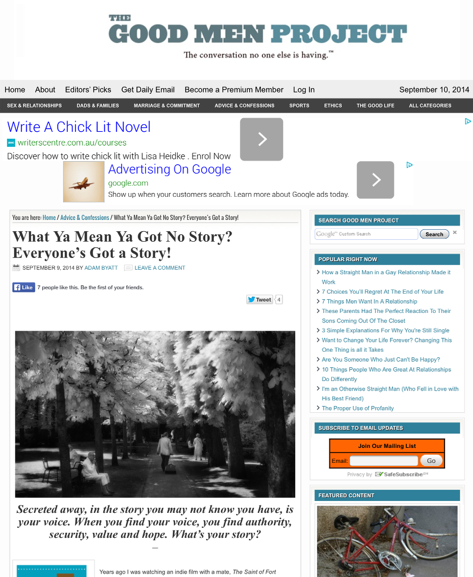
Today sees an article I wrote feature at The Good Men Project site. It is an exploration of why I write, a summary and manifesto to explain the reasons for my choice to use words to communicate.

What's Your Story

What’s Your Story?

You can read the full article here.

Remixing Is The New Creating

if:books Australia is running a remix challenge, Future of the Book.

Each week, 4 or 5 very short pieces (all sub-200 words) are posted and you get to use a paragraph or line or word and remix it in whatever way you choose.

You can write a poem, submit a drawing or photograph or write a short piece of fiction.

This week, one of my pieces is up for a remix.

Here’s the link:  Future of the Book

Have at it!

Is There A Right Time To Read A Book?

Is there a right time to read a book?

No, it’s not a rhetorical question because it’s always the right time to read a book.

What I am asking is do some books resonate with you at a certain age? Can you miss that opportunity and not have the book make the same impact as those who read it at the “appropriate age”?

For example, some years ago, a student of mine was reading J. D. Salinger’s Catcher in the Rye for her English Extension 2 Major Work, comparing the protagonist Holden Caulfield with the modern equivalent of the bad boy, Bart Simpson.

I read the novel to understand her thesis and I knew it was a celebrated text but it left me cold and unengaged. Since then I’ve tried to work out why. Perhaps I simply missed the phase during my adolescence when it would have taken on greater resonance.

In a similar way, I recently read Kurt Vonnegut’s Slaughterhouse Five and Cat’s Cradle and I learned much about writing from them, but they didn’t have the “wow factor” for me. Would I have gained more if I was younger? Had a different mindset?

In comparison, reading Joseph Conrad’s Heart of Darkness in high school blew my mind, while Mark Twain’s Huckleberry Finn left me cold. Don’t even get me started on Dickens’ Great Expectations.

I’m in the middle of Paul Coelho’s The Alchemist and again, it is touted as “one of the best books of all time” according to the sticker on the front cover. I am liking it as a fable but I am not “getting it.”

I’m not referring to the style or language of a text, but its engagement with a culture or generation. Context may play a significant part in a understanding a text’s reception and its reimagining in later eras through its thematic concerns keeps it relevant. Think Shakespeare and the various recreations of his texts.

But there are books, and plays, that I love. Sometimes a book speaks to right where you are, at a specific time in your life, addressing a particular issue or providing a revelation.

I love Shakespeare, ancient Greek tragedies, Homer’s epic poems, Milton’s Paradise Lost, anything by Tim Winton and Markus Zusak, Enid Blyton and Judy Blume when I was growing up, Tolkien in my teenage years (and more so now I’m older). Even the classics: Frankenstein, Jane Eyre, but not Wuthering Heights.

What books have you read that hit the right spot at the right time for you?
What books have you read that you felt were not the right time for you?

Throw Out Thursday – Changing Form

During the week I was sifting through old poems on my hard drive looking for possible works to submit to an anthology a friend worded me up to (didn’t find anything of note although I did find a younger version of me writing complete tripe).

I came across two half-finished pieces and combined some stanzas to make a relatively cohesive whole.

The starry satellites stand sentinel
over silent musings while an observer
of a different reality speculates on the starry host
these pinpoints of silver across the velvety blanket
blink without recognisance
Looking towards the blanket of the night sky
He sees a thousand times a thousand times a thousand
pinpoints of light and asks
“Does God shine a torch at night through the little holes?”

Posting it to my crit group for giggles brought one of the group to suggest it would work as a tanka. No, not a tank top.

What is tanka? Think of it as an extended haiku.

It has a 5-7-5-7-7 syllable count, as per the Japanese guidelines (not necessarily the same in English when translated but English writers use this basic format when starting out).

Go here for an introduction: http://www.ahapoetry.com/Bare%20Bones/wfftocintro.html (with thanks to my crit member, Sean for the link. There are some wonderful examples to read.)

A quick check with my copy of Stephen Fry’s ‘The Ode Less Travelled’ and the link above, I had a grasp of the basics of tanka. And by grip I mean a loose hold. And by loose, barely touching.

And this is what I came up with:

pinpoints of silver
against the velvety black
a blanket of stars
“Does God shine a torch at night
through the little holes?” he asks

I now have a new understanding of how form can affect and benefit a piece of writing. Changing form, in this case, forced me to focus on what were the significant images I wanted to convey in the poem, leading to the final line. Sometimes it could be as simple as breaking the line or stanza arrangement. Sometimes less is more.

But changes to a piece could be in the form of changing point of view, turning a story into a poem or a poem into a short story.

Has changing form helped you with a piece of writing?

The A-Z of Suggestions for Creative People

To misquote Captain Barbossa says, “They’re not so much rules, as guidelines.”

There are multiple permutations of a creative alphabet; your ideas will probably be better than mine. But that’s kinda the point. Listen to the advice, apply it to your work and do it better. Then teach someone else to do it. Pass the knowledge on.

Appreciate new ideas.

Build a body of work.

Collaborate. Cooperate. Coordinate. Critique. Vanilla Ice has wise words when he says, “Stop, collaborate and listen.”

Define your goals as a creative person. Revisit them weekly, monthly, yearly.

Explore what you’re passionate about. And maybe what scares you. You know, for balance.

Foster creative relationships for collaboration, networking and developing the next generation of new artists.

Grow as an artist. Stagnation is for ponds and mosquitoes.

Hunger for the development of your craft and the improvement of your skills.

Inspire others to create because the world needs useless beauty; it is there because it is, and it exists and it is uniquely you.

Jump into new opportunities. But check the depth first.

Kill what distracts you: procrastination, doubt, fear, comparison, jealousy.

Listen at every opportunity. Gather wise counsel and feed your soul.

Meditate on your work, why you do it and write a manifesto.

Network because it’s dangerous to go alone.

Occupy a creative space and protect it.

Publish your work. Whether it’s through your blog when you’re starting out or selling it via Etsy, Ebay or e-commerce.

Query why you are creating. Have you lost sight of your purpose?

Rush a new piece of work and enjoy the frenzy of ideas splashed down like a sudden summer storm.

Spend your time wisely.

Trust in your teachers and mentors.

Understand you are not your creative project; it is an expression of how you see and understand the world.

Vanquish your fears and validate how you feel about what you create.

Welcome feedback, critique, commentary that will help you grow as a creative person.

Xerox another artist’s work to learn how it is created. But show no one else. Learn how to apply it to your own work.

Yoke yourself to an artist further along the road than you. Learn from their guidance that one day you may be yoked to a new artist to teach them.

Zealously demand your need to create; creativity is oxygen to you. Without it you would suffocate.

What would your alphabet of suggestions for creative people be? Write a list, post it to your blog and link back here for everyone to read.

Breaking the Drought

Today marks the end of the rather intense Chaotic Marking and Editing month  for work: Trial HSC marking and 6 Major Works for my Extension 2 students. I can, if I want to, break the writing drought. And there’s a couple of lessons to share.

Firstly, returning to projects after the drought. I said a few weeks back I would be absent, and for the most part I was. My works in progress were put on hold and I can now return to them.

But not yet. Why?

Because I am absolutely knackered mentally, emotionally and physically. Today is a day of rest. Well, sort of. Washing done, biscuits made with Miss #2, couch time watching footy with Miss #1 and a gig to play tonight.

The adage, often said in all caps and repeated as a mantra, YOU MUST WRITE EVERY DAY, is in my mind, piffley twaddle. It would be ideal to write every day but the caveat is that every person is different, their schedules are different and you work out when and how you fit writing, or any creative activity, into your schedule.

During this last month, I gave myself permission not to write because I knew when the time was done I could return to it. It has been a writing drought. However, while washing up last night I had another idea for a poem to include in my verse novel, The Broken Chord. I found my notebook, scribbled the idea and returned to washing up. This is still writing. 

Secondly, the month of Chaotic Marking and Editing abated, I began to reflect on the work of my students. I posted this to Facebook and I’ll reproduce it here.

As I prepare for my Extension 2 English students to hand in their Major Works on Friday, I have a new credo as a teacher. And it comes (with a slight adaptation) from Doctor Who.

Great men (and women) are forged in fire. It is the privilege of lesser men to light the flame.

To completely misappropriate the quote and apply it to teaching, I am very proud of the work my students have produced. I am proud because they took on a challenge some of them were unsure they could tackle, and they have known what it is to work hard. And succeed.

As a teacher, I get to light the flame in my students. I want to instil in them a love of learning, not just my subject.
Sometimes that flame is encouragement, words of praise and congratulations.
Sometimes it’s telling the student the hard truth.
Sometimes it’s confronting their attitude, beliefs, values, and sometimes it’s supporting them.
Sometimes it’s asking them how they are, acknowledging their presence, saying hello as they enter the classroom and wishing them a good day as they leave.

To light the flame is to wish my students the very best in their endeavours and to do things better than I ever could.

I hope I never run out of matches.

I still need some rest before I tackle my WIP. No rush. It is knowing your creative cycle and how to ride it. It will take a little while to break the drought and gain momentum in my writing but that is fine.

How do you break the creative drought?

This Is How We Should Make New Friends

How should we make new friends?

I am a shy individual who masks it with bravado and a quip. New social situations makes my underpants an uncomfortable shade of brown. But it’s good to make connections with new people. Makes the village more welcoming and hospitable.

Here’s how I propose to do it: Everyone needs to carry a novel.

In a new social situation the novel is a means of beginning a conversation. We can talk about the book, what we liked, didn’t like, read aloud our favourite passages.

And when we’re finished, we can swap the book with the person we are talking with, read it and return it when done, or pass it on to the next new person we meet.

And it would be even better if it’s our own story in the book we give away. That way we must trust the other person to treat our book with respect and kindness.

And there should be blank pages for the new person to add in how we met, what we talked about, what the day was like. Then we can pass it on, receive the new person’s book and add our own details. If we happen to cross paths again, we can catchup on what has happened.

Imagine all the people’s stories we could read.

This is how we should make new friends. What do you reckon?