
Category Archives: Odds and Sods on Board

Is There A Right Time To Read A Book?

Is there a right time to read a book?

No, it’s not a rhetorical question because it’s always the right time to read a book.

What I am asking is do some books resonate with you at a certain age? Can you miss that opportunity and not have the book make the same impact as those who read it at the “appropriate age”?

For example, some years ago, a student of mine was reading J. D. Salinger’s Catcher in the Rye for her English Extension 2 Major Work, comparing the protagonist Holden Caulfield with the modern equivalent of the bad boy, Bart Simpson.

I read the novel to understand her thesis and I knew it was a celebrated text but it left me cold and unengaged. Since then I’ve tried to work out why. Perhaps I simply missed the phase during my adolescence when it would have taken on greater resonance.

In a similar way, I recently read Kurt Vonnegut’s Slaughterhouse Five and Cat’s Cradle and I learned much about writing from them, but they didn’t have the “wow factor” for me. Would I have gained more if I was younger? Had a different mindset?

In comparison, reading Joseph Conrad’s Heart of Darkness in high school blew my mind, while Mark Twain’s Huckleberry Finn left me cold. Don’t even get me started on Dickens’ Great Expectations.

I’m in the middle of Paul Coelho’s The Alchemist and again, it is touted as “one of the best books of all time” according to the sticker on the front cover. I am liking it as a fable but I am not “getting it.”

I’m not referring to the style or language of a text, but its engagement with a culture or generation. Context may play a significant part in a understanding a text’s reception and its reimagining in later eras through its thematic concerns keeps it relevant. Think Shakespeare and the various recreations of his texts.

But there are books, and plays, that I love. Sometimes a book speaks to right where you are, at a specific time in your life, addressing a particular issue or providing a revelation.

I love Shakespeare, ancient Greek tragedies, Homer’s epic poems, Milton’s Paradise Lost, anything by Tim Winton and Markus Zusak, Enid Blyton and Judy Blume when I was growing up, Tolkien in my teenage years (and more so now I’m older). Even the classics: Frankenstein, Jane Eyre, but not Wuthering Heights.

What books have you read that hit the right spot at the right time for you?
What books have you read that you felt were not the right time for you?
When Is Reading No Longer Reading?

When is reading no longer reading?

I am a high school English teacher and in the curriculum reading and viewing are separate modes (the other three are listening, speaking and representing).

Traditionally reading involves the printed word in either novel, poem, play or short story, feature article, news report or letter.

Increasingly, the definition of reading extends to visual media: television, film, the internet, graphic novels and comic books.

It could be argued that reading involved pictures long before words. And what are words but a recognised collection of pictograms arranged into a sequence:  Aboriginal rock art, Sumerian cuneiform, Egyptian hieroglyphics?

Reading is therefore the viewing of a codified system of verbal language.  But the modern codification of our verbal language means we now read the verbal equivalent in a codified form we call the alphabet, the written and printed word only.

With the advent of portable devices (tablets, smart phones, laptops and notebooks) the lines between reading and viewing are being blurred with multi-modal storytelling and the incorporation of multimedia into stories: text that moves, movies built into the experience of the text, the incorporation of sound.

For example, “The Fantastic Flying Books of Morris Lessmore” is a brilliant text. The illustrations are superb and the story is delightful.

There are 3 distinct modes of narrative;  3 distinct ways to ‘read’ the story: picture book, interactive narrative (app) and an (Oscar-winning) short film.

But which of these 3 modes of narrative is “reading”?

On the one hand I would argue that yes it is reading. We “read” film as we have learned the code for deconstructing and constructing meaning in film. I posit interactive narratives potentially detracts from the primary purpose of reading: the deciphering of code and symbolism to make meaning from words alone.

The imagination of the reader transports him or her into the world of the text, creating the visual images based on the words presented by the writer. In a picture book, the visuals are an adjunct to making meaning, giving the reader visual clues to the meaning of the printed words.

Brief research suggests different parts of the brain are activated by reading and viewing. Where does interactive, digital narratives fit into this scenario? I don’t know. Anyone have links to relevant research?

On a side note, the debate about handwriting and typing is analogous: what do we gain by learning to write and form letters that typing does not, despite the increased speed typing allows? 

Handwriting forms an integral part of learning and knowing a language, as opposed to learning to type (further longitudinal research needed). We are in a period of rapid change; the results of which we may not see for some years yet.

Anecdotally, I see my students who have grown up with computers and devices as a parallel, if not the preferred method of communication, rather than the handwritten word, and the formation of their language and conceptual framework is poorer than I think it should be for students who have access to more information than at any time in history. There is more educational research and study needed.

Does the definition of reading need to change?

The advent of digital storytelling and interactive narratives means we have to rethink the definition. And I suspect it will remain fluid for some time.

I have no firm answer on the matter. I define reading as the interpretation of the printed word. However, I see the reading of film as a legitimate, too. Somewhere in between lies picture books, comics, graphic novels. They are all valid texts to read, but I would caution balance between all forms.

What do you think “reading” is?

Making Money from Creativity


The discussion regarding Amanda Palmer’s choice to ask for musicians to donate their time and talents to her recent tour has elicited a wide ranging discussion about the arts, labour and payment for services.

For Amanda Palmer’s own words, drop in here: http://www.amandapalmer.net/blog/20120914/

For commentary go here: http://kotaku.com/5943112/amanda-palmer-asks-musicians-to-play-for-free-pisses-off-musicians

and here: http://overland.org.au/blogs/lfmg/2012/10/art-is-a-labour-issue-part-1-wages/

and a recent post from Amanda in response to the lengthy discourse, to understand where she is coming from and what she is doing about it: http://www.amandapalmer.net/blog/20120919/

Click your linky way around the threads of argument. Well worth your time. I am not intending to pour fuel onto sparking match heads, but simply help raise some questions for creative people to think about.

There is no single way of doing things; flame wars and vitriolic comments achieve nothing. Discussion, when informed by reading and research, is the preferred method we should all follow.

Disclaimer done. On with my perspective.

The breadth of the argument can be divided into two lines of thinking:

  1. It is about an artist’s choice to volunteer their time and talents.
  2. It is about an artist’s choice to receive payment for services rendered.

Within the artistic community, I am sure there are times when people will volunteer their time and talents for free, while at other times they will opt for payment for services rendered.

It is still the artist’s choice, but I think there is something else behind it, and it stems from those who are perhaps not within the artistic community. I am a firm believer that each individual can, and should be creative, in whatever media is appropriate.

But those from outside the artistic community see art not as an occupation, but as a hobby, a pastime, something to fill in the lazy Saturday afternoons. Art is considered a fringe activity, not a focal point of a person’s existence.

The arts should never be considered a fringe activity of society; it should be embraced as the heart, soul and mind of society. Just as science, philosophy, religion, capitalism are other aspects that make up our society and community, so too is the artistic circle. These different paradigms give meaning to the individual, a way of seeing and understanding the world around them.

Art (writing, painting, film making, theatre, performance poetry etc) is not play, it’s work. It’s fun work, but work nonetheless.

And work requires recompense. Art can be monetised, as with any occupation. It is worth someone’s financial investment whether it’s a painting, a novel, CD, film.

While some people become teachers, nurses, train drivers, others pursue artistic endeavours as their work, their life style and primary source of income.

Creative arts will always be about an individual’s expression and definition of themselves as some define themselves by their occupation as a designer, IT programmer or business owner.

How do you support the arts?


Create Art “Just Because”

We had our school Art Show during the week and I popped in to view the HSC (Higher School Certificate) Major Works.

There was a wonderful array of art utilising a variety of media from painting, photography, mixed media, sculpture, installation and pencil.

Accompanying each body of Major Work was a brief statement by the artist, explaining the purpose and intention behind the piece. Some statements were fluid pieces of prose, capturing the essence and beauty of the work in a brief paragraph.

And then there was one statement that struck me. 

The statement did not explain or describe the artwork. The artist put forward the idea that the expression in the art work was an expression of what was in his head. It was the equivalent of shrugging one’s shoulders and saying, “Just because.”

And I love that idea. 

Sometimes we want to explain our idea, describe the beauty of our creative work, wax lyrical on the deconstructivist, post-modern interpretation of Freud’s analysis in the subliminal metaphors of our work.

Our words, pictures, music, film or art does not always require an explanation or a reason for being. We do it for no deep philosophical reason or existential afterthought.

Sometimes, we created a piece of art, “Just because.”

A Child’s Crayon in the Hands of an Adult

Talking with my students, some of them talk about their graduation in primary school from a pencil to a pen, and the receipt of a “pen license.” A few proudly proclaim they have been using a pen “illegally” because they never passed their pen license test.

A pencil can be erased. Mistakes can be removed and covered up.

A pen is indelible. Mistakes are permanent.

But, I like mistakes.

I like seeing a beta reader’s comments slashed all over a new story because I know they care about the work as it will look when it is finished.

Sometimes we need make mistakes with the enthusiasm of a child with a crayon and a freshly painted wall.

Emotions

Watching my own children grow and develop, there is a wonderful sense of imagination and creativity, particularly in play and in their own artworks. A child is naturally observant, engaged, creative and often think with their emotions. (And thankfully, nothing on the walls. My own experience, as my mother tells it, involved a red crayon, a long hallway and the implausible excuse that “Mickey draw.”)

And children ask “Why?”

They want to know how the world works in order to make sense of their own experiences. While they develop their understanding, their creativity is unfettered and boundless.

Logic

As we grow up and develop, we learn (and are taught) to control our emotional impulses and adopt a more logical, analytical approach to learning. Our creativity is sidelined to the periphery of our lives, sometimes considered an unnecessary adjunct to our modern life.

Give children scissors, glue, textas and paper and they will create without a second thought. Adults will ponder what to do first by arranging the items, colour coding and planning rather than simply creating.

Balancing the Spheres

Creativity balances between the child-like emotions of play and exploration, and the adult need for logic and order. We need both.

There are times when we want to let the free, child-like perception to wreak havoc, running around with underpants on our head and a permanent marker in one hand and a piece of paper in the other.

And then there are times when you want the logical, adult part of your brain to take control and clean up the chaos and makes sense of the randomness. But keep the underpants on your head because you want to maintain a link to the childlike.

We can let one side (the emotional or the logical) have its sway, but we should not be driven by one side alone. We respond to the world emotionally and logically simultaneously, and in concentrated bursts of one or the other.

As a creative person we may be lead initially by the emotional side to create a piece of work, then allow the logical side to shape and craft the piece into a substantial framework, redolent with meaning and superimposed with layers of understanding.

Conversely, we use the logical side of our thinking to explore an issue, prognosticate about the form and purpose of our work, then let the childlike creativity have free reign to throw ideas around.

Creativity should be playful and fun, and plain hard work.

Being child-like in our creativity asks “Why?” to explore, to understand, to find an explanation.

Thinking Like A Child While Being An Adult

It is appropriate to ask with a child’s innocent intentions, to ask “Why?”.

It is asking, “Why is it done this way?” because we need to know the lineage and history of our chosen medium.

Is is also asking “Why has it not been done this way?” or “Why can’t I not do it this way?”

The adult side of our thinking then puts our childlike dreams into action.

Pick up a crayon or pencil or texta occasionally and look at the world with a child’s perception. Ask questions like a child.

Create good work.

Understand how the world works and question it; provoke it and challenge it like an adult.

Create good work.

And don’t forget to wear underpants on your head.

Boys, Reading and Subversive Acts of Creativity

In the light of the deaths of three young men recently (two I knew and one the son of a colleague), it made me think about how boys are often silent. Their deaths were the result of mental illness; something that is still a misunderstood disease. It is spoken about in terms that do not lend itself to understanding, therefore, people fall silent.

It is an issue that is not given a voice. Without a voice to speak, the sufferer is left mute.

In our Western society, traditional stereotypes of men are silent stereotypes. Their voices are limited to unctions of power and authority. Their actions reflect such notions, and this is what boys model their lives on.

Boys grow and mature into men who lack the language of feeling, empathy, understanding and vulnerability. They become silent because they do not have the vocabulary to express their emotions and because they have been taught to become so.

I can see this silence in some of the boys  I teach (high school ages 13-18), an inability to understand and express their emotions in a way that their female peers find so easy to do.

So, how do boys and men discover the art and language of feeling, empathy, understanding and vulnerability?

Within the pages of a book (in this case, fiction).

A small percentage of boys read regularly and it becomes obvious they have a broader understanding of the world and their emotions. Their understanding of the world is deeper and they are more perceptive to their emotional states. The older boys get, the less they read (in terms of fiction).

  • Fathers (and mothers), read to your sons.
  • Grandfathers (and grandmothers), read to your grandchildren.

Make reading a subversive act of creativity.

An act of creativity to give boys an understanding of their emotions. An act to subvert the silent stereotype. To give boys, as they mature into men, the vocabulary to express their emotional state.

Make reading a creative conspiracy between you and your child.

A Subversive Act of Creativity Action Plan

  • Read to them from a young age.
  • Model reading by being seen with a book in your hands.
  • Have them draw their favourite scene from the book.
  • Talk to them about the characters and the decisions they make
  • Ask them to express how they feel about characters’ actions
  • Read the book with them and share the experience
  • *insert your own ideas here*

Teach boys to understand feelings, empathy, understanding and vulnerability by examining and discussing the characters and their actions.

I count it a privilege as a male English teacher that I can model this understanding. We need more male English teachers.

Let’s help create men who understand their emotions and have the vocabulary to do so.

Intentional Art

Watching this TED talk by Hannah Brencher, a single thought struck me: letter writing is an intentional art form.

Hannah Brencher TED Talk The World Needs More Love Letters

I have paraphrased some of what she said below and added in my own thoughts.

In the midst of writing Post Marked: Piper’s Reach, at a point where the story has taken a sharp turn, the concept resonated.

When I sit down to write as my character Jude to Ella-Louise (Jodi’s character), there is an intention and a focus. All other distractions must be put aside to write a letter.

As a teenager I wrote long, lengthy missives to friends near and far. Sad to say, the development of the internet has changed that.

Letter writing is not about efficiency, creating pithy comments in 140 characters or less. We are a generation that has learned to become paperless where the best conversations happen on a screen.

In the modern world, pace and superficiality have taken the place of reflection and communion.

I love the conversations I can have with people in real time around the world, regardless of geography or time. Yet I want more.

Letter writing is intentional. It is focused on the recipient. It helps if all other distractions that “demand” our attention are removed: the open browser, the phone pinging with messages.

A letter gives you a reason to wait by the mailbox. It communicates your worth to someone because a person has intentionally and deliberately focused their attention on you.

From this brief five minute talk I picked out 3 important lessons about creativity and art.

1. Art is intentional and deliberate

With intention comes focus and an awareness of your audience. And more importantly, ANYONE can do it.

You don’t need to call yourself an artist to be intentional and deliberate.

Write a letter. Draw a sketch. Take a photo. Record a piece of music.

But do it for someone else. Give it to them or leave it for someone to find.

Check out Lucas Jatoba. In 2011, on his 30th birthday he gave 30 gifts to 30 strangers in recognition of the blessings he has received. Read the news article and see the video here. Makes me tear up every time.

2. Intentional art has a ripple effect

A church minister I know stands at the back of church and shakes people’s hands as they walk out, connecting with them for a brief moment. One reason he does it is the belief that a simple action of a handshake may be the only positive physical interaction they receive all week.

In the same way I make a point of ending my classes with “Have a great day” regardless of the behaviour that lesson. I aim to speak positively into their lives.

In the same way, what effect will your art have on someone? Will it inspire them to reciprocate? Or model your actions and replicate the deliberate intention?

Creativity joins people together in the same way sport brings people together to cheer and applaud.

Our world is broken and we need people to believe in the power of intentional and deliberate acts to heal.

3. With intention comes impact.

Your art may reach one person. It may reach five people. It may ripple out and reach 50, 100, 500 or 1,000. What if it reached one million?

The point is to impact on someone. Even if it’s just ONE person, it has significance and meaning.

I am merely a storyteller. I write fiction and I blog about writing and creativity. My intention is for you to find a way to be creative and bless others.

It is more blessed to give than to receive.

Write someone a letter, today.

Don’t Let The Fear Stop You

My long service leave is over and I have returned to work. The glorious hours of time for writing are gone. 

I completed about one-third of my novel (as well as writing a number of blog posts for my own site and Write Anything, and a couple of flash fiction pieces). I am disappointed in the output, but satisfied with what I have done. 

Back at work, my senior students are preparing for their Trial Higher School Certificate examinations. It means time has to be given over for marking exam papers. Lots of exam papers. 

The reduction of time to write has amplified something that started off benignly, close to the end of my leave, but has now taken root.

Something has crept into my thinking.

It’s like a bad song you hear on the radio and it burrows into your ear (anything cheesy will do, or something from “The Sound of Music” or “Mary Poppins” – yep, you’re humming something already). You start humming it in the shower, while you’re driving, and it somehow becomes the theme song during the most intimate moments with your partner.

And it’s starting to worry me. Something has happened and it’s affecting my writing.

I haven’t added to my word count in almost 4 weeks. I have stopped. My novel gathers digital dust as it waits patiently for me to return.

But this something has crept into other parts of my writing, too.

I have two short stories waiting for me to return to them. I have a short piece ready to send out, but hesitate to click the “Submit” button.

Why?

What is this thing that haunts my writing?

Fear.

Fear affects almost every creative person and almost every creative endeavour at some point. Whether you’re starting out or been creating for a long time. 

Fear is crippling and debilitating. It can cause a work in progress to stall, languishing in digital purgatory while it waits for you to get back to it.

Fear makes you question your ability and belief in your writing. You end up asking, “Why am I doing this? My work sucks greater than a vacuum cleaner.”

Fear makes you create excuses for not writing, to find some other activity to fill your time. Suddenly your socks and underwear drawer is tidied, labelled, alphabetised and colour-coded.

Fear distracts you with all manner of shiny things on the internet. 

Fear short changes your dreams. It gives you a Happy Meal (without the toy) when you asked for steak with the side order of chips and salad, and a strawberry milkshake.

Fear undermines the core of any creative endeavour.

Fear steals your creative flow.

What can you do about it?

Listen to the fear.

Hear what it has to say.

Weigh up carefully what it says. Act upon good advice if it is warranted.

Then upside its head and give it a wedgie.

A creative life lived in fear is a travesty and accomplishes nothing.

Someone will say, “I want to be creative but I am afraid to start.”

Do not be afraid.

Trust in yourself – self belief is crucial. Do not doubt. He who doubts is like a wave of the sea, blown and tossed by the wind (James 1:6). You create because it’s a compulsion, a drive, a passion.

Trust your planning – Know when you intend to create (write, painting, draw, sculpt, rehearse). Protect the time, and get it done. Writers: this also applies to your outlining: if you know where you are going, you have already joined the dots. All you’re then doing is colouring in between the line to make a pretty picture (you can, of course, colour outside the lines too).

Trust in the work –  There is a difference in knowing if a piece of work is below par and letting the fear subvert a good work. If the work is good enough (drafted, edited, beta read, rewritten etc), trust in its ability to reach and engage an audience.

Final Thoughts

Fear manifests itself to each creative person in different ways. Some doubt, others procrastinate, some quit.

Turn the fear into a motivating factor. Let it become a driving force.

I have faced the fear. I am moving forward.

Turn your fear into excitement. Same chemical in the brain, different interpretation.

Don’t let the fear defeat you.

When was the last time you faced up and confronted your fears, and won?

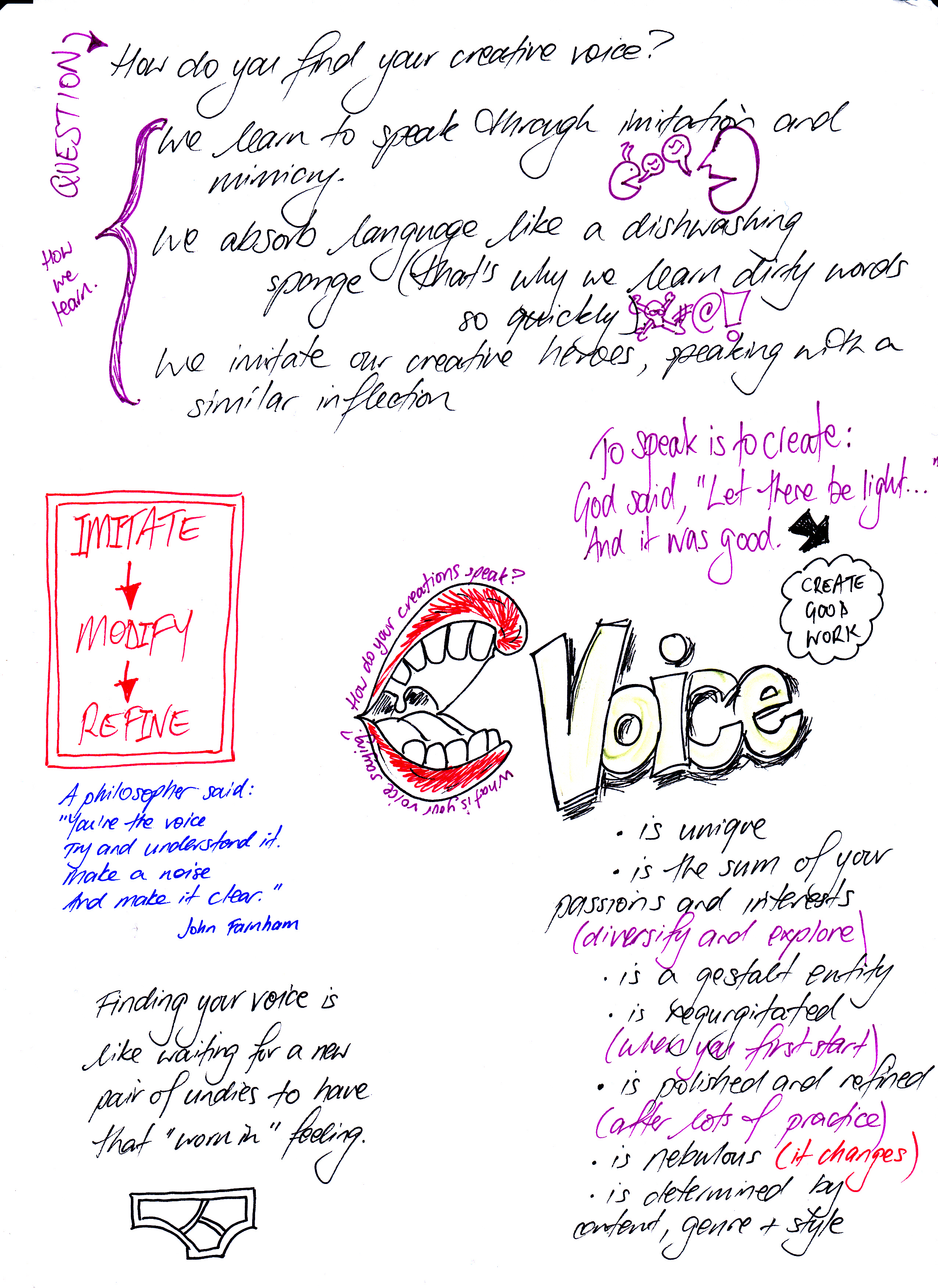
You’re the Voice

Another visual blog post about voice in creativity.

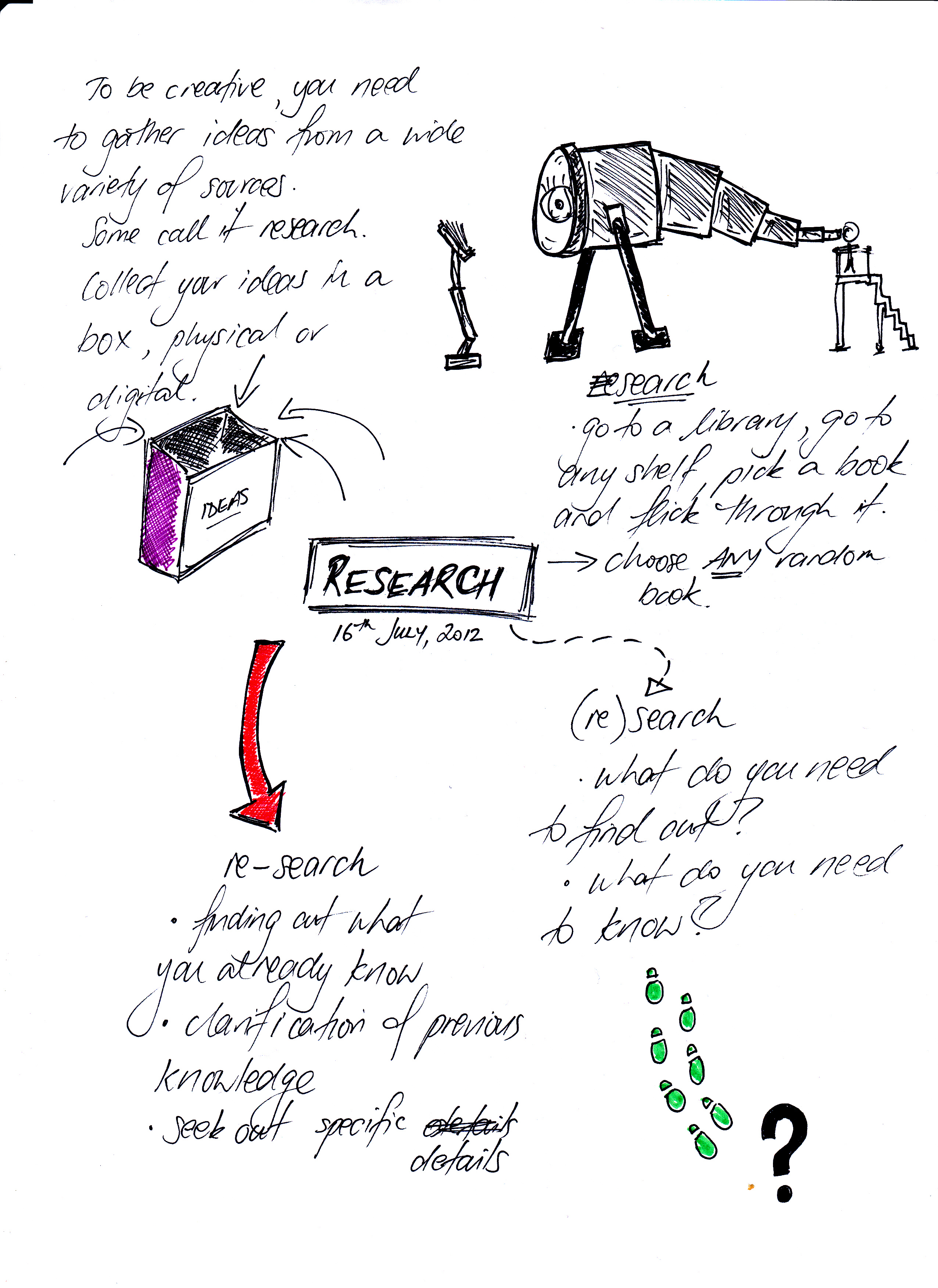
(re)search

A different blog post today inspired by Austin Kleon’s book, Steal Like An Artist. Go and read it.

I was picking apart the idea of research, and what artists do to slake their thirst for ideas.

I am not an artist, as should be evident, but I was simply exploring and deconstructing the word “research.”