Category Archives: Creativity

Community Over Competition

Screen Shot 2015-09-30 at 8.56.43 pm


I posted this yesterday and it was what I believe in.

I want to develop creative communities for amateurs and professionals where they can meet in real life and online to support and encourage, critique and develop, brainstorm and collaborate.

Gathering artists, musicians, writers from different creative fields to be a support network. We all tend to congregate with like minded artists (for me it’s writers) but how much more would we gain if we also met with other creatives to expand our thinking?

Creativity is about developing and championing community and the individuals within them. 

Who will you champion in your community?

Poetry Is Planned, Prepared, Edited, But More Often It’s Random

I love the spontaneity of writing, the burst of an idea committed to paper simply because you’re in the right place at the right time.

Then comes the hard work of making the piece sing.

Sometimes it’s playing with words as practice and having some fun. That’s what I did yesterday. 

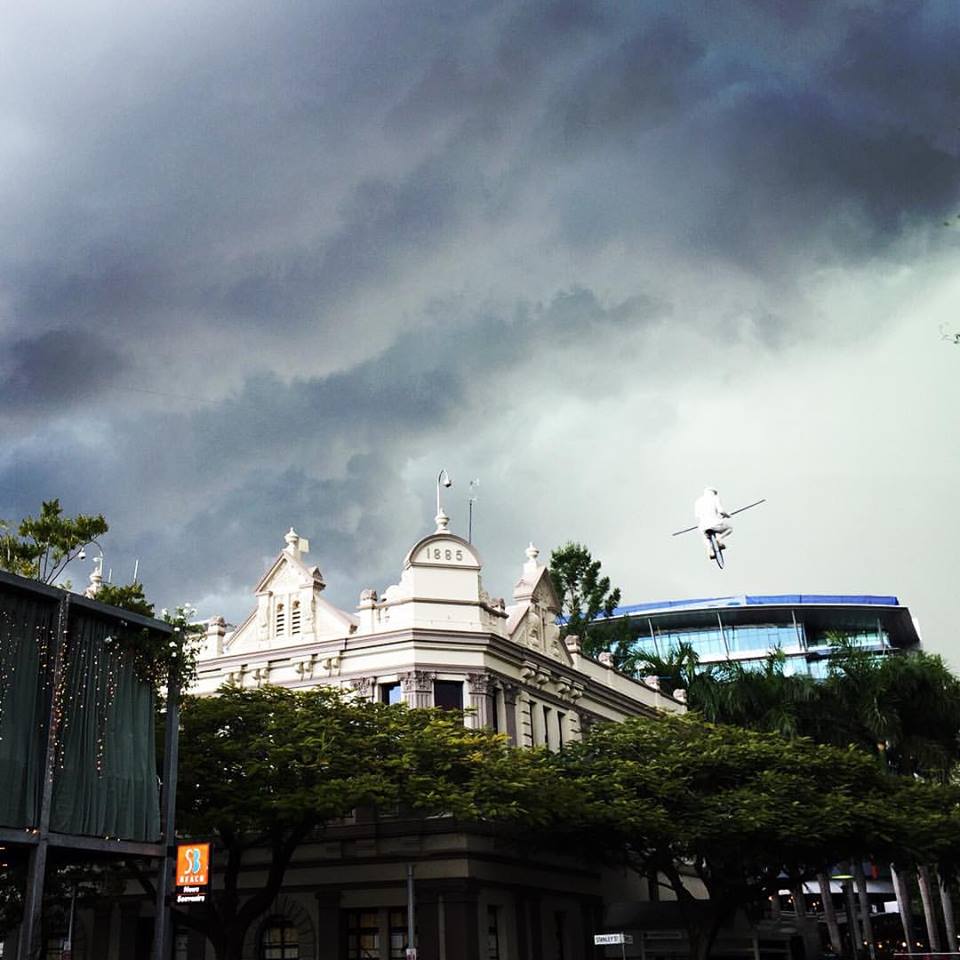
I took an image posted on a friend’s Facebook wall and scribbled out an idea based on his caption, “and then the albino human statue unicyclist flew off into the storm…”

Albino Unicyclist Statue

Albino Unicyclist Statue Photo by Rob Cook (@robgcook)

This is the result

the albino fiddled with the coffee
splashing froth and milk and sugar
a hastiness borne of watchfulness

he stirred, attacking the inside edge of the cup
the clink, clink, clink an echo of rain
spattering on the window
grasping the cup between his hands
the white of one shadowing the white of the other
his fingers tapped a thunderous morse code
paused
drained the cup
and then the albino human statue unicyclist flew off into the storm…

It was a random exploration and expression of an idea based on an image and its caption. 

Try it out as a writing activity, a way to practice and develop new ideas. As I posted recently, experimenting with Storybird does the same thing.

Experimenting With Storybird Part 2

One of the joys of being on holidays, apart from wearing tracky dacks all day every day and eating any bag of chips left lying around, is playing with new avenues for writing. I mentioned Storybird last week and presented a few poems.

I have been playing with a few more and present them here for fun.

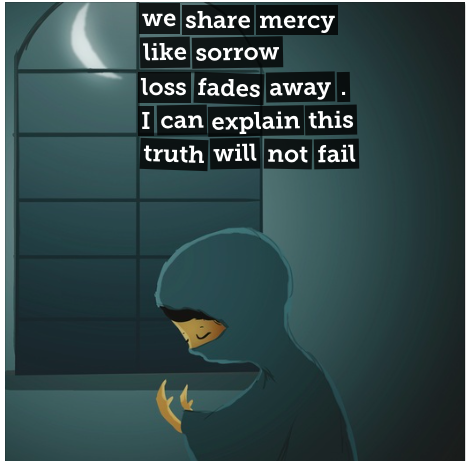
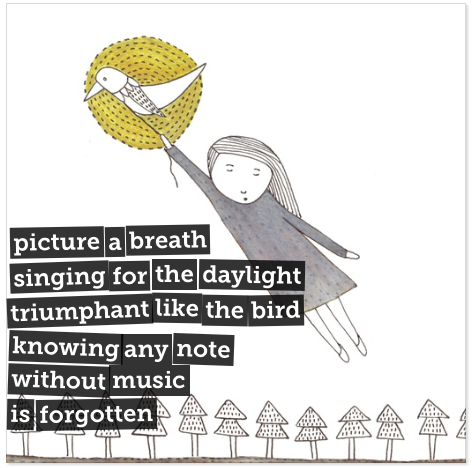
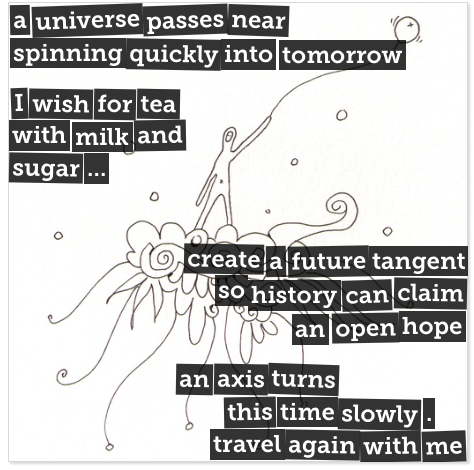
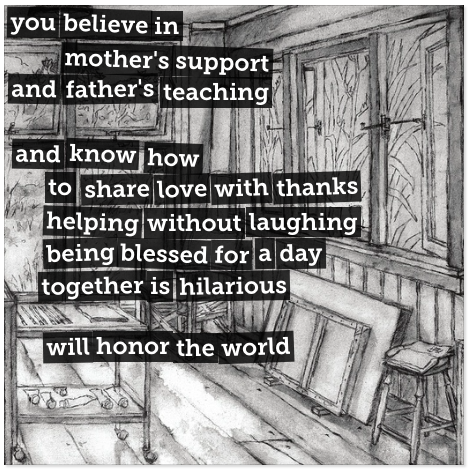
Screen Shot 2015-09-27 at 6.00.27 pm Screen Shot 2015-09-26 at 4.36.56 pm Screen Shot 2015-09-26 at 4.37.06 pm Screen Shot 2015-09-26 at 4.37.12 pm Screen Shot 2015-09-27 at 2.53.54 pm

Can I Get A Haibun Over Here?

Thanks to my pet friend, Sean Wright, I have been experimenting with haibun. It is a Japanese form utilising haiku and prose. The haiku is meant to be stand alone as well as illuminating aspects of the prose. They are brief and focused.

I wrote a few to play with the form, a way of practising. 

I have included two of them here. I used a third on Storybird as a picture book experiment and have had some good response to it. You can read it here: Pendulum

Exhalation

In the silent moment before the alarm makes its declaration of the birth of the day, I wait, awake. Outside my window the main road is silent, a petulant child trying to see how long she can hold her breath as if it can stop the day from starting.

spark of life
measured in two movements
light follows dark

The fanfare of the hourly news is followed by the burst of exhalation: the rapid, rasping, laboured breath of rubber on bitumen. It is a too-quick heartbeat, and if I lie here long enough I hear the rise and fall of cars. They lumber away, wheezing their way up the hill hoping the lights turn red to catch their breath again.

If I hit the ‘snooze’ button, I can pretend the news never happened and the breaths taken outside my window are nothing more than the wind playing with the trees shaking their thoughts onto the ground.

I want to see how long I can hold my breath until I find a pencil and a scrap of paper to keep tally. They will be filed in pockets of jeans, jackets and shirts, ensuring the stipend is not exhausted, and hoping the remainder can be carried over to the following day.

receipts kept in pockets
fall with autumn’s grace
kindling for the fire

Gunning Station

I only met you once in real life, officially, when I stood on your platform, my toes deliberately hanging over the edge, uncertain if a train was due to arrive.

Our first, formal introduction, where the firm handshake betrayed the frailty of the weatherboard spruced with a fresh coat of beige and capped with terracotta coloured corrugated iron. The blue Countrylink sign on each of the matching seats announced your name.

I felt the awkward familiarity of meeting a robust memory known only from photographs and second hand reminisces, seeing the aged decrepitude beyond. A faded discolouration, a tea-soaked sepia superimposed over the glare of a late winter’s afternoon.

shadow obscures
the printed timetable
a faded memory

A place as familiar as a Sunday lunch of roast lamb and vegetables, gravy thickened from the pan, linen napkins, silver cutlery and the lingering scent of tobacco rolled through your fingers. The smoke drifts up in curls like the steam engines who once waited on shunting lines now no longer connected.

Five generations of my wife’s family including her lived at some point in the stationmaster’s house on the hill overlooking the station. I look at the corrugated iron, rusting in the silence while paint peels off stone walls in a town redefining its face with brick veneer, upmarket cafes and gentrified real estate.

I walk the length of one platform, descend the ramp to cross the tracks and feel the rebellious rush of stepping over the rails. I half expect, even want, a passenger train or freight train to crest the curve and suggest that the pulse, however thready, exists for at least one more day. But none come.

I walk the length of the other platform and reach the boundaries of a circumscribed world defined by memories that are not my own.


Experimenting with Storybird

I came across the Storybird www.storybird.com website during the week and was initially reluctant to sign up for the free account (yet another log in to remember) but I gave it a crack.

You can do three things with it

  1. write poetry
  2. write a picture book
  3. write a chapter book/novel

You use the images as a stimulus to create a piece of work.

You can write for the following age groups.


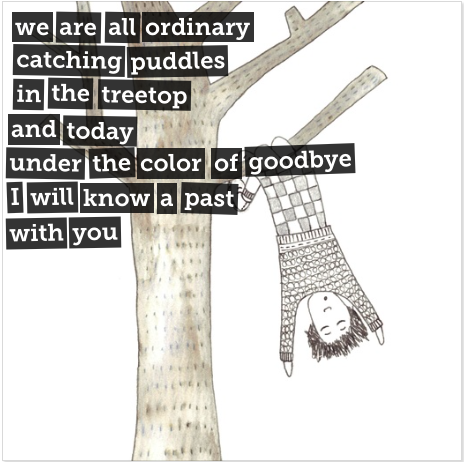
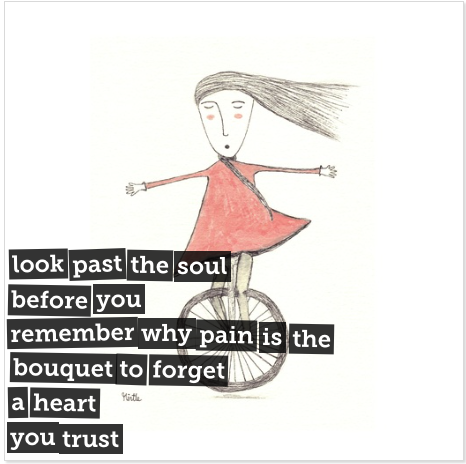
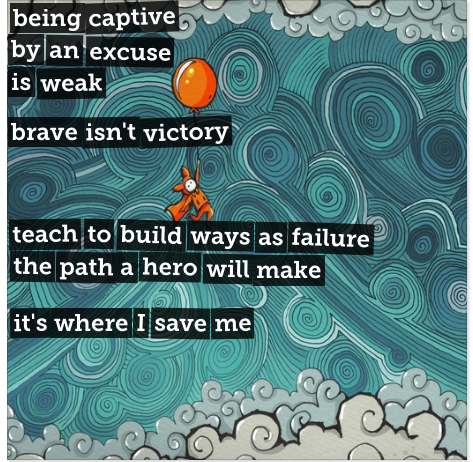
I began experimenting with poetry. You take a single image and are given a random selection of words. Think Magnetic Poetry for your fridge.

You are limited with the words you are given and this can sometimes be a frustration. However, the limited vocabulary makes you focus on what you can do with the words at hand. Sometimes the words are almost useless and you scrap it and start again.


These are some poems I have created.

Screen Shot 2015-09-23 at 10.03.44 am

Screen Shot 2015-09-23 at 10.03.53 am

Screen Shot 2015-09-23 at 10.04.04 am

Screen Shot 2015-09-23 at 10.04.11 am

Screen Shot 2015-09-23 at 10.04.18 am

I also have a picture book using a haibun(a mixture of prose and haiku) as an experiment. I was limited by the number of images provided to create a strong narrative.

Before a picture book is ‘published’ it is vetted by the site. I found my story had been approved within less than 24 hours. I suspect this is due to the broad audience range available.

I can see this being a good tool from an educator’s point of view as a way of helping students experiment with language, create their own stories with visuals already created (artists can also submit their work for use but I do not know how they are supported and/or paid).

It is useful for a 10 minute creative break, or something to spark your imagination if you’re feeling stifled.

I am not sure how far to go with it but for the moment it is a fun, creative way to pass the time and get you thinking and creating. It may lead to other works or ideas. Ultimately it’s another tool you can use to be creative.

What’s In A Pronoun?

The other day I scribbled this hastily worded poem onto twitter

She ties the night sky
loosely at her throat
a cape of stars trails behind
curls it around the boy
with the cape of sunshine
a gentle kiss

So far, so good.

However, it started differently.

The original line was “He ties the night sky/loosely at his throat”. To me it was reminiscent of children playing superheroes, tying an old towel or something similar around their throats as an impromptu cape (even if Edna Mole says, “No capes!”).

I was halfway through writing the poem, had an ending in sight, and I stopped myself and asked why I had used the masculine pronoun. On Twitter space is a premium and the inclusion of an extra letter could mean tighter editing in other places.

If I am writing poetry I will use pronouns in place of names for the sake of brevity and to give the persona a general facade for the reader to ascribe her/his own interpretation.

However, the masculine pronoun is not my default position; the content of the poem generally dictates my choice of gendered pronoun. Many of my stories focus on the feminine.

In this case, the use of the masculine pronoun was predicated by the content. Boys and capes are familiar tropes. The masculine is the dominant voice in our culture, to the exclusion of the feminine.

Therefore to change the pronoun is to change the emphasis of the narrative. 

There is nothing deep or meaningful on this poem but to change the pronoun order from masculine to feminine is to give agency and power, something our society needs to do more of.

Even in looking over the word choices in the poem as it currently stands, changes would affect meaning. If I used “man” instead of “boy” I alter the emphasis, the perception of the reading. Similarly, replace “boy” with “girl.” How would you read it now?

The written language is the best way we have to communicate, as inadequate as it some times. 

Are you conscious of the gender you ascribe to your work? How do you apply it?

The Texts of a New Generation


With a gentle nod to the advertising of the 80s and 90s in the title of this post I want to explore the idea that during your formative years, especially teens to early 20s, what you consume in terms of culture (music, film, tv, magazines etc) shapes your decision making processes and actions.

It was sparked by a story I read where the music and lyrics of the 70s, in particular Pink Floyd, David Bowie and the Ramones, shaped the zeitgeist of the culture and in turn shaped the decision making and perspective of the main character to the point when he had reached his late 30s that it was almost too late.

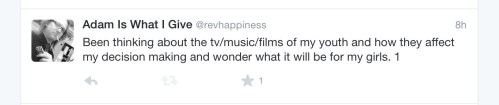
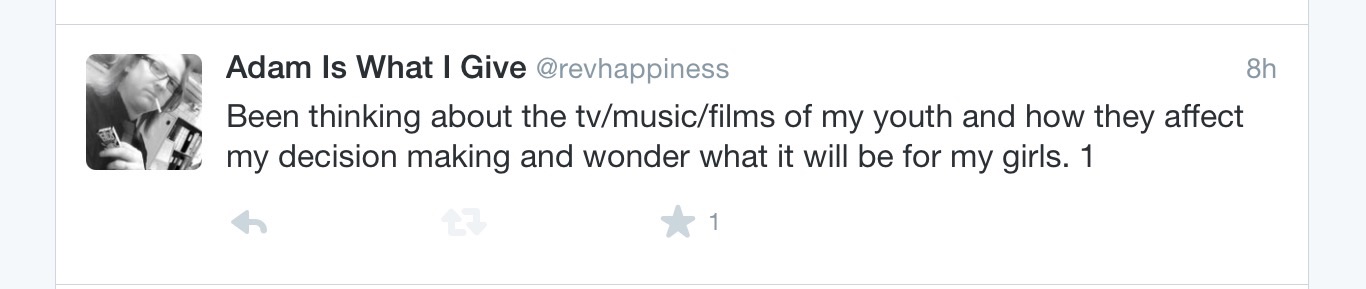
This sparked a brief twitter mind dump, collated here for your perusal, about what I watched, listened to, and consumed in my youth, that of the late 80s and early 90s. This in turn made me wonder what my girls (aged 10 and 8) are watching and listening to, and will be watching and listening to (right now my wife and I have influence and decision making over what they watch and listen to but in the years to come they will develop autonomy for their consumption of culture). 

image

image

image

image

I am a child of the 80s and 90s, the last of Generation X. I grew up listening to thrash and speed metal, hard rock, U2. I watched Friends, Mad About You, early Simpsons, The Cosby Show, Family Ties, Seinfeld, X-Files, ET, Raiders of the Lost Ark, Terminator 2 and much more.

These are the cultural products I consumed and in turn have shaped my thinking and decision making. The catch cry of that period was a balance between Gordon Gecko’s mantra, “Greed is good” and the turbulent introspective narcissism of grunge, the highlighting of the individual as greater than the whole and you don’t need nothing but a good time (hair metal of the 80s/90s was priceless).

Where does that leave us now, in the throes of middle age, with children and a mortgage, and perhaps a sense of disillusionment? Have the promises of our youth been fulfilled or is it still a romantic notion that will never be? 

Every cultural touchstone has a family tree, a connection to the past from where it developed its departure point. We wouldn’t have South Park, Family Guy or American Dad if it wasn’t for The Simpsons. 

I see my students consuming the pop of Katy Perry, Rihanna, Kanye; the sexual mores of Sex and The City, Girls, Modern Family. Where will they be in their middle age after feasting on the values of modern pop culture?

Again, I’m not positing a particular point of view or have any clear answers (although there are no doubt cultural commentators and sociologists who study this and have better knowledge; I’m merely brainstorming).

Here’s the takeaway: be a critical consumer; think about the attitudes and values a text is communicating. Do you agree with it or not?

And for creative people, what does that mean for us in terms of what we create?

  • Are we supporting or subverting current values, attitudes and mores?
  • Are we condemning, critiquing or questioning the focus of our culture?
  • Are we aiming to improve or develop our culture, because, yes, art/film/literature has a point.
  • Are we creating for the present or for the future? This is an important question as I think our answers encompass both. We create for the now, a reflection on the where we are at with our thinking, and for the future as a marker of what we wish to become as artists.

No answers. More questions. A starting point for a conversation. Have at it in the comments. 

On Fear and Its Perception

“I write in order that I may travel with my soul into the places I fear and I may have a friend to share the journey.”

I wrote and posted this on Twitter the other day and very soon after clicking the “Tweet” button I questioned and doubted the validity and veracity of my statement.

I have written before about how I believe fear holds me back from exploring the creative life I want. The above statement is in contradiction to my manifesto and vision for why I write.

Or is it?

I have no clear answer; more a series of random reflections which may or may not lead to a clear answer. It’s like cleaning your glasses only to have them dirtier than when you started.

What follows is simply scraps of thoughts about what I wrote and differing perceptions of it. I am not sure I am right; nor am I sure I am wrong. I will contradict myself, provoke myself, push and question myself. And you can have your addition in the comments.

  • Writing is about exploring your own fears; the fears you have of yourself and of the facets of life you find frightening.
  • Fear is lacking an understanding of the unknown, the different, the obtuse, the unfathomable. To understand is to give a name to the fear; to know its place and its where it resides.
  • My reader is the companion on the journey. They travel with me through the words on the page. At some time in their life they may, or may not, have experienced the same fear.
  • What I write may bring comfort to know someone else has experienced the same fear; it may trigger a response; it may have no effect because the experience related in the story is not connected to their own life experiences.
  • The opposite of fear is… what? Hope? Vision? Clarity? Discipline?
  • The same chemical that is the basis for fear, adrenaline, is the same chemical that is the basis for excitement. Is fear the way our bodies tell us something new and exciting is about to happen?
  • Defining fear as it relates specifically to yourself is the first step. What am I afraid of? Is it personal fear, an internal dialogue, or an external fear of something random outside your control? Is there a topic or issue you do not want to explore because of the fear it generates for yourself or fearful of the consequences of exposing it?

So, no answers. Definitely more questions but I know where my thinking is leading me.

If I rewrote my tweet, I would explore another aspect of why I write, another permutation of thinking about creativity and its purposes.

“I write in order that I may travel with my soul into the places I seek to understand and I may have a friend to share the journey.”

“I write in order that I may travel with my soul into the places I find comfort in and I may have a friend to share the journey.”

“I write in order that I may travel with my soul into the places I want to light a flame of light and life and I may have a friend to share the journey.”


What would you say?

The Parallel Between Writing and Drumming Part 2

A little while ago I wrote about the parallel between drumming and writing and I’d like to extend the idea with a few more examples.

I’ve been having a bit of dig into U2’s back catalogue lately and really enjoying the drumming of Larry Mullen Jnr. He is not touted as one of the world’s best drummers but he has some inventive drum parts that are fundamental to U2’s sound. It’s a unique voice.

The same applies to writing; each writer has their own voice, their own turn of phrase and vision of seeing the world that is evident in their work.

Here are my Top 5 U2 songs where the drum part is an integral feature, a way of finding and expressing voice. For me as a writer and drummer, sometimes the simplest groove can speak volumes but then it’s the little touches and flourishes that make your work stand out from the rest.

5. Pride (In The Name of Love)

There are 2 touches that I love in this song. The first is the floor tom hit just after the snare. The other is the snare roll into the chorus. Nothing flash; just solid and accented beautifully.

4. 40

I’m a sucker for a sixteenth note pattern on the hi hat (played on one hand) and this song delivers. It provides the motor to the song, accompanied with quick, open accents, and 32nd flourishes. Tasty.

3. Sunday Bloody Sunday

A military march played on hi hats and snare. Crisp, focused and aggressive. 

2. Bad

I love this song for its build. The kick drum is the foundation while the snare and hats become layers as the song builds to its climax. There are echoes of Sunday Bloody Sunday (and you can also hear the 16th note pattern feature heavily in other U2 songs like Where The Streets Have No Name, All I Want Is You, Sometimes You Can’t Make It On Your Own. It’s a feature of Larry’s drumming and I love it).

1. With or Without You

The pattern on the floor tom, the snare hit and the open hi hat bark. Simple, elegant and brilliant.

I have my drumming heroes and my literary heroes. I am influenced by what they play, what they write, and through experimentation, amalgamation, inspiration I find my own voice.

How do you find your writing voice? 

Why Do You Write? A Revision

Almost four years ago I wrote this post, The Reasons Why. It lead to Light My Way – A Creative Manifesto. It was first and foremost an exploration of why I write. It also examined why others write. 

This is my manifesto:

I write because I want to tell a story, but not just any story.

I write because I want to tell the story of those who are not heard.

I write because I want to tell the story of those who cannot speak.

I write because I want to tell the story of those who are disempowered.

I write because I want to tell the story for those who cannot.

I write because I believe that telling a person’s story is integral in understanding who they are.

I create art to speak into the darkness, that I may be a light for others to ignite their own flame and walk clearly.

The other night I was talking with my collaborator, Jodi, via Skype and she was discussing her social media sabbatical. Part of the sabbatical involved a three-week camping trip to the middle of nowhere in Central Queensland, without phone reception. It allowed her time to revisit the fundamental question of “Why do I write?” 

For her, the stripped back existence allowed her to return to what it was about writing that inspired and motivated her.

Every so often we need to pause where we are and revisit why we write and see if it still aligns with the vision we had. It may need a revision, a realignment, a reappraisal, a reworking.

If you’ve moved away from the core reason for writing, you’ve lost vision.

I returned to my creative manifesto and asked if these were still the reasons I wrote. I am pleased to respond in the affirmative. It’s a good check, perhaps once every six months or once a year, to reevaluate why you write to ensure you are aiming to produce the best work you can.

Why do you write? Have you made a revision of your purpose?