Category Archives: Creativity

Creativity is the Mother Tongue

Victor Wooten delivered this talk to TEDx Gabriola Island. He is a remarkable musician, master of the bass and a genuine and erudite educator.

The focus of his talk is music as a language. Listen carefully and you will learn.

I want to take his words and comment on them as they apply to other creative arts: writing and art.

Creativity (writing, art, film and music) is a language. Learn to speak a different tongue. Or in some cases, we need to relearn to speak our mother tongue.

Victor Wooten – Music as a Language (click link to view the talk)

I have taken excerpts from his talk, either quoted directly or paraphrased, and extrapolated their application to other artistic endeavours such as writing and art.

Your first language is not taught. People spoke to you. You were allowed to speak back – creativity should be learned with your mother tongue. Give children pencils and paper and allow them to speak in their own way. Give yourself pencils and paper and find your mother tongue again.

Beginners are not allowed to play with the masters – in music, the beginner and the amateur are separated from the genius of the master, able to watch but not participate. In all aspects of creativity we should learn from and participate alongside the masters.

As a baby, you’re jamming with language. Not made to sit in a corner and practice; not corrected when you’re wrong. Even to the point your parents learn the new way of speaking. You remain free in how you talk. When you could hear it (language), you started learning – Language is a freedom we have, a freedom of expression. Creativity is another freedom of expression. Learning language is immersive; we are around it all the time and learn the nuances from what we hear.

Growing up in Hawaii, Victor learned to play not by being given an instrument, but by being played to. A plastic stool was there for him to sit on and so he sat and listened. When older he was given something to hold – even before we understand what creativity is, how we should hold a pencil or a paintbrush, we must immerse ourselves in creativity activities and involve our children so they too, learn the language. When we surround ourselves with creativity we internalise the language.

Music is a pure voice. We want to teach the rules and the instrument first. We teach to play the instrument before they understand music. Learning to play music, not the instrument. Knowing the phrases, tones etc, learning – when we instigate boundaries and restrictions, demonstrate how-to or chastise for what we perceive as incorrect, we must stop and let the creativity flow from within. When our children see, and when we see, the joy flowing from the creativity within, we understand the process. The rules and techniques are there to serve as a creative conduit, not the tool itself.

When he was finally given a bass to play, Victor was playing to songs he already knew. He has listened and internalised the music. Therefore music flowed through the instrument. He was musical first, learning to talk not about learning the instrument first. It’s about what you have to say. He learned how to speak through his instrument – when our children have been given opportunity to be creative with great freedom, given the chance to express themselves, they will find their voice to speak clearly.

Practicing works but it is a slow process – practice alone for the sake of practice will develop skills but we will learn more when we participate in community and learn to speak with our own voice.

Children are born with freedom. A lot of us are taught out of our musical freedom when we’re first given a lesson because a teacher rarely finds out why we’re there in the first place. Playing air guitar where there’s no right and wrong. It’s not about right and wrong notes; they’re playing because it feels right

A woman said to me, “I’m Ella Fitzgerald when I’m in the shower.” And she’s right. The freedom we have a child is grown out of us, but we need to find a way to keep the freedom. Approach music like a language and allow it to keep that freedom, to keep the smile on the face, and not taken away by lessons – Creativity is expressive freedom and we would do well to instil into our children the freedom of creativity.

What does the world need with another good musician? *insert own creative choice here* It has become a lifestyle. To be a good musician, you have to be a good listener – this is good life advice. Choose your words wisely before you speak, or better still, saying nothing at all. It’s not all about you, or me; it’s about the people around us.

If you want music to come out of you, out of your instrument, you have to put it into you – do not let the well run dry. Fill it at every opportunity from whatever source.

If I use my greatness in the right way, it can help others rise up. If you’re on a pedastal, don’t come down, bring them up so they can see and they’ll grow faster – help others to find their creative voice if they have lost it. Create community to help others grow. Better still teach your children to be creative so they never lose their voice.

We speak our mother tongue verbally and artistically.

For some, we need to find our voice again.

For others, it is strengthening their voice.

Creativity is our mother tongue. Let people hear your voice.

Walking Lonely

The walk of the lonely brushes
shoulders with the multitudes
contact without connection
as silence walks besides
hand on shoulder

Creative Dichotomy

Creative Dichotomy

Make art from the beautiful and the ugly;

From the joyful events of life and from the circumstances marked by sorrow.

Make art to evoke laughter and to break someone’s heart;

To provide fun for celebration and provide solemnities for mourning.

Make art to teach and inform, and to prick the conscience;

To elevate the humble and bring down the proud,

To encourage and to chastise.

Make art to provoke anger and rebellion;

To reflect and critique, to warn and admonish.

Make art to give voice to the voiceless and to silence the mouthpieces.

Make art to reflect and embrace the ordinary and the extraordinary.

Create Useless Beauty

Create Useless Beauty

Take a gander around the natural world and you will see a remarkable diversity. Even in the depths of the oceans where the creatures are nightmare fodder there is incredible diversity and beauty.

I’ve had the phrase “useless beauty” stuck in my head since I read Franky Schaeffer’s book, Addicted To Mediocrity (*) as a teenager. In reference to the diversity and beauty of nature he cited the jellyfish as an example. It exists within the ecosystem simply because it is. It exists because the creator designed it to be there. Therefore, it is beautiful.

What I mean by “create useless beauty” is this:

Create a piece of art because it has no other function than to beautify your presence, illuminate your thoughts, elevate your attitude, satisfy your creativity, to please only yourself.

Create a piece of art you can throw away or give away

Create a piece of art you can leave behind on a park bench or a cafeteria table.

The Beatles sang, “I heard the news today, oh boy.”

Every day we are surrounded by examples of the negativity, despair, the depths of depravity mankind can conjure and inflict upon one another on a daily basis.

However it does not take much searching to find the beauty of humanity in a shared experience of creativity.

And it begins with each of us creating useless beauty.

  • Write a short story scribbled on a Post It Note
  • Draw a random sketch on the back of a serviette
  • Record a hastily composed melody on your phone
  • Learn a favourite song, record it and post it to your blog or youtube
  • Fold an origami flower or a crane or a boat
  • Draw marginalia in the borders of the book you’re reading
  • Deface magazine pictures with a permanent marker
  • Take a picture a day (of the same spot, of something interesting you see about your day, but please don’t make it a selfie unless you’re making a documentary about yourself)
  • Decorate your office desk (or someone else’s desk).
  • Make a model aeroplane like you did when you were a kid.
  • Bake a cake (packet mix cakes are perfectly acceptable)

Make it something you would willingly give away, throw away or delete (don’t throw away the cake, eat it. Better yet, share it with others over a cup of tea).

Creativity is about communication.

Communicate first with yourself then communicate with others.

Practice random acts of creativity.

Create useless beauty.

(*) For those of you who have read “Addicted to Mediocrity” I realise I am taking a different angle to what Schaeffer was proposing, that of excellence in the arts. I believe in excellence in the arts, but I also believe in creativity as an integral part of the human experience. Excellence comes through refinement and dedication, learning and education in the arts. Schaeffer is addressing a cultural issue; I am addressing the need for creativity to be an important expression of our humanity.

The Sound of Noise and Silence

The Sound of Noise and Silence

Go placidly amid the noise and haste, and remember what peace there may be in silence – Max Ehrmann, “Desiderata” (Desired Things)

Creativity is birthed in the chaos of noise and the silence of meditation.

As a drummer, I love sounds. Four limbs working together in synchronous co-ordination to create a pattern whether it’s a beat, groove or fill.

I create by reading the chart and playing the pattern.

But sometimes I forget something. I forget about the spaces between the notes, the gaps and silences. It is as important to understand the correct notes to play as it is to understand the silences between the notes.

It doesn’t matter if the tempo is slow or fast; if the beat is simple or complex, the gaps and silences are just as important. I am conscious of the silent movement of my hands and feet before they create a sound.

Noise in Creative Production

I can create out of the noise and I can create out of the silence.

Noise is the default creative setting: white noise, background noise, conversational noise. However, it’s where ideas are birthed and generated. The noise in the to and fro of conversation and found in the noise of information I sift through in my tweet stream.

As a drummer, I love sounds. Out of the noise something musical is created.

Silence in Creative Production

As a creative person I also need silence. I sit behind my drum kit and visualise the movements of my hands and feet, imagining the sounds I create when I strike a drum or cymbal and the pattern I am creating. In a similar way the sportsperson visualises the perfect throw, pass, stroke, movement in silence.

For writers, musicians, artists, dancers, filmmakers, there is a need for silence.

Silence is not a state of nothingness.

Silence is a state of meditation and mastication of ideas.

Silence requires time.

Silence requires patience.

Silence requires meditative focus.

Silence cannot be rushed.

Silence allows the mind to become still.

Silence brings introspection, clarity and solutions.

Silence restores strength and refreshment.

Silence is engaging with the moment as it is now.

As a writer, I need moments of silence to think through plot or characterisation, themes or symbolism, dialogue or description. I need moments of silence to compost ideas, turning them over in my mind like a koan.

Out of the silence and stillness comes creativity.

Find your place amongst the noise and the silence.

Expressing What’s Inside You Creatively

Some say there is a novel in every one of us, trying to get out, waiting to be written.

I say that’s wrong.

Not everyone is a writer, nor is everyone a musician, nor is everyone an artist.

But…

I say there’s a story within every one of us.

That story can be expressed:

  • as a novel
  • in a poem
  • through photography
  • in film
  • in music
  • via singing
  • performing a dance
  • with paint and brushes on a canvas
  • by creating a sculpture
  • cooking new meals
  • by designing a garden
  • creating a website
  • giving someone a new look with a haircut
  • on a fashion catwalk
  • in politics
  • in philosophy
  • in a scientific environment
  • through the skills of oratory…

The possibilities are endless.

You need to know your story.

You need to know how to best express your story.

Tell your story…

…your way.


Folded Peace – A Poem

Folded Peace

Folded Peace

Were I to fold one thousand pages

Into one thousand cranes

Will I have erased enough

Print onto my fingers

That I may wash it away?


I fold despair into wings


Each page I fold

Is a prayer for peace

A flock tied like a kite’s tail

To let serenity slipstream

Over a tattered fringe of feathers


And give flight to hope

Create Because It Counts

We create not for fame.

Not for money.

Not for recognition.

Not for glory.

Not for the praise of others.

We create because it counts.

This principle came out of an article on pianist James Rhoades, “Find What You Love and Let It Kill You” from The Guardian newspaper in the UK.

Create because it counts.

James put himself through an extreme, almost ascetic regime: “no income for five years, six hours a day of intense practice, monthly four-day long lessons with a brilliant and psychopathic teacher in Verona, a hunger for something that was so necessary it cost me my marriage, nine months in a mental hospital, most of my dignity and about 35lbs in weight.”

I do not connect with the extremism (yet I can see the validity in it if you want to take something as far as you can go) but I do connect with the emotional response he has when he has put in the time and practice to learn and master a new piece of music; I apply it to writing.

“And yet. The indescribable reward of taking a bunch of ink on paper from the shelf … Tubing it home, setting the score, pencil, coffee and ashtray on the piano and emerging a few days, weeks or months later able to perform something … A piece of music that will always baffle the greatest minds in the world, that simply cannot be made sense of, that is still living and floating in the ether and will do so for yet more centuries to come. That is extraordinary. And I did that. I do it, to my continual astonishment, all the time.”

This is what counts: the emotional connection in creating, and in mastering a skill.

It is about the experience of joy in any creative endeavour. The joy in folding an origami crane for the first time; completing a short story; learning a new chord for guitar; finishing a water colour painting.

Doing it because it brings you a sense of completeness and wholeness as a person.

We do not have to go to the same extremities as James but his encouragement goes further to explore the “What if’s…?”

What if we used our time more wisely? Spent less time wasted on social media and engage in a creative activity? Spent a little bit of money to start a creative pastime like painting or photography? Knit? Crochet? Took our phone, shot some footage and made a short film? Used our time to engage with others in a writers’ circle? Wrote the story or novel we have been aching to tell for decades?

What if…?

So many possibilities. So many options.

And we create because it counts for something.

It counts for the children whose father draws a new picture on their lunch bag EVERY SINGLE DAY.

It counts for the short story writer, novelist or picture book writer creating worlds for others to inhabit.

It counts for the musician sitting in a cafe playing her guitar to six people.

It counts for the grandmother making a quilt as an heirloom for her grandchild.

It counts for the child who discovers the joy of the world through the lens of a camera and documents his journey to and from school every day.

It counts for the dancer at the bar, perfecting a pirouette.

It counts because we need stories and art and music and film and theatre and dance.

Creativity liberates your spirit. It enriches who you are, and the people who engage with your work.

Creativity is a mentality of giving; giving to yourself and others.

Creativity costs in terms of commitment, of sacrifice, of dedication.

You create because it counts.

What Happens When You Reach ‘The End?’

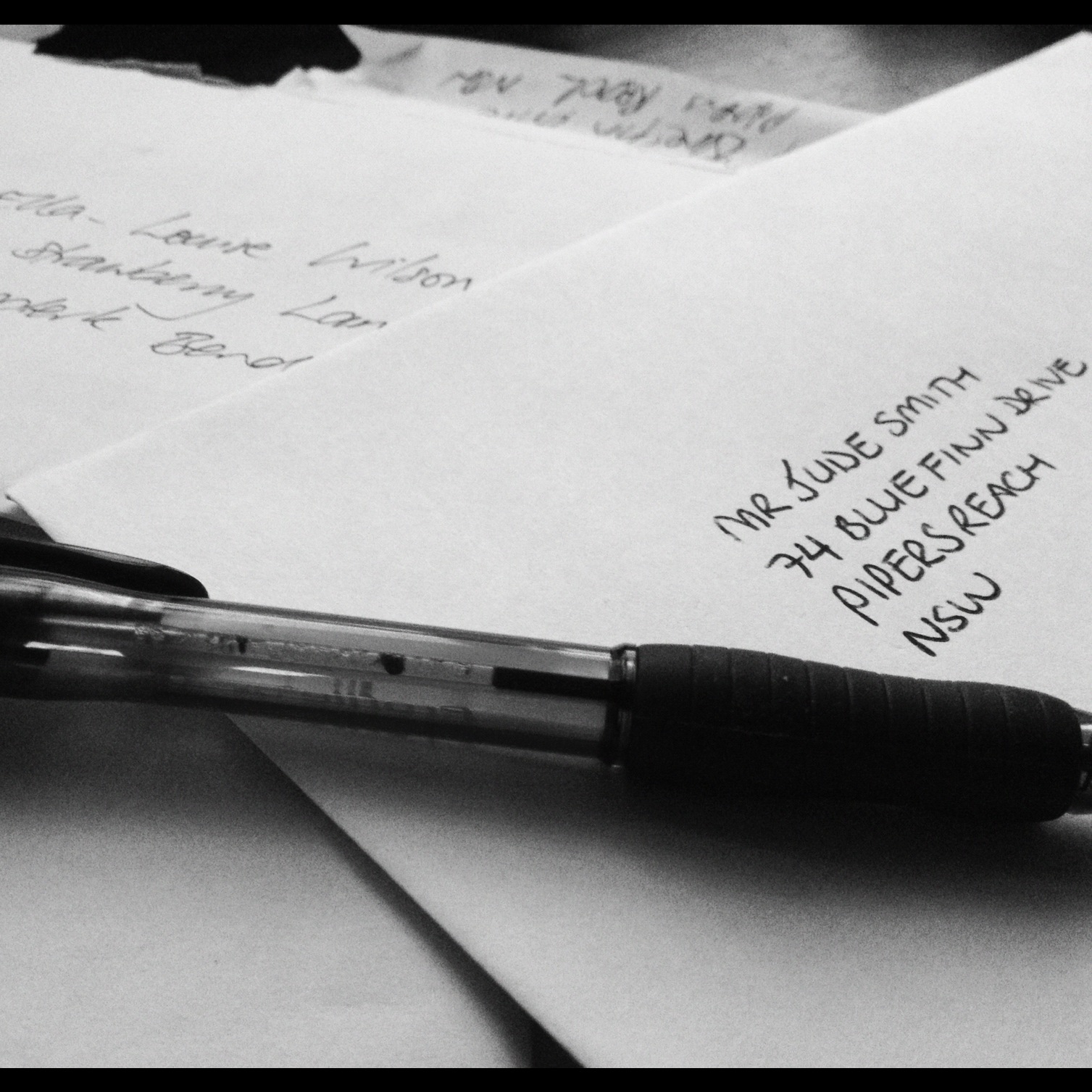
In the early hours of Wednesday morning, my collaborative writing partner, Jodi Cleghorn, and I finished writing the first draft of our epistolary narrative Post Marked: Piper’s Reach.

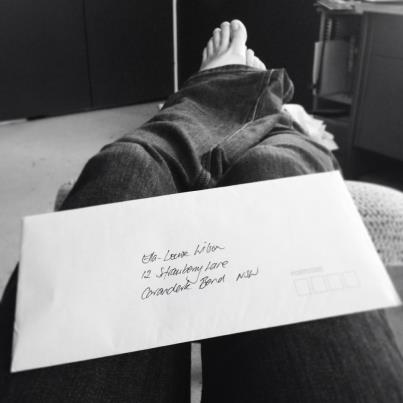
We are separated by distance, living in different states in Australia and have written this novel by handwriting the letters and sending them via the post. Yes, we wrote 85,500 words BY HAND.

Fortuitously, for the first time we were able to sit down together in the one place and write the final installments.

If you want to know what Post Marked: Piper’s Reach is all about, here’s the blurb:

In December 1992 Ella-Louise Wilson boarded the Greyhound Coach for Sydney leaving behind the small coastal town of Piper’s Reach and her best friend and soul mate, Jude Smith. After twenty years of silence, a letter arrives at Piper’s Reach reopening wounds that never really healed.

When the past reaches into the future, is it worth risking a second chance?

Post Marked: Piper’s Reach is an ambitious collaborative project traversing an odd path between old and new forms of communication, differing modalities of storytelling and mixed media, all played out in real and suspended time. The project has at its heart a love of letter writing and music.

The letters are handwritten and posted in “real time.”

“To send a letter is a good way to go somewhere without moving anything but your heart.” ~ Phyllis Theroux

photo 2 copy

And now we have written “The End.” The story is finished.

This is the first significant piece of writing I have completed apart from flash fiction. It is the first novel I have written (I have another currently in the works that I began last year but have put on hold for a number of reasons).

How do I feel?

I feel excitement at having completed the novel; joy and relief; a sense of accomplishment because of what I have completed, and with it also, I feel sadness.

Coming to the end of this project brings with it a whole series of conclusions and endings.

  • The ending of the narrative and the story of Ella-Louise and Jude.

We have had such an emotional investment in our characters and their intertwined lives that coming to ‘The End’ is like the passing of a dear friend. I wrote the character Jude while Jodi wrote the character Ella-Louise and for the better part of 16 months we have lived with these characters. We keep saying we’ll need some therapy to get through the tumultuous times our characters experienced. And vicariously we have too, reading each letter through the lens of our character and as a reader.

We were sitting at opposite ends of my dining room table, writing the final lines. When we finished, we handed them over to be read. There were tears, stunned silences and a gutted feeling that it was all over.

  • The end of the interaction with our small, but dedicated, core of readers who we dubbed “Posties.”

They engaged with the characters and the writing, commenting on the weekly letter, discussing the characters’ motivations, arguing over what should or should not happen to the characters.

Over on the Facebook page we had long conversations with the Posties, ran contests and trivia, and had a whole lot of fun.

And we will feel the sorrow of the ending all over again when our readers get to ‘The End’ in about 8 weeks’ time.

  • The ending of the collaborative partnership.

Jodi pitched the idea to me in January, 2012 after we met for the first time in real life in December the year before. She runs eMergent Publishing and I had the privilege of working with her to have my first two short stories published. Our friendship developed and grew as we worked together, and when we met in real life it was like we had known each other for decades.

After the initial pitch we spent three days brainstorming by text and the first letter arrived later that month.

Since that time we have worked closely together during this project and it has been an exhilarating journey.

It was not a traditional collaboration; rather than plan and talk through ideas on the plot and structure, we let it develop in an organic way in what we came to term the “No Spoilers Policy.” Without discussing plot and ideas it kept the writing, and anticipation, fresh as we waited for the arrival of the postman to deliver the next letter.

We spent hours talking and deconstructing each letter after it arrived and we had read it. You can hear about our process of writing and what we learned as writers in an audio interview we did with Sean Wright (@SeandBlogonaut) over on his blog.

But our collaboration (but not our friendship) has come to en end, and with it, a strong sense of sadness.

img_1100

After ‘The End’

With the writing of ‘The End’ comes a feeling of finality (at least temporarily), that the initial phase of writing and drafting is finished and complete. Yet the end of a draft is only one step in the path to publication.

Now comes the time to put it all aside for a while, let it sit and be forgotten about until it comes time for editing.

This is then followed by synopsis writing, query letters and the like; but that’s in the future (we have big dreams for this novel).

After ‘The End’ comes a new project. For me it will be a novella, some short pieces, a picture book and a multimedia project.

Envelope Addressed

What Next?

‘The End’ does not mean I stop. It means I begin the next step in the process. I begin writing new material. I begin editing other projects before I return to the manuscript of Post Marked: Piper’s Reach and polish it ready for submission.

Reaching ‘The End’ is only one part of the process, because for a writer, there is always another story to tell.

Tempest’s Questions – A Poem

Tempest’s Questions

Tempest's Questions

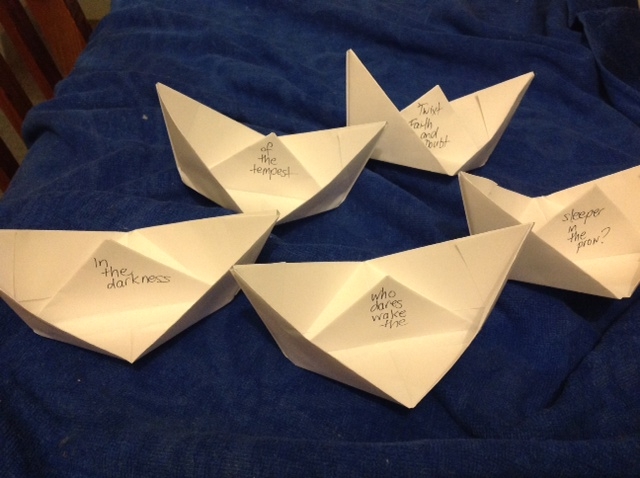
In the darkness

of the tempest

twixt Faith and Doubt

who dares wake the

sleeper in the prow?