Category Archives: Creativity

Creativity and Post It Note Philosophy

Today is the first of September. It is the first day of Spring in Australia and it is Father’s Day. Symbolically it is a time of new beginnings, of creation, of celebrating new life.

I firmly believe in the creative dynamic is a part of everyone’s life; it is not the sole domain of the writer, the artist or the musician, the film maker or dancer. Therefore for the month of September I will post a Post It Note with a statement about creativity. It will be an exploration of what I believe creativity is, and how it can be a dynamic part of everyone’s existence.

Please share and encourage people to find their creativity.

Here’s the first one.

PIN Philosophy 1

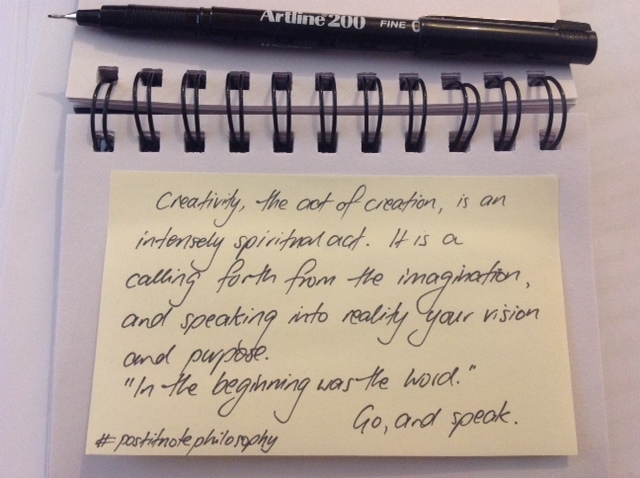
Creativity, the act of creation, is an intensely spiritual act. It is a calling forth from the imagination and speaking into reality your vision and purpose.

“In the beginning was the Word.”

Go, and speak.

Letting Go in Creativity and Writing

Letting Go in Creativity And Writing

As a writer I look for great examples of creativity and approaches to art, whether it is writing, art, film, photography, dance, as sources of inspiration, technique or information.

I came across this video, initially drawn to it by the chalk art, but listening to the artist’s approach I saw it had applicability to writing. It confronted me about how as a writer I am attached to my words. It made me view the permanency of my words in a different light and to become less attached to them.

Watch the video here: Hand Drawn Chalk Art

As a writer, I want the words I write to have an existence beyond when I write them.

This video has taught me to let go of it, to understand I can erase and rewrite.

The process becomes important; the writing, drafting and editing until what I have left is a permanent record of what I do and say.

But even then I cannot be too precious about my words. When my words are read they will be interpreted, reinterpreted and misinterpreted; quoted and misquoted. And I’m cool with that.

For example, I wrote a piece of flash fiction, “The History of a Relationship As Told By A Mix Tape of U2 Songs.” It is in the reader’s interpretation of the song titles to make meaning. It doesn’t require knowledge of U2 songs, but if you know them it does enhance the story. I could have used almost any other band’s back catalogue for the same purpose; now I am imagining a story told by Pink Floyd song titles.

I have quoted some of the statements made in the video and make their connection and application to writing and the writing process.

“With paper, you’re using white paper or a toned paper and you’re going darker in value, which means you’re going black. On the chalkboard it’s already black so you’re working in the opposite way; you’re bringing your highlights to the front.”

The white paper or the white screen of a new document is often a terrifying prospect for the writer. Once you have reached “The End” of the first draft you are confronted with the darkness of the page inscribed with words. The editing process is like drawing on a chalkboard, bringing the highlights to the front, seeing the essence of the scene and the story and paring away what is not required.

“It’s about the biggest shape to the smallest shape. It’s about the big picture, not about the smallest detail… What is the biggest shape you see?”

Whether you plan everything in minute detail or let the wind blow past your bare butt cheeks as you fly merrily along where the plot and characters take you, there is still a simple premise and focus of the narrative. Developing a log line or brief statement about your work in progress means you have the really simple shape outlined. From there it is filling in the blanks and adding detail.

“Dynamic sketching – it’s about the interpretation of really simple shapes.”

When I am writing a new story, I like to know the end from the beginning, and have some of the points in between mapped out. This gives me the big picture, the biggest shape of the story. If I get focused on the little details, the motifs, symbols, characterisation, I lose sight of the big picture. Each of these details is an interpretation of the simple shape of the story arc.

“Because I enjoy the process more than the finished product, I can erase, I can let go of it… When you can let go of it, you can give yourself to it, give it focus.”

This is what first drafts are for. They are called ‘brain vomit,’ ‘word explosions,’ ‘smearing the alphabet with wild abandon.’ Call it what you will, the process is important. The finished product is a culmination of the process but if you’re too focused on the end, to be able to say, “I gave birth to this novel,” you won’t let go and you’ll focus on word counts, sentence structure and wickedly crafted metaphors to be the doyen of your writing group. You have to know when something isn’t working and not be afraid to excise it from your manuscript. It may be a character, a plot point, symbolism, dialogue, or sentences of description.

“When you’re too limited by how you think about your pieces, your pieces become limited as well.”

Letting go of preconceived ideas about the purpose of your narrative allows you to explore the ideas further, rather than being restricted in the parameters you have established. Let the narrative breath on its own rather than relying on you to breath for it, compressing its chest in the vain hope it will be revived.

In the words of Princess Leia to Grand Moff Tarkin, “The more you tighten your grip, the more star systems will slip through your fingers.”

Hold onto your work loosely but keep a firm hold. Be prepared to let it go if necessary and never lose sight of the big picture.

How tightly do you hold onto your words? Are you prepared to let go?

Write Clothed. Edit Naked.

Write Clothed. Edit Naked.

I am ripping off the maxim, “Write drunk. Edit sober.”

I’m not a drinking man so I’ll go for a metaphor that works for me.

Write clothed. Edit naked.

When you are getting ready to write, get dressed in your finest outfit. Pick something lavish and opulent.

Then, during the first draft of a manuscript, write with all the embellishments: describe in minute detail the way a man’s beard reflects the sunlight of a winter’s morn; the sound a woman makes when passing flatus during lovemaking; the focused intensity of a child sorting out the M&M’s into colours before eating them alphabetically.

Over write that sucker.

Write with all the adornments.

Use adverbs! And exclamation points! While using three superfluous, over-reaching, hyperbolic adjectives!

Recreate the Gatsby-esque lavish champagne soaked prose you want to. Go all “Pretty Woman” and tart up that wardrobe.

When you’re done, go for a walk in all your finery. Parade yourself around the lounge room and glory in the splendour that is your first draft.

Now, go to the front door. Close the door and lock it. Find a full-length mirror in the house. If you don’t have one, find one where you can see most of yourself.

Stand in front of the mirror.

Undress, taking off one piece of clothing at a time. Fold each piece of clothing and put it away.

Stand in front of the mirror. Look at yourself and admire what is there. Look at all the good bits, the wobbly bits, the bits you glorify in and the bits you are embarrassed by.

Now you can edit your manuscript. Sit down naked. 

As you read the words again look for what it is you are trying to say. When you’ve found the message of your manuscript, strip it back to the bare essentials. Take out everything decorative and glittery. Learn to revel in the nakedness of your story. Learn to appreciate the perfection of its form and function before disguising and embellishing it with prose so it looks like the discount bin exploded all over your work.

Remain naked while you edit.

When you have reached the end of Act 1 you may put on some underwear. Nothing flash or fancy but comfortable and practical. Allow a little bit of lace if you’re feeling special.

Continue to edit naked.

At the end of Act 2 you may choose a pair of pants, a dress, something suitable to fit your narrative. This could be a pair of tracky daks or a three-piece suit; a pair of cotton short and a t-shirt or a simple, elegant dress.

Choose an outfit that enhances the body of your work and tells the reader exactly what it is.

Only when you’ve reached the end of your manuscript can you allow yourself to get fully dressed. When you have reached “The End” of your manuscript, you will be dressed perfectly and appropriately. Resist the temptation for ostentatious accoutrement; be selective: a good watch or a diamond pendant; a ring or a favourite pair of sneakers.

(Remember, it’s a metaphor, but if you want to do it naked, let the breeze play wherever it may roam)

Learn to write clothed and edit naked.

The Power of Creativity to Tell Your Story

The Power of Creativity to Tell Your Story

“What’s your story, boy?”

“I haven’t got a story.”

“Everyone’s got a story.”

The Saint of Fort Washington


I believe everyone has a story.

I believe everyone needs to tell their story.

Why tell stories?

Stories help you make sense of the world.

Stories help you imagine the possibilities.

Stories help you map the path you’ve forged or taken or destroyed.

Stories help you understand and question your own humanity.

Stories help you celebrate the good events of life.

Stories help you learn from the dumb mistakes you’ve made.

Stories help you question humanity when they do dumb things.

Stories help you to have courage, overcome fear and pursue goals.

Your story gives someone the knowledge that they are not alone in their experience.

What is your story?

When I meet you for the first time, I ask for your name.

I am asking for more than nomenclature. I am asking for the identity and meaning of who you are.

I am asking, “What is your story?”

Everyone’s story is valuable and interesting.

The collected snapshots on your phone are specific, potted memories that make for an opening conversation about who you are.

The chain around your neck is symbolic of your story.

The tattoo on your shoulder has a story behind it too.

Tell me who you are.

Tell me how you see the world.

You do not have to tell me the minute details of your life; I want to understand how you see and perceive the world.

How do you tell your story?

I choose to use words. But I will not be writing a memoir or autobiography.

I will write stories because they tell you how I see and perceive the world.

You may choose some other symbolic visual representation.

Your story can be represented:

  • linguistically (story, memoir, diary, poetry)
  • visually (photographs, film and video, painting, sculpture, art and craft)
  • verbally (song, performance poetry, recorded oral history, speeches)
  • physically (dance, theatre)

But it is your story. You choose the message. You choose the medium.

Your story doesn’t have to be a public document. It may simply be recorded in a journal for you and you alone.

You can choose to blog your story, give it away for others to read and learn from.


Find your voice to tell your story.

How you tell your story is up to you.

Everything Is Interesting

Everything Is Interesting

For the creative person, everything is interesting.

Everything.

Every thing.

Every natural wonder, every man-made phenomenon, every moment of human interaction no matter how small or insignificant or significant or world-changing or spontaneous or planned or tragic or brutal, every design or act of chaos is a fascinating study of “Why?”

Every thing is the spark for an opportunity to create.

Every surface is a medium for the intended message.

Every person is a character study for a writer: facial response to sucking a lemon; every mannerism, action, the way the old man eats cake with a knife and fork in a cafe; the way a girl rummages through her backpack; the way pigeons scatter when a child runs through them.

Every sound is a potential sample for a musician: the rattle of a stick down a fence; the clack of a typewriter hammer; the echo in a public toilet, the note of a truck’s horn in traffic; the tempo of the indicator light in the car.

Every colour and shade is an inspiration for a painter: the tomato sauce squeezed from a sachet; the blue of a new born’s eyes; the chocolate smeared face of a toddler; the crisp whiteness of a piece of paper; the triple stripe colour of toothpaste.

Every smell is an olfactory repository for the chef contemplating new flavour combinations: barbequed sausages and onions; the tang of salt on hot chips and the bizarre smell of the pitch-like viscosity of Vegemite.

Every touch is a tangible representation of sensory interaction: the cold metal of a handrail in winter; the stubbly roughness of a three-day growth; the warm sticky flakiness of a freshly cooked cinnamon doughnut.

The mundane is interesting because it allows time to reflect and rejuvenate.

The boring is interesting because it allows your mind and body to rest and let the subconscious sift through the noise of the day.

The spectacular is interesting because we get to see the ingenuity of humanity’s thinking and the testing of the limits of physical, mental and emotional endurance.

And it spurs us, pricks the sides of our intellect, pushes us to create, to stretch our boundaries and create.

For the creative person, every thing is interesting.

The Lines (Very Short Story)

Decades away from a colouring book, he paused the pencil above the page’s lines of demarcation. He questioned: inside the lines or out?

In the light of last week’s post, Colouring Outside the Lines, I wrote this piece of twitfic.

How would you tell a story about learning something new? Write it in the comments.

The Tap (Very Short Fiction)

He watched the tap dripping, spanner in hand while his thumb rubbed against his wedding band. To fix the leak would destroy the charm.
Twitfic, twitter fiction, is a challenge to write a story in 140 characters or less.
Is it really a story?
Can you have a beginning, a middle and an end in such a tightly defined space?
It’s taking a snapshot of a moment within a narrative, a held breath implying the breadth and depth of the narrative within a few short sentences.
Last year I tried my hand at a few, The Slap and Polaroid Memories, and will continue to write and post them here on the blog.
Giving parameters to your creativity can liberate your thinking and provide new opportunities to produce new work.
Have a go at writing one yourself.
Post them in the comments.

Colouring Outside The Lines

As a child, colouring outside the lines was the mark of a juvenile understanding of boundaries and parameters: they were ignored.

You were handed a pencil or crayon and a colouring book and told to have fun. And fun was most definitely had. Scratched lines of pencil or crayon all over the page. There was fun simply in the act of creating marks on the page.

Yet gentle adult encouragement made you aware of the lines of the picture; the boundaries drawn to keep the colours within.

So you took extra care and effort to colour within the lines and make the picture look special. You were disappointed if your pencil or crayon slipped over the line, extending the colour beyond its prearranged designation.

And so it is with any creative endeavour. Initial enthusiasm and fun is gradually replaced with awareness of the skills, parameters and boundaries of your chosen creative medium. You become a skilled practitioner of your creative art and can produce good work.

So, how do you extend your creative skills? How do you extend your knowledge and understanding of your medium? When you are entrenched in your chosen creative medium, whether it’s art, literature, film, painting or music, how do you extend the boundaries and parameters?

You learn to colour outside the lines again.

As a drummer playing contemporary music and musical theatre, I am used to the drums forming a rhythmic foundation, providing timbre, dynamics and tone colour, the beat and rhythm.

The other day I had the opportunity to meet up with Adrian, an old teaching colleague of mine who is an art teacher, musician, boutique record label owner and producer, and a mutual friend and drummer, Costa.

P1010973

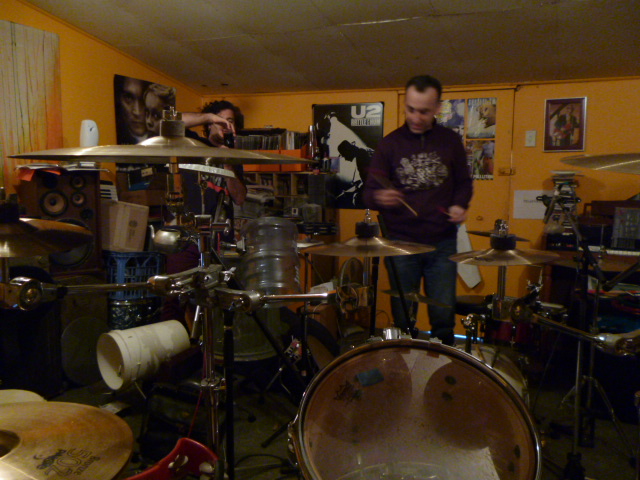
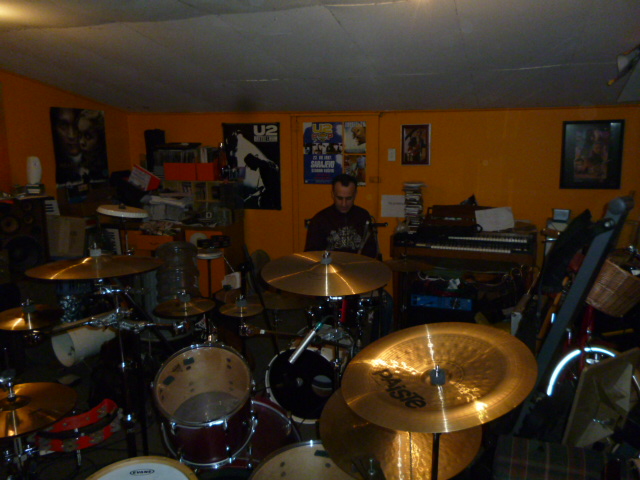
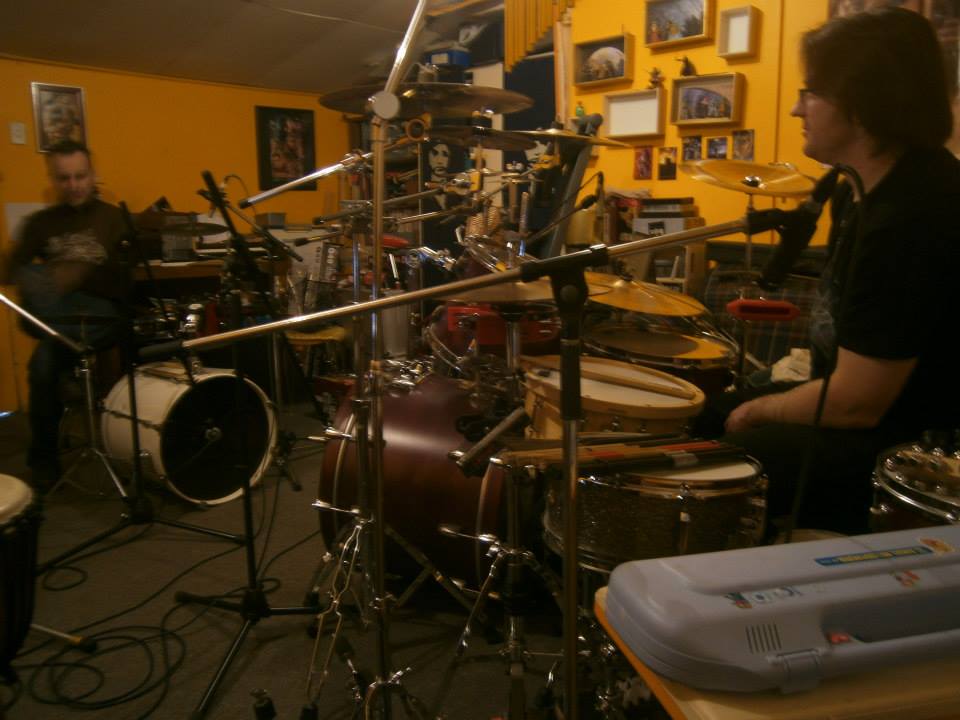
The three of us convened in a small home studio out the back of Adrian’s house. We lugged gear in and set up while Adrian placed mics.

There was no preconceived ideas as to what we were going to play and record, except for some youtube clips we had looked at earlier. There were no lines to demarcate the boundaries of our creativity.

Yet how easy it is to rely on the boundaries of what we know. As drummers Costa and I fell into an improvised jam in 6/8, using a form that was familiar to us, creating a beat and rhythm. As we played we listened to each other, playing around each other’s grooves and timbres, sometimes playing with the groove, sometimes playing against it.

We were colouring within the lines.

P1010968

I learned to colour outside the lines because of Adrian’s artistic vision and creativity.

Adrian suggested for the second jam an experimental form playing in different time signatures: Costa played in 4/4, I played in 5/4 and Adrian played in 7/4. It sounded gloriously messy as we experimented within the constraints of the time signature allocated while listening to what the others were playing.

The Junk Collective 3

The last jam was truly a learning experience of colouring outside the lines. Adrian suggested we play not rhythms or beats, but focus on the sounds produced from each part of our instrument.

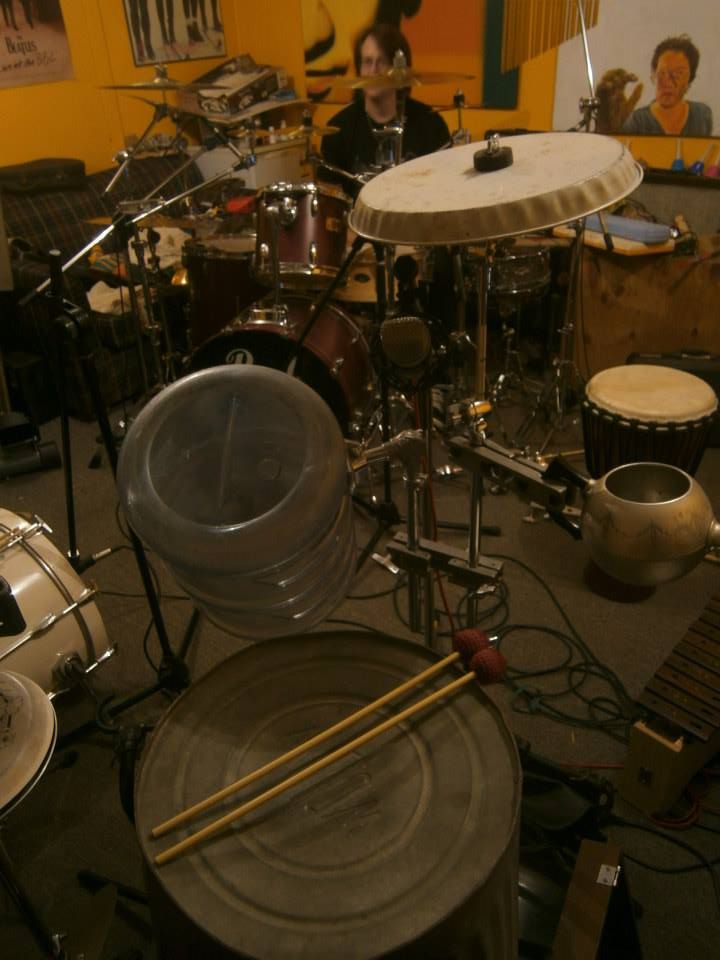
We used sticks, mallets, brushes, rods, plastic rods on all parts of the drums and cymbals including the rims and stands. I threw a handful of sticks into the air and let them fall where they may. I bounced sticks, mallets and rods off my snare to see where they landed. Adrian used a violin bow on cymbals and played mallets on my kit, Costa’s kit and their “junk” drum kit which consisted of a metal garbage bin, water bottles, saucepan lids made into hi-hats and a metal tea pot.

The Junk Collective 2

It was this last improvisational jam that really expanded my understanding of rhythm, drums and music in terms of creativity. It allowed me to colour outside the lines as I was not focused on the traditional parameters of my instrument, rather learning to see outside the lines and create accordingly.

Artists talk about the ‘negative space’ on the page; what is not there is as important as what is there.

My next step is to apply this principle to my writing.

Whatever creative medium you are engaged in, whether it’s writing, music, art, have you learned to colour outside the lines again?

Piper’s Reach: The Writer and the Reader

Piper’s Reach – The Writer and the Reader

A writing adage you see on various blogs is to write for your ideal reader, the audience you want to read your work. You create in your mind an image of a specific person, male and/or female, the type of person you imagine will enjoy reading your novel. The specific reader in mind, may in fact, be you.

When Jodi Cleghorn (@JodiCleghorn) and I sat down to write the epistolary serial Post Marked: Piper’s Reach (now being edited as an epistolary novel), it presented an interesting dichotomy. The instigation of the No Spoiler Policy (we did not discuss the plot or character development, but rather let the narrative form as an organic process) meant we were thrust into the role as simultaneous writer and reader.

It was unique as Jodi wrote as the character of Ella-Louise and I wrote as the character of Jude; two high school friends reunited by letter after 20 years of silence.

Click here to read about Piper’s Reach – The Project

img_1100

As each letter was written, posted and received, we had no idea of its content in regards to plot or character. It was the perfect balance between writer and reader. 

We wrote as authors, read it as readers. 

With each letter we would read and reread from different perspectives:

As writers:

  • Looking for the momentum and motivation in the character’s actions and how it moved the plot forward
  • Contemplating different permutations of plot for both characters
  • Establishing back-story and history for each character, events significant to both characters and how it affected the present day.

As readers:

  • We became caught up in the lives of the characters; how their past and present intertwined, split, became a messy entanglement and how they tried to sort it out.
  • We read the voice of each character, how Ella-Louise and Jude articulated their thoughts, what they wrote about and how they expressed it; what they revealed and what they kept hidden.

Jodi asked if I read the letters as the character of Jude or as myself because I was both catalyst and consumer, the writer and the reader. It was hard to separate myself from the narrative of Ella-Louise and Jude, to be solely the reader as each new letter was a revelation of character, plot, motivation and secrets.

There were times when I deliberately distanced myself from the character of Jude to read a letter, to be the reader and not the writer. I let myself be absorbed into the world of Ella-Louise as she revealed it, taking it at face value, rereading it again to further my understanding of who she was and what she wanted.

In the same way there were letters I read intentionally read as the character of Jude to feel the impact of the letter as Ella-Louise wrote to her dearest and most-loved friend.

Engaging with the letter as either writer or reader produced strong emotions, even to the point of tears.

Now we are in the editing phase, we get to experience the narrative of our characters all over again, this time solely as readers. After we have made our notes and compared them we will return to our role as writers and continue fashioning the narrative and our characters.

It lead me back to a question I have asked myself over the last couple of years in regards to writing and reading: Is a reader more interested in the story or the writing?

Is it an either/or, both/and dichotomy? Is the reader more interested in being moved by the story than the power of the words? Or is it the power of the words the more important aspect for the reader?

The power of storytelling versus power of writing with which there is no clear answer. The answer will not be a “Yes” or “No” response but a sliding continuum of responses. For some readers story will trump the writing and for other readers the power of the words will enhance the story and be the focus.

As a writer I aim to balance the power of the story with power of the word. I use words to convey the power and strength of the story, and I want you to be engaged as a reader with the story, drawn in by the power of the words.

Keep an eye for updates on the progress of Post Marked: Piper’s Reach and I hope you enjoy the story.

Creativity Week Wrap Up

Each day this week I posted a new idea on aspects of creativity.

I have gathered all the links for you in one easy place for you to catch up. I would love to hear what you have to say on creativity.

Monday – Create Useless Beauty

“Create a piece of art because it has no other function than to beautify your presence, illuminate your thoughts, elevate your attitude, satisfy your creativity, to please only yourself.”

Tuesday – Creative Dichotomy

“Make art from the beautiful and the ugly;

From the joyful events of life and from the circumstances marked by sorrow.”

Wednesday – The Bridge Between Imagination and Reality

“Creativity is the bridge between imagination and reality. We live in a divided state of how we see the world as it is and the vision of how we see the world as we want it to be.”

Thursday – Birth and Death in Creativity

“Creativity is a birthing act. Its genesis lies in the conception of an idea and by a word it is spoken into being.

And in the end we see that it is good.”

Friday – Creativity is the Mother Tongue

“We speak our mother tongue verbally and artistically. For some, we need to find our voice again. For others, it is strengthening their voice. Creativity is our mother tongue. Let people hear your voice.”

Have  a creative weekend.