Category Archives: Creativity

Friday Flash Fiction – Indentation

Welcome to another Friday Flash Fiction.

This piece was the development of a very short piece (sub-200 words) I had submitted for a competition. I wanted to explore the idea a little further and see what happened. 

I toyed with the idea of subbing it out again but am leaving it on the digital practice pile. 

Indentation

I dislodged your glasses the first time we kissed, tripping over the hidden arms of the frames as I ran my hands through your hair. Unseated physically and linguistically, I fumbled an apology.

“Romance inhibitors,” you said pushing the glasses over your forehead, collecting your fringe, before taking them off.

The kiss interrupted we drew away from each other. You felt behind your ears the indent of a new paragraph.

“I’ve worn glasses for years,” you said. “Never really noticed it before.”

You drew me in again and before our lips cautiously brushed, I wondered how you could see without your glasses; a stupid thing to think because our eyes were closed. My fingers returned to the place behind your ear and traced the indentation, a small eroded furrow, and I stopped, retreating my lips from yours.

Your face, now naked without adornment, I saw two more dents, small and red, on either side of your nose. The slight weight of pressure bridging your face giving you the chance to see.

Over the years I watched the indentations change shape with each new pair of glasses, watch you adjust to how the new frames sat on your nose and behind the ears. You pinch your nose when you buy new frames, adjusting to a new bridge; push them back up your nose when you’re sweaty and they slip down when you lean forward. You push them onto your head when you read a book.

You never really get to see it, except when you look in the mirror, but with each new pair of glasses I create a new character: the bookish librarian, a 50s executive, the hipster folk musician. Only when we retire to bed do I see the character removed when you put your glasses beside the clock radio on your bedside table. Your face is no longer framed by what I impose upon it; the only evidence the two small, red indentations on your nose.

 On the couch I slip under your arm, fit into the shape of your body, perhaps worn as smooth as the spot behind your ears and wonder if we have worn a furrow between my legs each time we make love. I feel the shape of you within me, the pacing of your movement when you’re above me and I focus on the bridge of your nose. Or when I sit astride you and move with my own rhythm. Have I worn you down through the repetition of our lovemaking?

Now I turn the wedding band around my finger, notice the furrowed shape encircling, evidence of the presence of you in my life.

I still run my finger along the indentation behind your ear, searching for that first kiss. But you hate it when I dislodge your glasses, especially while you’re watching TV.

I’ve learned to wait until the ad breaks.
 

When Ideas Turn to Manure

Over the last few weeks I’ve been plugging away at some older pieces of work, deciding whether to forge on with them or cut them loose.

I had just closed the document of a poem I had been working on after having decided it was not worth pursuing at this time and launched into a quick twitter self-evaluation session.

The conversation I had with myself is below.

Cleared the desk of old projects hanging around. Abandoned some. Others into storage. Time to focus on the new things. And Get Stuff Done.

Come to conclusion some ideas are worth exploring but awareness they are practice, amassing the hours needed to master the craft.

Nothing wrong with that. Some ideas sprout early, look good but produce only weeds. Cut them down, turn them into compost for new ones.

It does seem to contradict “finish what you started” but sometimes the piece will not work no matter how much manure you pour on it.

Commitment to an idea is noble but not at the expense of developing as a writer, artist, creative person. Shelve it. File it. Let it go.

Sometimes ideas just suck. Sometimes they turn into manure. Put it on the compost pile and let it feed new ideas and projects.

Do you ever let something go or do you see it out to the end?


1 Step To Kick Start Your Creativity

Ever wondered how to kick start your creativity?

Besides a swift kick up the bum (which is easy to do by the way. Tie a piece of rope around your right ankle. Bring the rope up and over your shoulder from behind. Pull the rope swiftly and kick yourself in the bum).

There is an easy way to kick start your creativity. 

You start by DOING.

No thinking. No procrastinating. No making a cup of tea first. No checking twitter or Facebook. No worrying. No hesitation. No. No. And no.

To get you started in the DOING phase of kick starting your creativity, there are a list of suggestions. Pick the appropriate category and off you go and DO IT.

For Aspiring Writers

* write 5 very short stories or pieces of description. Each story must be 6 sentences in length and include one sentence of dialogue.

For Curious Poets

* write 5 poems. It doesn’t matter about how bad you think they are, write them. Give yourself 5 minutes to write each poem. Do them all at once or one at time.

For Ingenious Artists

* draw 5 pictures. Draw each picture on a Post It Note.

For Ambitious Photographers

* select one random object from around the house or office and take 5 photographs in different locations.

Which one are you doing? 

If you’ve given it a go why not show the world what you’ve done and link it back here?

Art Is An Introduction

Meeting a piece of art (I am defining ‘art’ to mean literature, music, painting, sculpture, photography, dance; in fact any creative endeavour) for the first time it is an introduction to the artist and his/her work, the rationale and purpose behind the work and what it means to the artist.

Here’s a thought to bounce around with you: art is an introduction, then a conversation, a relationship, an understanding, a sharing.

A tangent to start with: I suspect much of the reaction to an artist’s work stems not from an offence created by the composer (unless that is the specified intention) but more from the responder’s own set of values, attitudes and beliefs. 

In the media an artist is forced to apologise for an artistic statement they have made regardless of their intention. In the past week, recording artist Sia has issued an apology about the content of her most recent video clip featuring Shia Labeouf and a young girl engaged in interpretive dance. The complaints focused on the age of the girl, allegedly 12, and the state of undress of Shia. 

This article is a good summation of how people react without understanding. Even the writer of article shows his lack of understanding. Sia Sorry Over Pedophilia Upset

It didn’t take in to consideration the content of the song, the purpose of the lyrics or the meaning of the video clip itself. 

A glib summation: TRIGGER WARNING – it’s your fault I’m offended. 

An artist’s work should be questioned, interrogated, debated. But we have to also confront WHY we are offended and feel uncomfortable. 

I remember the controversy surrounding the artistic work, Immersion (Piss Christ) when I was in my late teens/early twenties. The art was a small plastic crucifix immersed in a yellow liquid.

It was exhibited in Australia and two attempts were made to vandalise the artwork. There were threats made against the artist and the gallery. 

It is a significant religious icon and thus, hold supreme importance to Christians and Catholics. I can’t find the reference now but a friend had done some research  into the artist’s intention, and it was not to be sacrilegious. Crucifixion, as a Roman form of punishment, was barbaric and intended as an act of humiliation. The artist had made a parallel in the modern age to another act of humiliation: to urinate on someone is to denigrate and proclaim that person worthless. 

It also means having an understanding of the significance of the icon, why it is important and how it is used. The New Testament writer of the Book of First Corinthians understood the complexity, and controversy, of crucifixion: “For the message of the cross is foolishness to those who are perishing, but to us who are being saved it is the power of God.” Therefore, as an act of salvation it is contradictory.

Therefore art is an introduction.

Then it is a conversation between the artist and the responder, coming to a common ground. The first thing you do at a party when you are meeting new people is to ask for their name, what they do, find out what they are interested in or passionate about. Once you have established commonalities, a conversation begins.

From there it develops into a relationship. Aside: you can tell if a conversation is going nowhere as you run out of topics, lacking a connection. And it’s ok to not like a piece of art, to have no connection with it. But know why you don’t connect with it.

If there is a connection, you seek to develop it, leading to an understanding of the artist, his/her worldview, purpose, intention, vision. You see out other works, attend other performances, read more novels, and even if it confronts you, there is still a point of understanding.

And all of this leads to sharing. When you have taken the time to cultivate a relationship, to understand the artist’s vision and purpose, you can eloquently share your love of the artist’s work.

Art can, and indeed should, offend. The right to free speech entitles that. My caveat on that is offensive, racist, sexist bollocks should not be tolerated. Call it out for the garbage that it is.

It is the conversation we engage in with the art that makes it beneficial, even if we do not like it. Saying “I’m offended” reveals more about your own insecurities, values and attitudes than it does about an attempt to understand the art. You have every right to be offended but have a sustained and logical reason to defend your proposition.

Art is an introduction, then a conversation, a relationship, an understanding, a sharing.

Have you been introduced to any great art lately?

Teaching Others To Be Powerful

Being creative is a powerful tool for an individual because it releases a person’s sense of actualisation. But I believe there is more power in teaching others to be creative. 

To teach someone is to give the person the knowledge, skills and understanding that they, too, can be a powerful creative person.

I learned this lesson from Benjamin Zander, a classical pianist, and more importantly, the conductor of the Boston Philharmonic Orchestra.

You can see his TED Talk here: Benjamin Zander – TED Talk

Here’s the takeaways from a delightfully rousing discussion.

  • Everyone loves classical music; they just don’t know it yet. You need to teach them the power of the music.
  • As the conductor he makes no sound at all, but he can allow the players to know the power within, to be powerful, to play powerfully.
  • He depends for his power on his ability to make other people powerful and to awaken possibility in other people.

When you have mastered your own creative endeavour, even if you haven’t, teach someone else how to do what you do. 

Help the person unlock their own creativity, to realise their own potential as a creative person. 

Creativity is a secret you want someone else to know.

Friday Flash Fiction – Up and Down

Today I am posting a piece of flash fiction I have been working on for a while. The second half of 2014 was turbulent mentally and emotionally from a creative viewpoint where my day job demanded a lot of my attention.

I put off some short pieces until later in the year and was trying to decide whether I put more work into them to get them ready to sub, or put them out to pasture and let them go the way of cassettes and VHS tapes.

When the school year ended I managed to come back to these short pieces to have a closer look at them. I worked them over and decided that it was not worth subbing them out as I didn’t think they would sell. Maybe they would have sold but I felt it was time to put the old things aside and focus on the new. I’m also clearing my virtual desk to make way for some other projects that I want to attend to. 

Any piece of work is a practice, a development of voice, tone, structure, ideas. Some of them will work, others won’t and it shows you what you need to improve. It’s also a case of ‘showing my work,’ seeing some of the progress, some of my ideas, what’s working, what isn’t.

But you get the benefit of a FREE READ. Please enjoy it.

Up and Down

The blank television screen flickered on as he pressed ‘Play’ on the video camera. A young boy wearing a Superman cape was engaged mid sequence moving like a pendulum, arcing back and forth, on a set of swings. The cape fluttered behind him on the upward trajectory and stuck fast to his bottom on the downward pass.

A disembodied voice, too loud against the background noise, jumped from the speakers. “Hey buddy, how you doing?”

The boy waved. “Hi Dad.”

The camera flicked sideways and a woman with her arms crossed filled the frame, focused on the boy on the swings and her gaze did not alter. With another flick the scene changed again to see-saw, a simple old-fashioned broad wooden beam with a metallic T-shaped handle. Once painted green, only flecks remained between the splinters.

“Want to swing a leg over?” his voice asked.

“We haven’t done that in years,” she said, her arms folded stedfastly.

Jerky movements and the shuffling of feet accompanied the quick passing of ground. The handle came into view, then a hand grasped it, pulled it closer to the camera. A bump, clatter and suddenly the movement ceased.

He raised his end to equilibrium, the seat in line with the horizon behind it then dipped it lower.

“Chivalrous,” she said and walked to the other end. “What have you done to the camera?”

“Attached it to the handle,” his too loud voice said.

She straddled her end, filling the frame, and took the weight. The camera jerked slightly as the sounds of him lifting himself onto his end filtered through. She moved higher as the horizon dipped beneath her.

“Think we’re a bit old for this?” she asked.

With a gentle push upwards, she descended, the horizon moving up and down like a pilot’s instrument as she stayed in the centre of the frame, an odd optical illusion. She bent her knees and absorbed the weight, feeling the pressure, making it difficult to gain purchase.

Slowly, momentum begat momentum.

Up

     and

            down.

            up.

     and

Down.

Movement opened conversation.

“Remember the roundabout in the old park by the railway station?”

“It always made me dizzy.”

“You felt sick on the carousel at Luna Park on our honeymoon.”

Up

     and

            down.

“But you did win me the big teddy bear.”

            up.

     and

Down.

“How are the kids going with their homework?”

“I am now adept at my times tables.”

“Katie’s teacher is worried about her progress.”

Up

     and

            down.

“Remember the holidays to Coffs Harbour when the kids were in primary school.”

“Car sickness all the way.”

“Katie was stung by bluebottles.”

“And bananas with every meal.”

“Stuart was convinced he’d become a monkey if he ate any more.”

            up.

     and

Down.

“I heard Susan’s mother died. How is she coping after the funeral?”

“She’s finding it very tough but she’s managing.”

Up

     and

            down.

“Want to try for equilibrium?”

The camera wobbled and rocked as they shifted and slid, her body leaning forwards and backwards, as her arms outstretched like she was balancing. The horizon settled in a moment of balance.

The afternoon breeze picked up, punching into the camera’s microphone, and almost imperceptibly the horizon behind her lowered as the balance shifted until he knew for certain he was descending while she ascended.

Up

     and

            down.

            up.

     and

Down.

            Two young faces crowded the centre of the seesaw, careening into the view of the camera.

“Mum and Dad, what are you doing?”

“Going up and down, sweetie.”

“That’s not a real answer.”

“Help your Mum off, please.”

His son offered a small hand to his wife. She twisted sideways and with a little girlish yelp, jumped off.

The imbalance of weight jolted the camera and when it steadied she was no longer in frame, the end of the seesaw vacant. The camera wobbled again as it was unclipped and the view pulled backwards until the whole seesaw was in the frame, slowly coming to a halt with his end paused above the ground.

Her voice broke in over the image. “You still ok to have the kids same time in a fortnight?”

“Yes.”

“Say goodbye to Dad.”

There was a sudden collision of bodies and arms, muffled farewells and the wet smack of kisses as the camera pointed to the dirty patchwork of grass and dirt. In the bottom half of the frame arms entanged each other and feet shuffled.

The embrace finished, the camera swung up and captured the boy and girl walking hand in hand with their mother, disappearing towards the car as a focal point.

The camera turned, focused on the seesaw paused in its trajectory.

Two young children raced over for their turn, chose an end, scrambled on and bounced

Up

     and

            down.

            up.

     and

Down.

Leaning forward he pressed the ‘Stop’ button and stared at the blank television screen.


A Found Poem

Rifling through this list, 51 Of The Most Beautiful Sentences in Literature (via Buzzfeed) a poem formed in my mind by compiling, editing, amending some of the sentences.

I have come across this form by other writers. It’s an interesting new form in that it is almost a type of plagiarism (except I am acknowledging my sources), to create a new piece of work with words that are not mine. In some ways it is another form of blackout or erasure poetry.

Follow the link above to see which sentences I have borrowed and what I have changed. There are some instances of changing letters for the sake of grammatical accuracy, and I have divided up some of the sentences to link them with specific ideas or imagery.

Untitled
I took a deep breath
and listened to the old brag of my heart;
I am, I am, I am.
Sometimes I can feel my bones straining
under the weight of all the lives I’m not living.
Do I dare
disturb the universe?
What are men to rocks and mountains?
Folks say God crumbles up the old moon into stars.
The pieces I am,
I could see
standing there
leaning on the balcony railing.
How wild it was,
to let it give
them back to me
in all the right order.
an enormous, unmerited gift
given randomly,
stupidly
holding the universe together.
Everything was beautiful
and nothing hurt.
Let me be something
every minute
of every hour
of my life.
Let the wild rumpus start.

Blackout Poetry – Another Questionable Attempt

image


Between us
the bond of
periods of separation
and
a box of dominoes
toying 
with 
the anchor
we did not begin that game of
placid staring
The day 
was a benign unstained
mist
Only the 
brooding
somber minute
angered by the
curved and imperceptible
heat
a change
more profound
unruffled dignity
that comes and departs in the
abiding memories. Indeed nothing’s
easier
than to evoke
its unceasing

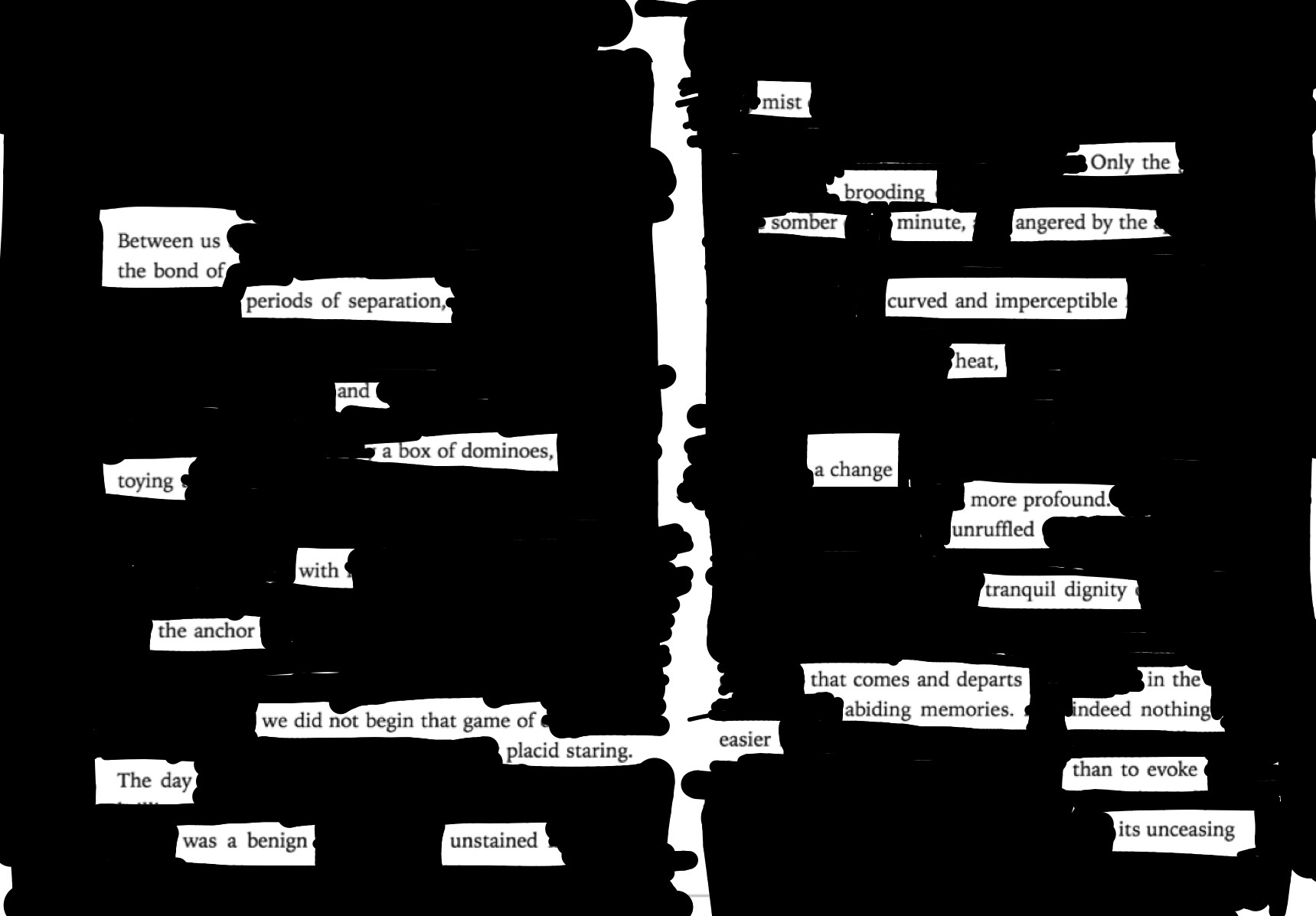
After yesterday’s modicum of success with blackout poetry, I tried my hand at another (need to do something creative at the moment while I get my head back into shape to tackle some significant writing projects in January).

This page comes from Joseph Conrad’s “Heart of Darkness.” I studied this text in high school last century and thoroughly enjoyed it. Admitting at the time I didn’t quite understand the colonialism and inherent racism, it still holds as a powerful metaphor. Tie it with Francis Ford Coppola’s “Apocalypse Now” and you have a teenager’s existential orgasm. 

So, with that in mind, I wanted explored the idea of relationships through the text.

It’s a diversion from writing Post It Note Poetry (and a couple of other major works in progress) but I posit that flogging someone else’s idea to pursue something creative is better than nothing. Blackout, or erasure, poetry makes you look at words, their order and the meaning created. It opens your mind to see other possibilities, limited as it is by the choice of text, to create something new.

I encourage you to try it yourself. Or buy a colouring book and pencils. Do something to stimulate your brain. 

Blackout Poetry – An Attempt of Questionable Merit

image


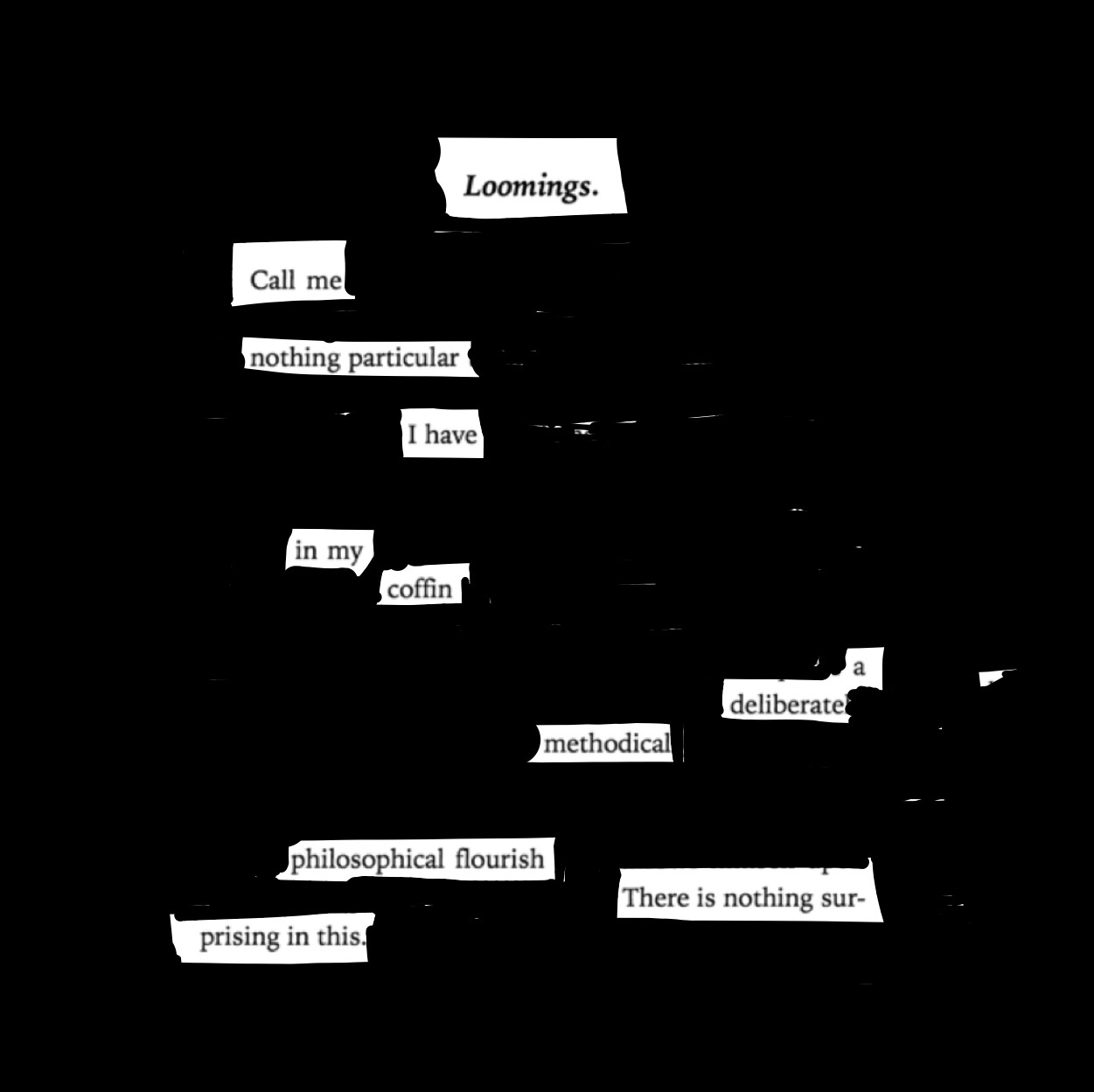
I have loved Austin Kleon’s work (@austinkleon) and I own his book, Steal Like An Artist (It’s fabulous. Get a copy). I follow his tumblr and love reading his work.

So I decided to give it a go. Armed with my iPad, a digital copy of Moby Dick and Notability, I ripped into the first page of Herman Melville’s tome. 

What does it mean? I. Have. Absolutely. No. Idea. I like how it sounds. And I’ll be adding this to the collection of poems I have on tumblr (even if it’s not a Post It Note).


if:book – Open Changes

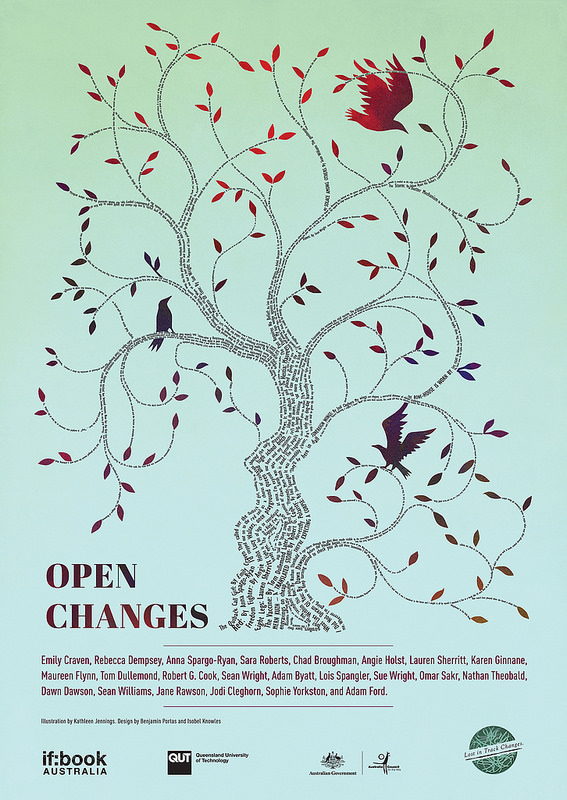
A little while ago I mentioned I had submitted a couple of pieces to the if:book Open Changes project.

I am proud to say I have been included in this project and the artwork for the poster has been released. Included in this wonderful piece of art are a whole bunch of fabulous writers I know.

if:book Open Changes Poster

if:book Open Changes Poster

It is based on the spectacular work of Kathleen Jennings whose art work I seriously adore. Check out her blog and sees the inspiration behind the poster you see above. 

I highly recommend following Kathleen on twitter (@tanaudel) as you will get to see some of her amazing sketches.

I can’t wait for my copy to arrive. I’ll be posting photos.