
On Friday my Year 8 class were set the task of writing haiku.
The English approximation of a beautiful Japanese art form is known to most, if not all, primary school children. They learn it is a poem of 17 syllables broken into 3 lines (5, 7, 5) and it is about nature (or something…).
It is taught because it is easy and accessible for students. It gives definite boundaries and restrictions, confinements for words and their interplay of meaning.
But writing great haiku is difficult.
I told my students I wanted them to experiment and play with language. I encouraged them to enjoy the process, to have fun with language. And so I had a go at writing a couple myself.
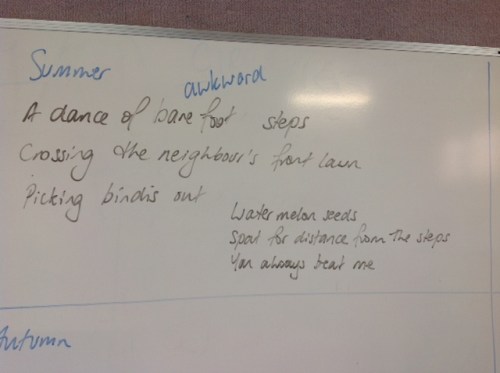
Summer Haiku
A dance of barefoot (awkward) steps
Crossing the neighbour’s front lawn
Picking bindis out
Watermelon seeds
Spat for distance from the steps
You always beat me
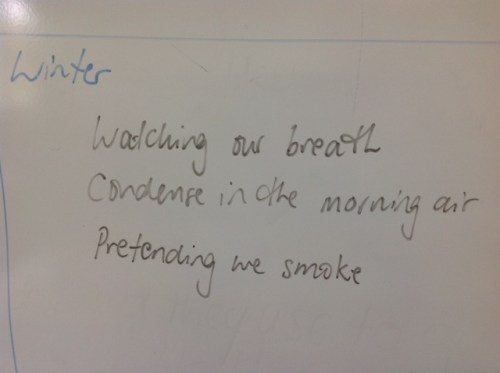
Winter Haiku
Watching our breath
Condense in the morning air
Pretending we smoke
Are they any good? Probably not.
Why is random creativity important?
It can be done quickly and in spare moments, disposable as an empty soft drink container or laboured over and agonised and deliberated for each and every syllable.
This is why creativity is important.

 A Fullness in Brevity - Adam Byatt